Home › Some Early Mammals and the Story of the Horse › Some Early Mammals and the Story of the Horse: Marsh's
Some Early Mammals and the Story of the Horse: Marsh's
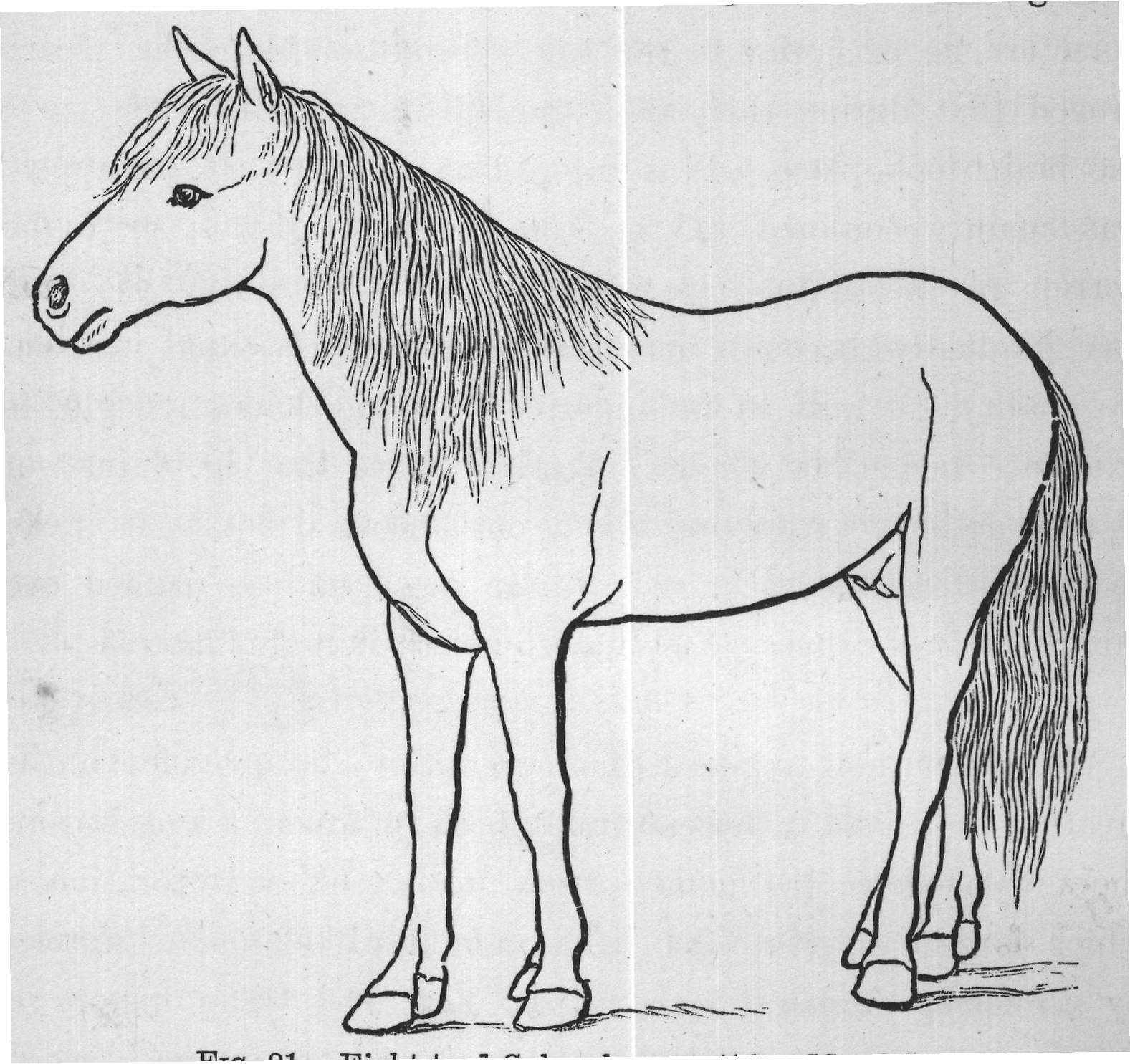
Occasionally the hind feet have two extra toes, while the fore feet have only one, as in the horse from Texas, figured by Marsh; ¹ but in rare cases both the fore and hind feet may each 1 American Journal of Science, vol. xliii. p. 344.
SOME EARLY MAMMALS have two extra toes fairly well developed, and all nearly of the same size. In such cases the result is something very like the feet of the ancient American type Protohippus, and the European Hipparion.
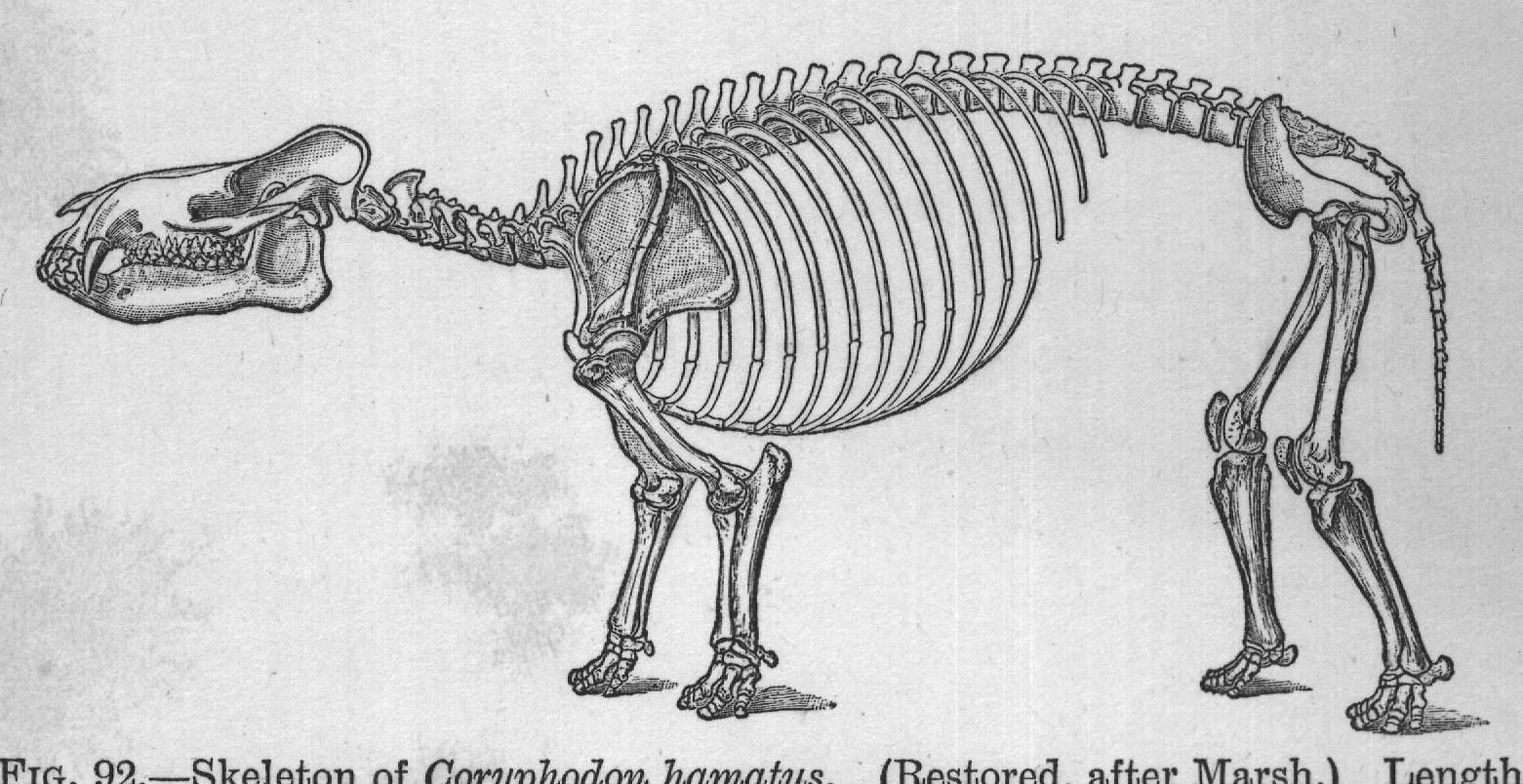
We have pointed out previously that the mammals of early Tertiary days had small brains, and the oldest ancestors of the horse are no exception to the rule. Professor Marsh has clearly proved that during this era a gradual increase in the size of the brain took place. It is interesting to find that the growth was mainly confined to the cerebral hemispheres, or higher portion of the brain. In most groups of mammals the brain has gradually become more convoluted, and thus increased in quality, as well as in quantity. In the long struggle for existence during the whole of Tertiary times the big brains won, as they do now. Applying this to our ancestral horses, it is easy to see that, as they acquired greater speed, and so roamed over larger tracts of country, they had to use their brains more. We pass on now to give a brief account of a strange elephantine creature that lived in Eocene times, both in America and Europe, the Coryphodon¹ (so named from its teeth), a restoration of which is seen in Plate XL. The complete skeleton, as restored by Professor Marsh, is shown in Fig. 92.2 The history of this remarkable animal, so long shrouded in obscurity, is worth recording here. The specimen on which the genus was founded by Sir R. Owen, in 1846, is unique, and was dredged up from the bottom of the sea, between St. Osyth and Harwich, and consists of the right branch of the lower jaw. This distinguished naturalist confessed that he had seldom felt more 1 Greek-korufé, a ridge; odous, odontos, tooth. 2 From Professor Marsh's paper, Amer. Journ. Science, xlvi. (1893), p. 325, a copy of which he kindly sent to the author. misgiving in regard to a conclusion based on a single tooth or bone than that which he arrived at after a careful study of this specimen. Its smaller and less obvious features carried conviction to him against the showing of the larger and more catching ones. But although some naturalists for a time thought he had mistaken the fore for the back part of the jaw, yet his conclusion proved to be correct. His experience taught him that the less obvious points, which require searching out, frequently, when their full meaning has been grasped, guide to a right FIG. 92. Skeleton of Coryphodon hamatus. (Restored, after Marsh.) Length about 6 feet. interpretation of the whole. "It is as if truth were whispered," he says, "rather than outspoken by Nature."