Home › Some Early Mammals and the Story of the Horse › Some Early Mammals and the Story of the Horse: Evolution
Some Early Mammals and the Story of the Horse: Evolution
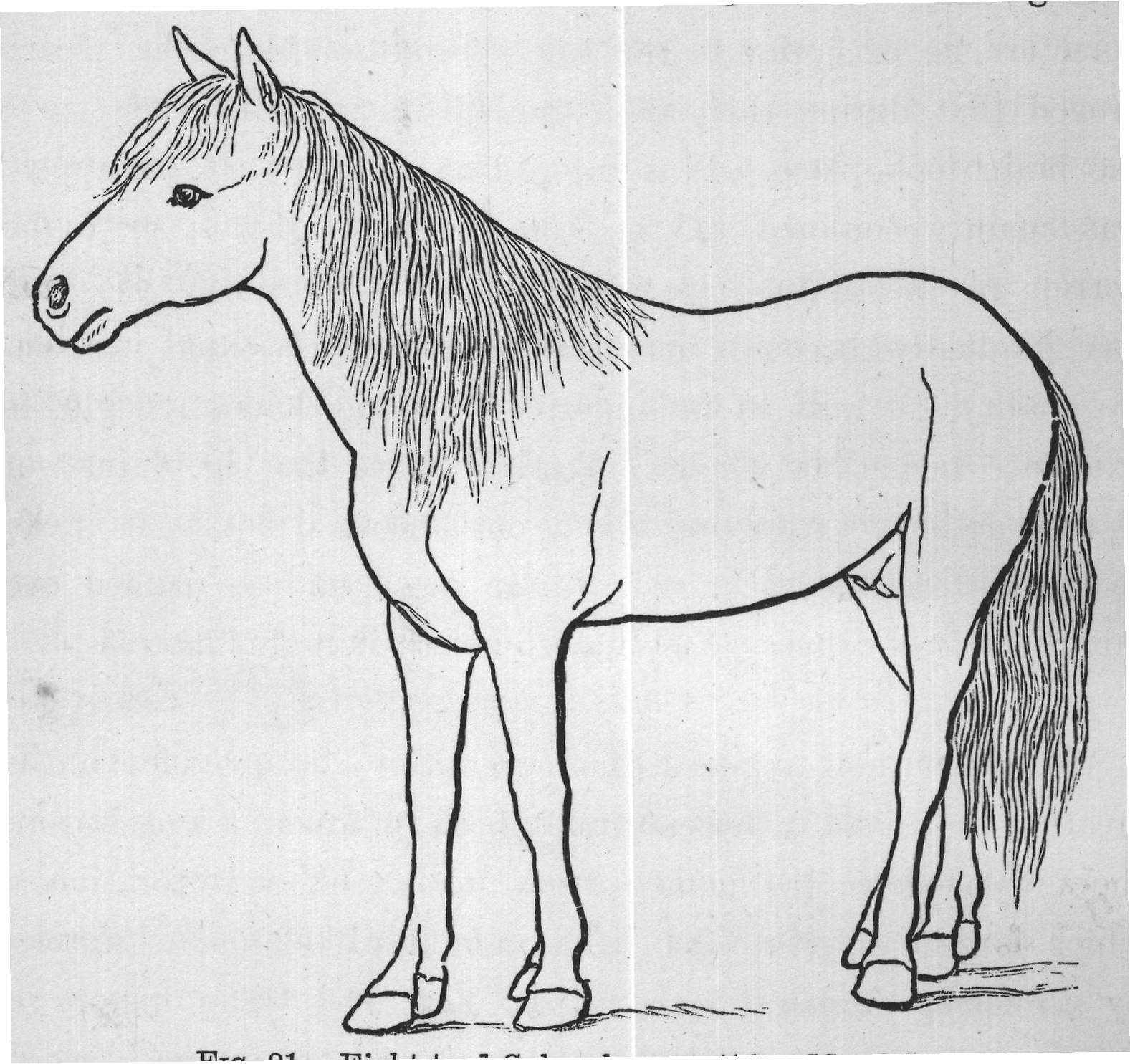
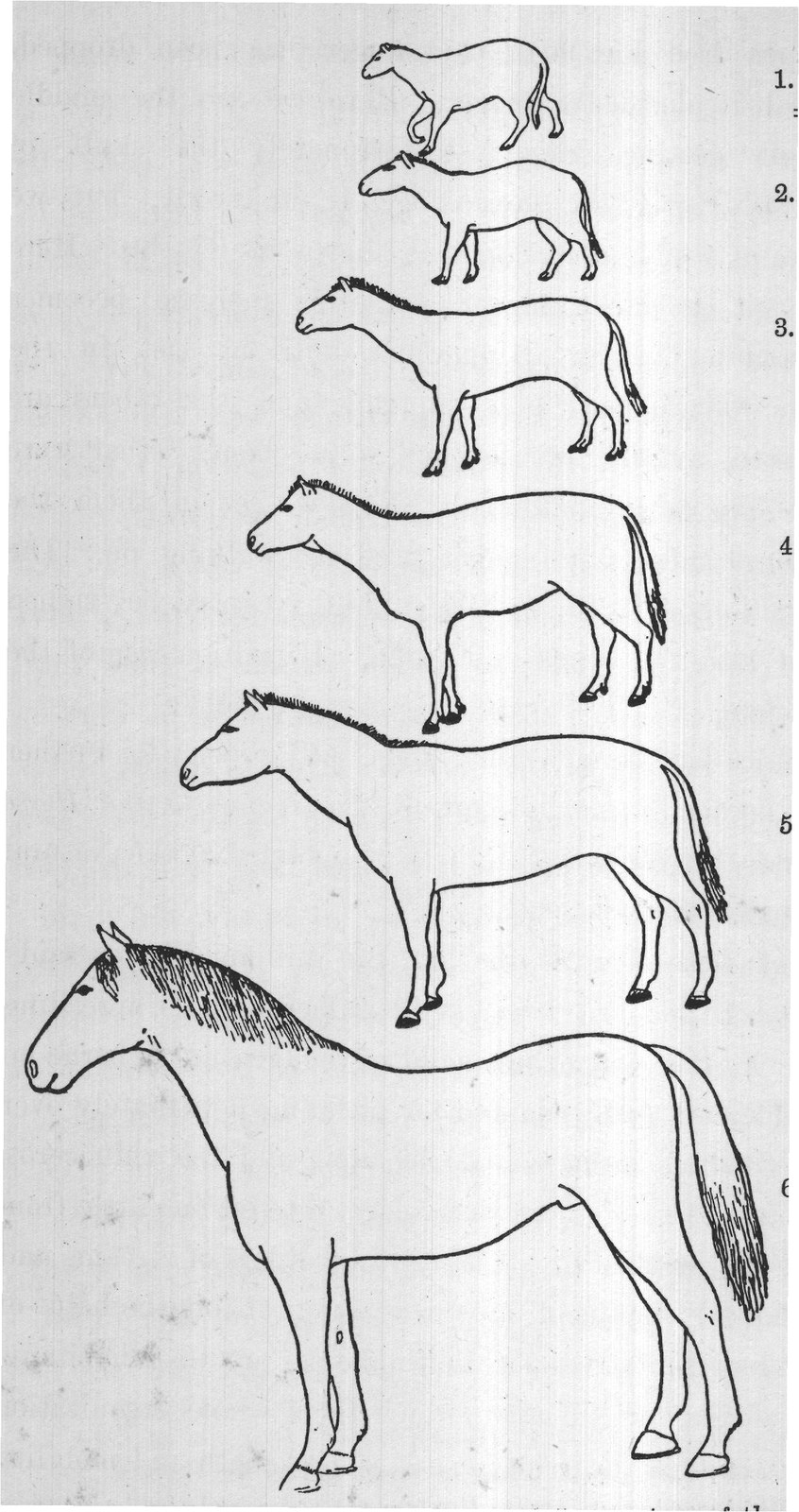
FIG. 90. The Evolution of the horse. 1-5, ancestors of the horse restored in outline from fossil remains from the Lower Eocene to recent times. (H. S. Lull, American Jour. Science, vol. xxiii.) the organ of smell, give them ample means of becoming aware of the approach of enemies; while the length of their limbs, the angles different segments form with each other, and especially the combination of firmness, stability, and lightness in the reduction of all the toes to a single one, upon which the whole weight of the body and all the muscular power are concentrated, give them speed and endurance surpassing that of almost any other animal." 1 At the same time that these changes were taking place (and in accordance with the "Law of Correlation") certain important changes in the structure and mode of growth of the teeth were being developed, the consequence of which was that they were able to masticate and grind up their food much more perfectly, and thus, no doubt, to obtain therefrom more vital energy with which to supply their muscles and nerves for working their limbs more rapidly as they became fitted to attain higher speed. They gained a grinding tooth for each toe that they lost. Of these ancient horses it may well be said they "ran the race that was set before them" or, perhaps we might say, which they set before themselves; and the victory was to the quickest runners-those who could "beat the record" made by their predecessors! It is a wonderful story, this, of the evolution of that noble and useful animal to which man is so much attached; and one cannot help sometimes wondering whether to some extent the will of an animal may not be an important factor in Evolution, although it is the fashion to ignore it, and to attribute organic changes to Natural Selection, or the "survival of the fittest." Mind has a powerful influence over matter, and can we not 1 Visitors to the Natural History Museum will do well to examine the admirable set of casts and actual bones of fossil horses in Gallery No. 1. Complete casts of Phenacodus and Hyracotherium are there exhibited. In the hall may be seen the skeleton of a man and of a horse side by side, in the same relative position, also casts of bones represented in Fig. 89. - SOME EARLY MAMMALS conceive that the earliest ancestors of the horse, finding (perhaps for the first time in the world's history) boundless grassy plains before them, were impelled by a strong desire to run ? It is a well-known fact that young horses are occasionally born with small extra toes on their feet. Suetonius¹ has given an account of the famous steed of Julius Cæsar. According to the historian, Cæsar "used to ride a remarkable horse, which had feet that were almost human, the hoofs being cleft like toes." This account clearly indicates the presence of extra digits, and the occurrence is more frequent than is generally supposed. Professor Marsh has made a study of this subject, since it has an important bearing upon the history of the evolution of the horse as given above; for in the light of modern teaching such occurrences are but "reversions" to older types that lived ages ago. He has therefore examined a large number of living animals with this peculiarity, and several interesting specimens of the same character have been sent to him: he has likewise received photographs, drawings, and detailed descriptions of various other examples, the authenticity of which cannot be questioned. The various cases he has come across may be summed up as follows:- Sometimes there is only one extra digit on one foot. This is always much smaller than the main or third digit, the largest he has seen being about one-half its size, and the smallest very diminutive. This extra toe is almost invariably on the inner side of the main digit, and usually on the fore foot. Sometimes it is entirely hidden beneath the skin, the only external evidence of its presence being a prominence, which, on close examination, may be found to contain, below the "splint-bone," two or more bones corresponding to the finger-joints of our own hands. Sometimes a corresponding extra toe is developed on the other fore foot. At 1 De Vitâ Cæsaris, lxvi. other times a second extra digit has been found, as well as those above mentioned, which may be either smaller or larger. Coming now to the hind feet, we find that an extra toe may sometimes be present on one or both of them, and always on the inside. As a rule, however, these posterior toes are much smaller, and often concealed beneath the skin. Fig. 91 is a drawing of a FIG. 91.-Eight-toed Cuban horse. (After Marsh.) horse from Cuba, in which the extra toe is well developed on all four limbs. This animal was examined by Professor Marsh during its lifetime.
Occasionally the hind feet have two extra toes, while the fore feet have only one, as in the horse from Texas, figured by Marsh; ¹ but in rare cases both the fore and hind feet may each 1 American Journal of Science, vol. xliii. p. 344.
SOME EARLY MAMMALS have two extra toes fairly well developed, and all nearly of the same size. In such cases the result is something very like the feet of the ancient American type Protohippus, and the European Hipparion.
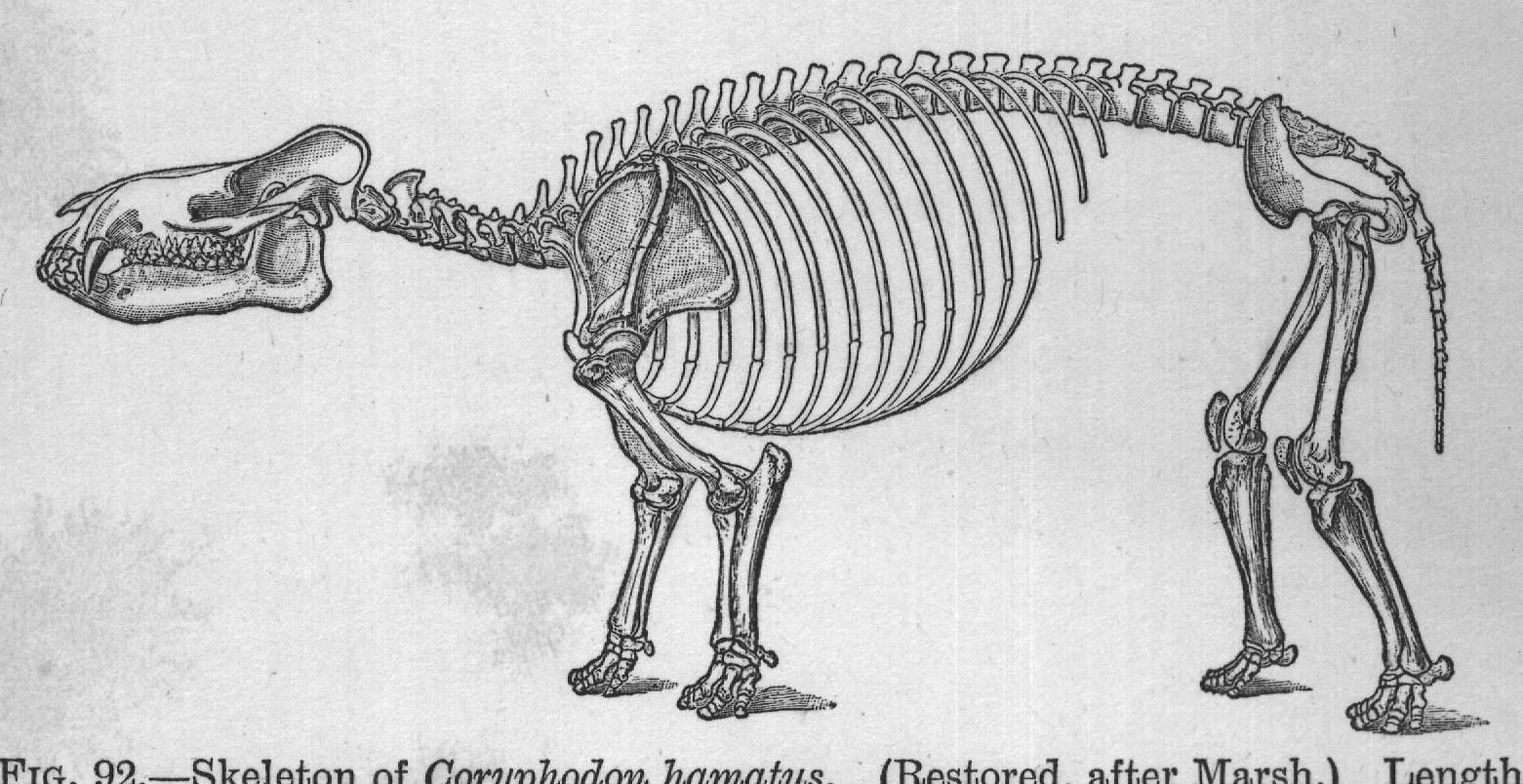
We have pointed out previously that the mammals of early Tertiary days had small brains, and the oldest ancestors of the horse are no exception to the rule. Professor Marsh has clearly proved that during this era a gradual increase in the size of the brain took place. It is interesting to find that the growth was mainly confined to the cerebral hemispheres, or higher portion of the brain. In most groups of mammals the brain has gradually become more convoluted, and thus increased in quality, as well as in quantity. In the long struggle for existence during the whole of Tertiary times the big brains won, as they do now. Applying this to our ancestral horses, it is easy to see that, as they acquired greater speed, and so roamed over larger tracts of country, they had to use their brains more. We pass on now to give a brief account of a strange elephantine creature that lived in Eocene times, both in America and Europe, the Coryphodon¹ (so named from its teeth), a restoration of which is seen in Plate XL. The complete skeleton, as restored by Professor Marsh, is shown in Fig. 92.2 The history of this remarkable animal, so long shrouded in obscurity, is worth recording here. The specimen on which the genus was founded by Sir R. Owen, in 1846, is unique, and was dredged up from the bottom of the sea, between St. Osyth and Harwich, and consists of the right branch of the lower jaw. This distinguished naturalist confessed that he had seldom felt more 1 Greek-korufé, a ridge; odous, odontos, tooth. 2 From Professor Marsh's paper, Amer. Journ. Science, xlvi. (1893), p. 325, a copy of which he kindly sent to the author. misgiving in regard to a conclusion based on a single tooth or bone than that which he arrived at after a careful study of this specimen. Its smaller and less obvious features carried conviction to him against the showing of the larger and more catching ones. But although some naturalists for a time thought he had mistaken the fore for the back part of the jaw, yet his conclusion proved to be correct. His experience taught him that the less obvious points, which require searching out, frequently, when their full meaning has been grasped, guide to a right FIG. 92. Skeleton of Coryphodon hamatus. (Restored, after Marsh.) Length about 6 feet. interpretation of the whole. "It is as if truth were whispered," he says, "rather than outspoken by Nature."