Home › Some Early Mammals and the Story of the Horse › Some Early Mammals and the Story of the Horse: Anoplotherium
Some Early Mammals and the Story of the Horse: Anoplotherium
Its contemporary, the Anoplotherium,¹ so called from its apparently defenceless state, is represented in the same Plate. This animal was of a lighter and more elegant form, and its limbs ended each in two digits, only terminating in hoofs. As in the Palæothere, the jaws contained forty-four teeth, but there was no interval in the series. There are suggestions in its frame- 1 Greek-alpha, privative; hopla, arms; therion, beast. உ I Smith TAPIR-LIKE ANIMALS. EOCENE PERIOD. EUROPE.
Xiphodon.
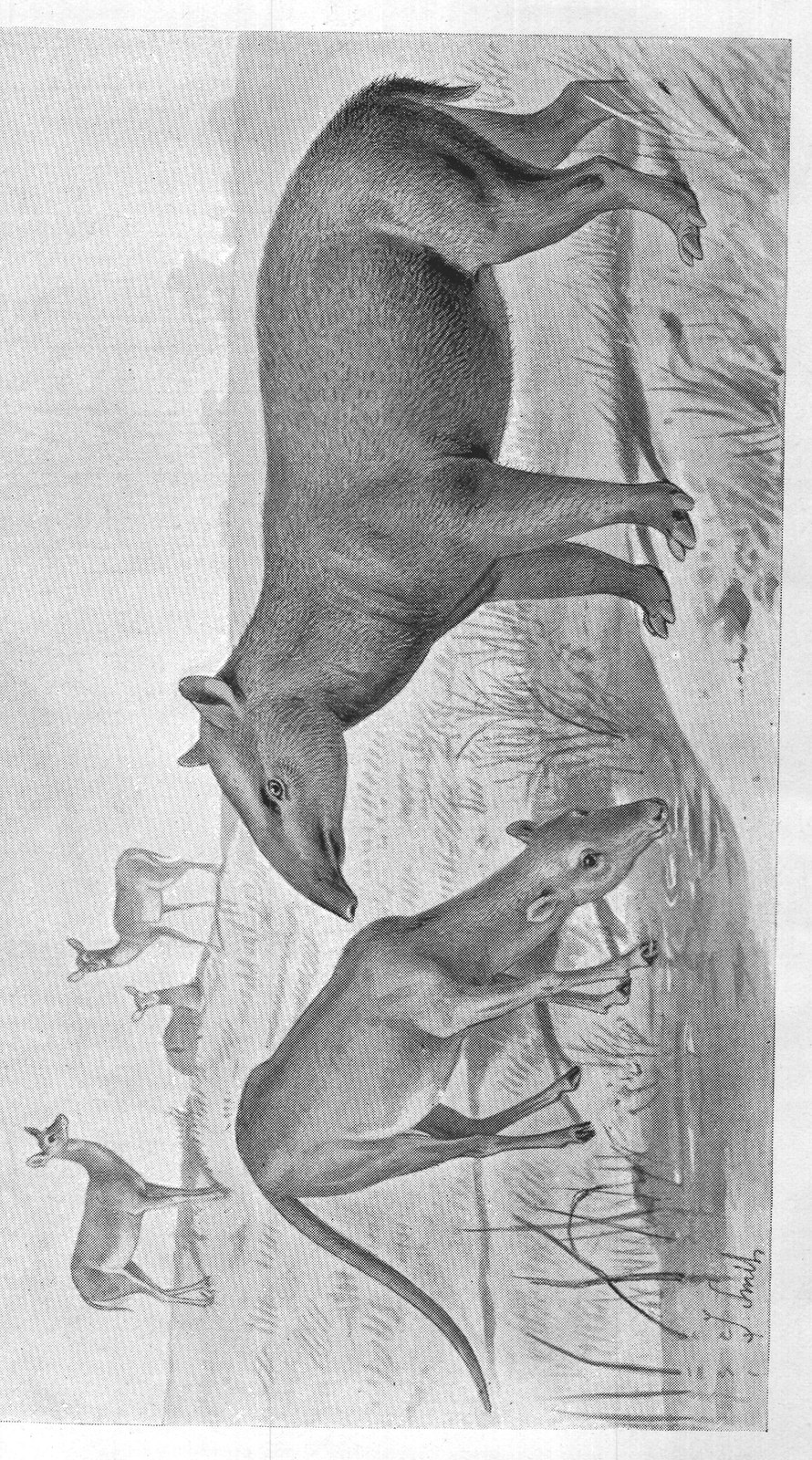
Palæotherium.
Anoplotherium.
PLATE XXΧΙΧ.
SOME EARLY MAMMALS work of the modern ruminant type; 1 thus it resembled the ox in having an equally divided hoof, or rather two hoofs. Fig. 87, in which the skeleton is seen, shows that it possessed a long tail. In size it was about equal to a fallow deer, and the long tail has been supposed, perhaps erroneously, to indicate aquatic habits. Small and more delicate species have been taken to represent distinct genera. "Judging from its habits of swimming and diving," said B 63 FIG. 87.-Skeleton with restored outline of Anoplotherium commune, from Eocene strata. (After Cuvier.) Cuvier, "the Anoplotherium would have the hair smooth like the otter; perhaps its skin was even half naked. It is not likely, either, that it had long ears, which would be inconvenient in its aquatic kind of life; and 1 am inclined to think that, in this respect, it resembled the hippopotamus and other 1 Cuvier divided all the hoofed animals (ungulates) into two orders, pachyderms and ruminants. The former is a heterogeneous order, and has since been abandoned; but the ruminants have been regarded as one of the most distinct of mammalian orders, for they are separated from all other animals by having horns and hoofs in pairs, the absence of upper front teeth, complex stomachs, and the habit of ruminating or "chewing the cud." Professor Owen showed that ungulates should be classified by the structure of their feet. He therefore divided them into odd-toed (perissodactylate) and even-toed (artiodactylate), and he placed elephants in a separate order-the Proboscidia. quadrupeds which frequent the water much." But was it really aquatic?
Xiphodon,¹ so named by Cuvier on account of the shape of its teeth, was a small and delicate animal, long, with slenderer limbs than the Anoplotherium; its feet were provided with two toes, and the tail was short (see restoration in Plate XXXIX.). X. gracilis was obtained from the lignites of Débruge, near Apt. It was some three feet high, and of about the size of a chamois, but lighter in form, and with a smaller head. Cuvier says of this creature, "Its course was not embarrassed by a long tail; but, like all active herbivorous animals, it was probably timid, and with large and very mobile ears, like those of the stag, announcing the slightest approach of danger. Neither is there any doubt that its body was covered with smooth hair, and consequently we only require to know its colour in order to paint it as it formerly existed in this country, where it has been dug up after so many ages." Instead of resorting to rivers and lakes, this graceful little creature probably kept to the dry land and fed upon aromatic herbs.
Discoveries, chiefly made since Cuvier's day, have shown that these ancient herbivorous mammals had carnivorous enemies, which doubtless kept down their numbers-not lions and tigers, but certain lower and less "specialised" creatures, from some of which the latter are descended.
The nearest living ally of our Palæothere, that once inhabited Europe in great numbers, must be sought for a long way from home; and it is highly instructive to observe that the further we wander away from the present down "the corridors of time," the further we must travel, geographically, to find creatures at all matching those that lived in early ages of the world's history. 1 Greek-xiphos, sword; odous, odontos, tooth.