Home › Sea-Serpents › Sea-Serpents: Leiodon
Sea-Serpents: Leiodon
In 1831 a portion of a lower jaw with large conical teeth was discovered in the Chalk near Norwich. But these teeth were not quite similar to those of the Maestricht specimen, and Sir Richard Owen therefore founded upon them the new genus Leiodon.¹ But Leiodon must have been very similar to Mosasaurus. Of late years many fine specimens have been discovered in North America, and the labours of Leidy, Marsh, and Cope have been of the greatest service in completing our knowledge of this strange group of saurians. In the American Cretaceous seas they ruled supreme, as their numbers, size, and carnivorous habits enabled them easily to vanquish all rivals. Probably some of them were seventy-five feet in length, the smallest being ten or twelve feet long. In the inland Cretaceous sea from which the Rocky Mountains were beginning to emerge, these ancient sea-serpents abounded; and many were entombed in its muddy deposits. On one occasion, as Professor Marsh rode through a valley washed out of this old ocean bed, he observed 1 Greek-leios, smooth, and odous, tooth. no less than seven different skeletons of these monsters in sight at once! The same authority mentions that the Museum of Yale College contains remains of not less than 1400 distinct individuals. In some of these the skeleton is nearly if not quite complete; so that every part of its structure can be determined with almost absolute certainty.
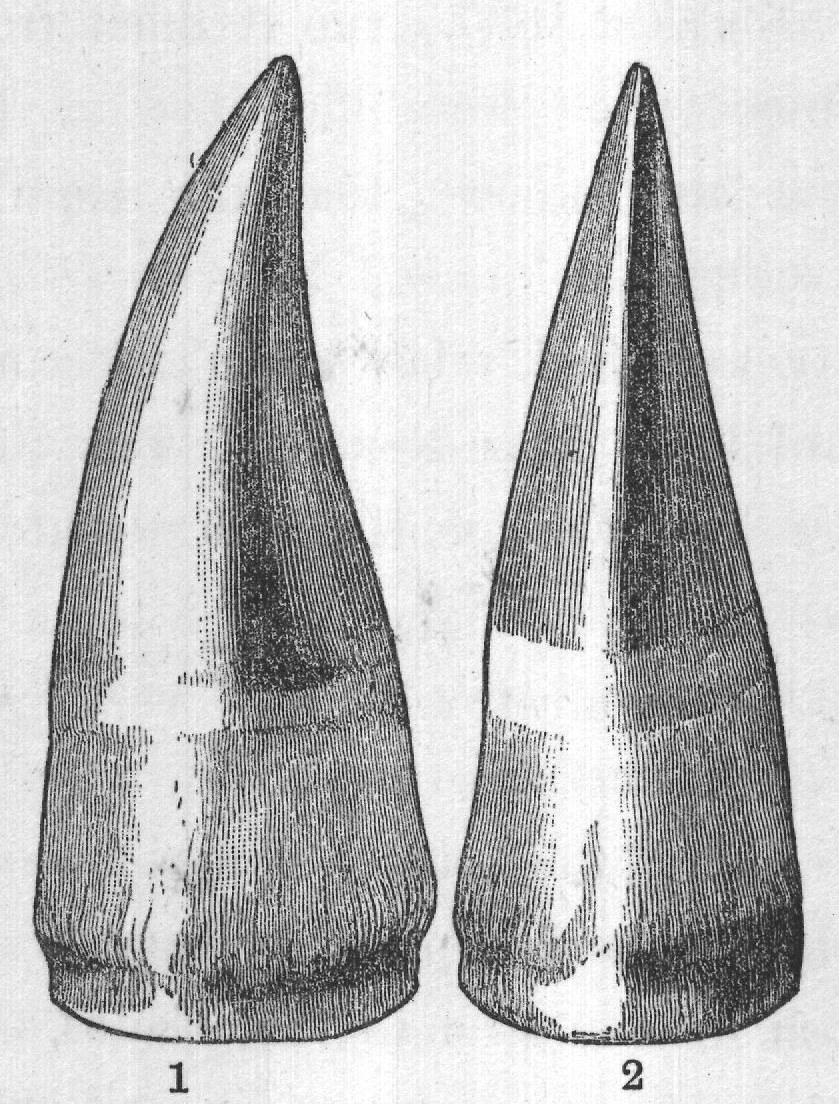
According to the late Professor Cope of Pennsylvania University, who made a special study of this group of extinct saurians, fifty- 1 2 FIG. 69. Lower tooth of Leiodon. 1. Side view. 2. Profile. one species have been discovered in North America, in the States of New Jersey, Alabama, Kansas, North Carolina, Mississippi, and Nebraska. The same authority has shown that they were characterised by a wonderful elongation of form, especially of the tail; that their heads were large, flat, and conical in shape, with eyes directed partly upward; that they were furnished with two pairs of paddles like the flippers of a whale. With these flippers, and the eel-like strokes of their flattened tail, they swam with considerable speed. Like snakes, they were furnished with four rows of formidable teeth on the roof of the mouth, which served admirably for seizing their prey.
But the most remarkable feature in these creatures was the arrangement for permitting them to swallow their prey whole, in the manner of snakes. Thus each half of the lower jaw was articulated at a point nearly midway between the ear and the chin, so as to greatly widen the space between the jaws, and Professor Cope thinks that the throat must consequently have been loose and baggy.
Professor Cope, however, in giving the name Pythonomorpha to this ancient group, has pressed his views too far, and dwelt unduly on their supposed relationship with serpents. Other authorities regard them as essentially swimming lizards, with four well-developed paddles; and this is probably the right view to take of them. "If, as appears certain," says the Professor, "the Mosasauroid, discovered by Webb, measures seventy-five feet in length, and the M. maximus, eighty, the Leiodon dyspelor must have been the longest reptile known, and approaches very nearly the extreme of the mammalian growth seen in the whales, though, of course, without their bulk. Such monsters may well excite our surprise, as well as our curiosity, in the inquiry as to their source of foodsupply, and the character of those contemporary animals preserved on the same geological horizon."