Home › Sea-Serpents › Sea-Serpents: Williston
Sea-Serpents: Williston
According to Dr. S. W. Williston, who has, of late years, discovered and described most valuable specimens of Mosasauroid reptiles, Clidastes had a skull less flattened than that shown in some earlier restorations (e.g. in the previous edition of this book) and the digits were curved, as in Platycarpus. Of the former reptile, which was forty feet long, a single specimen was discovered by Dr. Williston, complete in nearly every detail. The restoration of the skeleton of Platycarpus, shown in Plate XXX., is based chiefly on one specimen, but certain parts are supplied conjecturally from Tylosaurus. The latter has been restored, as to its skeleton, from three specimens found by Dr. Williston, who was fortunate enough to find an impression of the skin, near one of the paddles, showing small scales, rather like those of a snake, but these were too small to be shown in our restoration (Plate XXXI.) of Tylosaurus. Platycarpus seems to be intermediate between Clidastes and Tylosaurus. In Clidastes we see a very long body, and a shorter tail, but this tail must have FIG. 70. Superior aspect of the cranium of Platycarpus curtirostris, Cope; from the Upper Cretaceous of N. America (greatly reduced). (After Cope.) been a powerful organ of propulsion. The limbs were strong and flexible, and the movements of this Mosasauroid reptile were more snake-like. The vertebræ in the tail had their neural arches lengthened, and probably the tail had a fin-like expansion to help in propulsion, as in the case of eels.
The accounts given by Professor Cope of his explorations and the difficulties encountered in procuring the valuable specimens on which his conclusions are based, are most interesting, and such as every fossil hunter will appreciate. We, in England, who visit clay pits, stone quarries, railway cuttings, etc., during a morning or afternoon walk, and return home at our leisure with a few small specimens in our pocket, or in a bag at our back, can hardly realise how arduous must be the work of finding, digging out, and transporting for such long distances, the remains of the monsters of Kansas, and other parts of North America.1 Leiodon proriger (Cope) was abundant in the old North American Cretaceous sea, and reached a length of seventy-five feet. It had a long projecting muzzle, somewhat like the snout of a sturgeon. Platycarpus and Tylosaurus had peculiarly sharppointed heads (see Figs. 69, 70, and 71). A few words may be added here with regard to Professor Cope's important discovery of Leiodon-a genus already alluded FIG. 71. Snout of Tylosaurus, palatal view. (After Marsh.) to as having been founded by Sir Richard Owen. The type specimen of Leiodon dyspelor, which first indicated the characters of this wonderful species, was obtained from the yellow beds of the Niobrara epoch of the Jornada del Muerto, near Fort McRae, New Mexico. The greater part of the remains have been described by Professor Leidy. But a 1 Mr. Charles H. Sternberg, who has spent his life collecting fossils for Cope, Osborn, von Zittel and others, has recently published his experiences in a delightful little volume (illustrated), under the title The Life of a Fossil Hunter, American Nature Series, Henry Holt and Co., New York. It is a most readable book, written with great enthusiasm. 2 We retain the old spelling with the e as being nearer to the Greek, although Professor Cope writes it "Liodon."
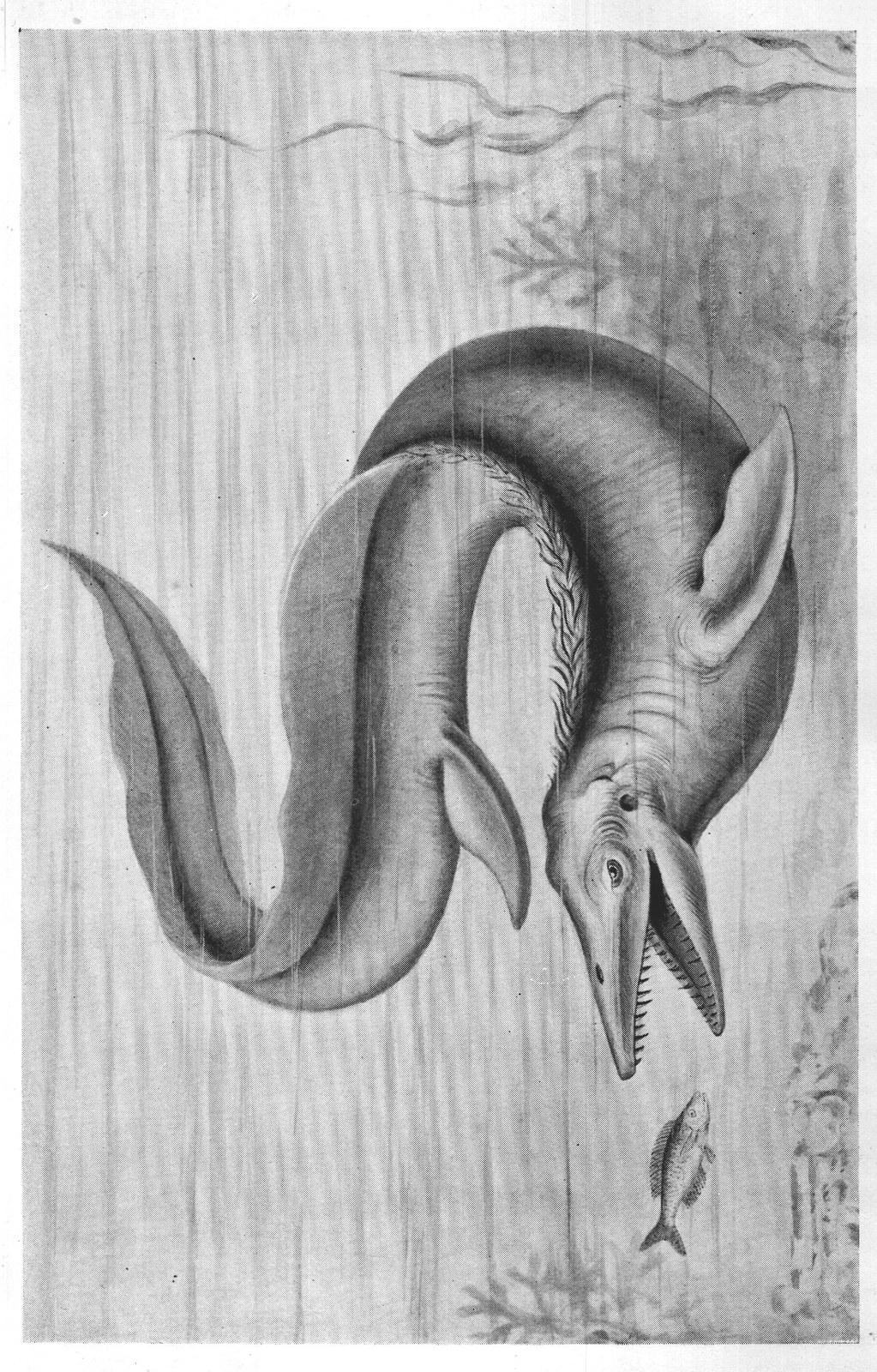
PLATE XXXI.
RESTORATION OF TYLOSAURUS, A GREAT MARINE REPTILE OF CRETACEOUS AGE. Length about 40 feet. (Drawn by J. Green). second specimen, more complete in all respects, was discovered by Professor Cope's exploring party during an expedition from Fort Wallace, Kansas, in 1871. This specimen he has fully described and figured in Cope's Tertiary Vertebrata, 1875. It is a very instructive specimen, including fifty of the vertebræ from all parts of the vertebral column, a large part of the cranium, with teeth, as well as important limb-bones. These precious relics were excavated from a chalk "bluff," or high bank.
In considering the "Age of Reptiles," we cannot but marvel greatly at the diversity of forms assumed by the various orders of this class, their strange uncouth appearance, their assumption, in some cases, of characters only known at the present day among the mammals, their great abundance, and the perfect state in which their remains have been preserved in the stratified rocks of various parts of the world. And the reader may naturally ask, "How is it that so many types have disappeared altogether, leaving us out of a total of at least nine orders, only four, viz. those represented by crocodiles, lizards, snakes, and turtles?" To such a question we can only answer that the causes of the extinction of plants and animals in the past are not yet known. Climate, geographical conditions, foodsupply, competition, with other causes, doubtless operated then as now; but if there is one clear lesson taught by the record of the rocks, it is this that there has been at work from the earliest periods a Law of Progress, so that higher types, coming in at certain stages, have ousted the lower types, sometimes only partially, sometimes completely. But why the Dinosaurs, for instance, perished entirely, while the crocodiles survived to the present day, no one can yet explain. We can see no reason, however, why such problems as these should not be solved in the future by the co-operating labours of naturalists and geologists.
In the great onward and upward struggle for existence, higher types have supplanted lower ones; and, in accordance with this biological truth, we find that in the next era (known as the Tertiary or Cainozoic) the mammal held the field while the reptile took a subordinate place.