Home › Sea-Serpents › Sea-Serpents: Cuvier
Sea-Serpents: Cuvier
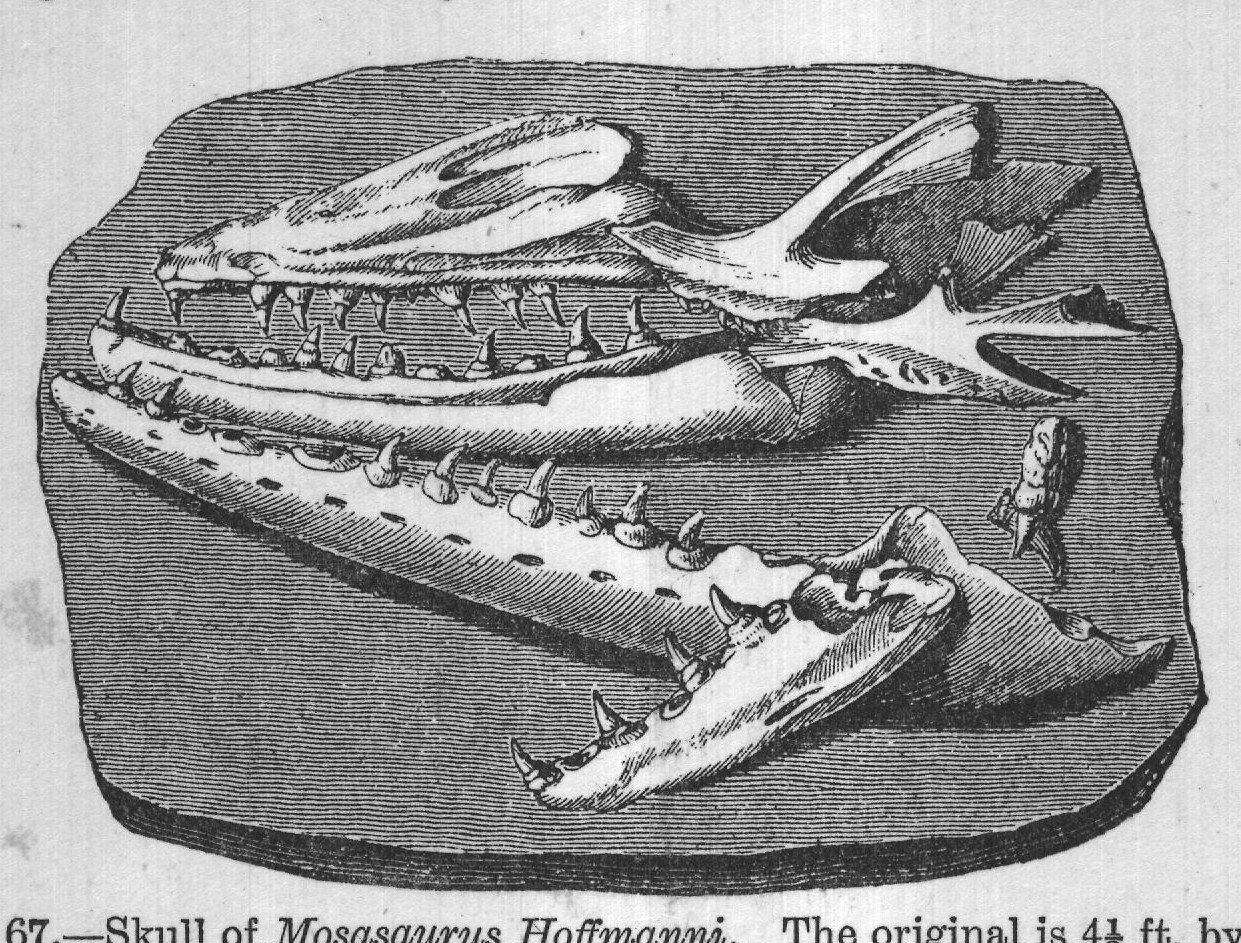
The beautiful cast (Fig. 67) at South Kensington (Fossil Reptile Gallery III., Wall-case 1) was presented to Dr. Mantell by Baron Cuvier in 1825. It consists of both jaws, with numerous teeth, and some other parts (see Fig. 68). The length is about PLATE XXX.
SKELETONS OF MOSASAUROID REPTILES FROM UPPER CRETACEOUS STRATA OF KANSAS, U.S.A., 1. Clidastes.
AFTER DR. S. W. WILLISTON. 2. Platycarpus. 3. Tylosaurus.
SKELETONS OF MOSASAUROID REPTILES FROM UPPER CRETACEOUS STRATA OF KANSAS, U.S.A., 3 four and a half feet. This nearly perfect head was for a time a stumbling-block to many naturalists, some of whom were of FIG. 67. Skull of Mosasaurus Hoffmanni. The original is 4½ ft. by 2 ft. opinion that it belonged to a whale. Cuvier and others considered it to be a kind of link between the Iguanas and the Monitors.1 The entire backbone of the Maestricht animal appears to have consisted of one hundred and thirty-one vertebræ, of which ninety-seven belonged to the tail. The total length of the skeleton is estimated at twenty-four feet, and the head was about one-sixth of the total length. The tail is only ten feet long, whereas in a crocodile the tail exceeds the length of the body.
Although in his day the limbs of the Mosasaurus were imperfectly known, Cuvier la 2a di 1 2 FIG. 68. Teeth of Mosasaurus ( natural size). 1º, 2º, transverse sections of the teeth. 1 The Monitors are a family of large lizards inhabiting the warmer parts of Africa and Asia. They live near the banks of rivers, and some are altogether aquatic. They often devour the eggs of crocodiles and aquatic birds. The Nile Monitor, or Varanus, grows to a length of six feet. rightly considered them to be adapted for swimming, and, with his usual foresight, concluded that this monster was a marine reptile of great strength and activity, having a large tail flattened vertically and capable of being moved from side to side with such force and rapidity as to be a powerful organ of propulsion, capable of stemming the most agitated waters. The large conical recurved teeth, the largest of which was nearly three inches long, are well seen in Figs. 67 and 68. Dr. Mantell was fortunate enough to find, in the year 1820, some vertebræ from the English Chalk, near Lewes, which were identified as belonging to a Mosasaurus. It is now known that this reptile attained the length of forty-five feet.