Home › Footprints on the Sands of Time › Footprints on the Sands of Time: Sandstone
Footprints on the Sands of Time: Sandstone
These impressions figured by Professor Williamson remind one a good deal of some tracks described by Professor Huxley, in his paper on a "New Red Sandstone Crocodile from the Traiassic Strata of Elgin,"¹ which may have been made by that ancient leviathan.
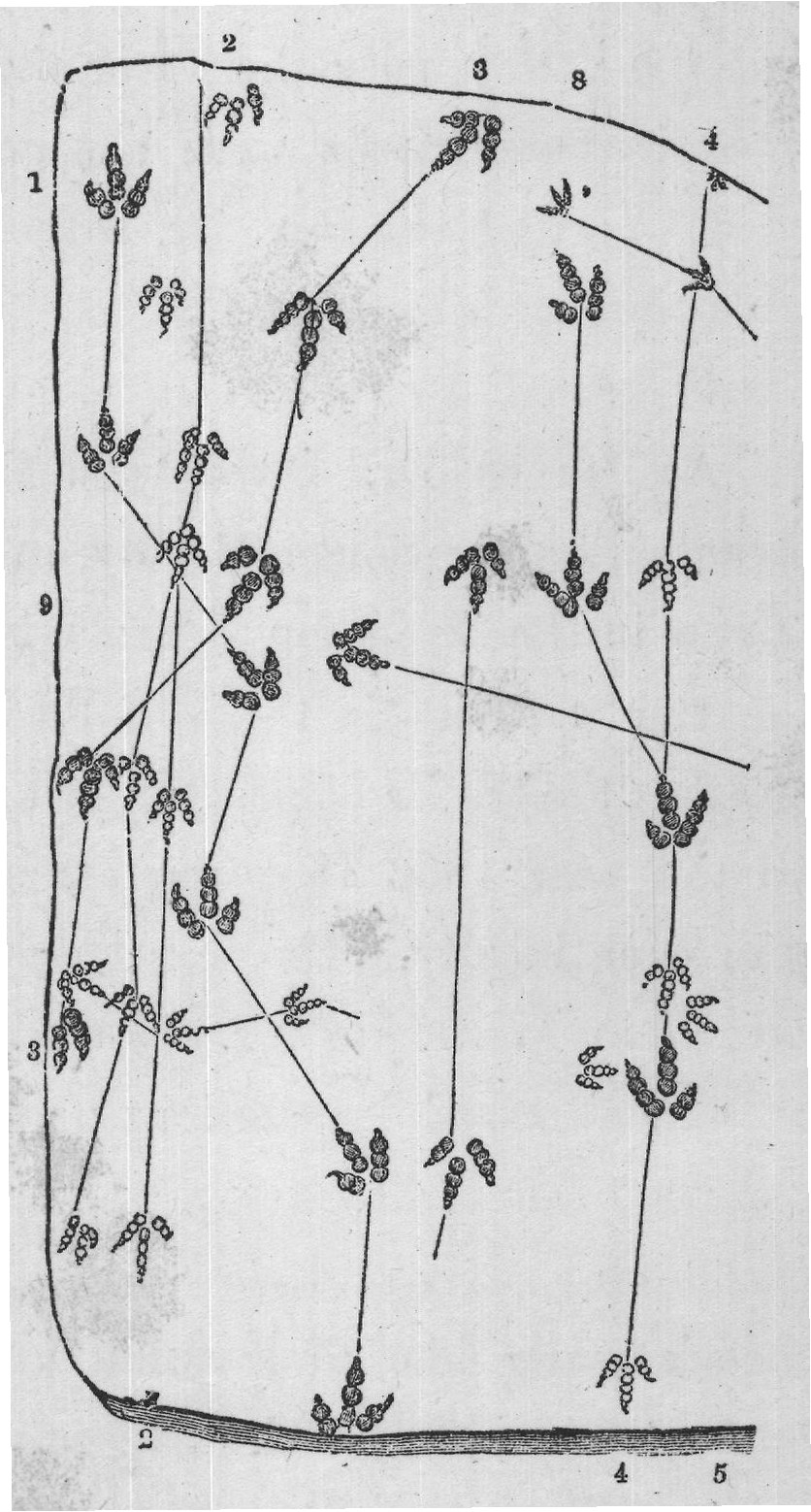
We now pass on to give some account of those famous footprints in the Connecticut Valley, of which probably all geologists have heard. The River Connecticut, in part of its course through the country which bears its name, and in the northern district of 1 Quarterly Journal of Geological Society, xv. (1859), p. 440. the adjoining State of Massachusetts, flows through a valley cut out of sandstone of the Triassic age. Successive layers of this rock are exposed all along considerable tracts of country. From this circumstance, and from the facility of transport afforded by the river, numerous quarries have, for many years, been worked in various parts of the valley, near the water's edge. The many footprints contained in these rocks were observed much earlier than the date (1828) in which the Rev. Dr. Duncan first described the tracks at Corncockle Muir (see p. 37). They have been very fully described and figured by Professor Ed. Hitchcock¹ and Dr. J. Deane. As far as Dr. Deane could learn, the first specimen was ploughed up in South Harley, in 1802, by a boy. This specimen is now in the Appleton Ichnological Cabinet. So strikingly did the tracks resemble those of birds, that they were familiarly spoken of as the tracks of poultry, or of "Noah's raven." It was not until the year 1836 that any attempt was made to describe the tracks scientifically. The year previous some flagging stones were obtained in Montague for the streets of Greenfield, by a Mr. Wilson, who observed impressions upon them, which he regarded as tracks of "the turkey tribe." These were observed by Dr. Deane, who sent casts of them to Professor Hitchcock. Professor Hitchcock gave his first account of them in The American Journal of Science, in 1836. He propounded the idea 1 Professor Ed. Hitchcock, Ichnology of New England. (Boston, 1858.) 2 Dr. J. Deane, Ichnographs from the Sandstone of Connecticut River. (Boston, 1861.) 3 The late Honourable Samuel Appleton, of Boston, left by his will a large sum of money to be appropriated by the trustees under his will to benevolent and scientific purposes. Those trustees accordingly appropriated ten thousand dollars to the erection of the Appleton Cabinet at Amherst, a museum of which the lower story is entirely devoted to fossil footmarks (see Report of Smithsonian Institution, 1907). A still larger collection is now in the Museum of Yale University, but only a part is on view. that they were the tracks of birds--a view which was not adopted by scientific men at the time, though afterwards many came round to his opinion. We have perused his work with great interest, and cannot but admire the care with which he studied 1 2 3 8 4 600doon 9 10000 3 000 COCAD to 0000 4 5 FIG. 3. Portion of a slab of New Red Sandstone, from Turner's Falls, Massachusetts, U.S., covered with numerous tracks, probably of Dinosaurs. This specimen is now in the Natural History Museum, London. The separate tracks are indicated by the numbers. (After Hitchcock.) the tracks and endeavoured to interpret their meaning, although his conclusions now require a good deal of modification. Professor Hitchcock chose to give fanciful names to the creatures that made the tracks, such as Brontozoum giganteum, 3 2 PLATE I.