Home › Footprints on the Sands of Time › Footprints on the Sands of Time: Dinosaurs
Footprints on the Sands of Time: Dinosaurs
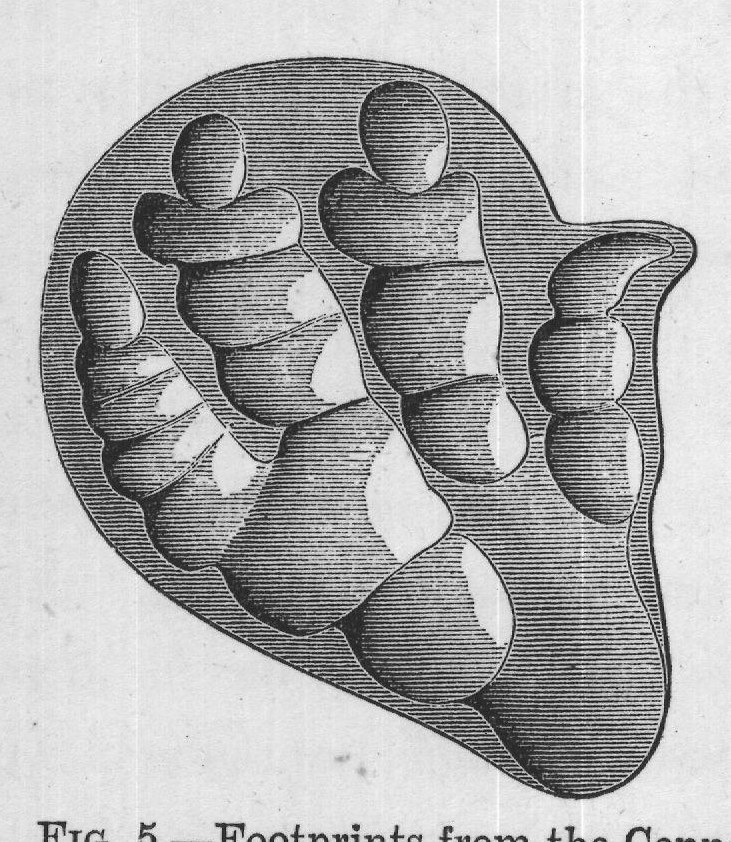
We have here reproduced, from Professor Hitchcock's work, a highly interesting plate (Plate I.), which shows that some of the animals had large hind feet and small fore feet, and that they sometimes put down the latter, as kangaroos do, for there are the impressions of them. However, such impressions are rare, and, as a rule, the creatures, many of which were probably Dinosaurs, walked on their hind limbs, thus producing those three-toed bird-like impressions which are shown on the slabs represented in our figures. It is hardly likely that they hopped on their hind legs as kangaroos do; they were probably too heavy for that; but they may have made something like a hop in bringing up their hind feet, as we have seen the kangaroos do in the Zoological Gardens. Another very interesting point brought to light by the researches of Hitchcock and Deane is, that on some slabs may be seen what is believed to be the impression of the tail of a Dinosaur as it dragged along over the moist sand of the seashore or estuary where these antediluvian creatures of old disported themselves (see Fig. 5).