Home › Flying Dragons › Flying Dragons: Pterodactylus
Flying Dragons: Pterodactylus
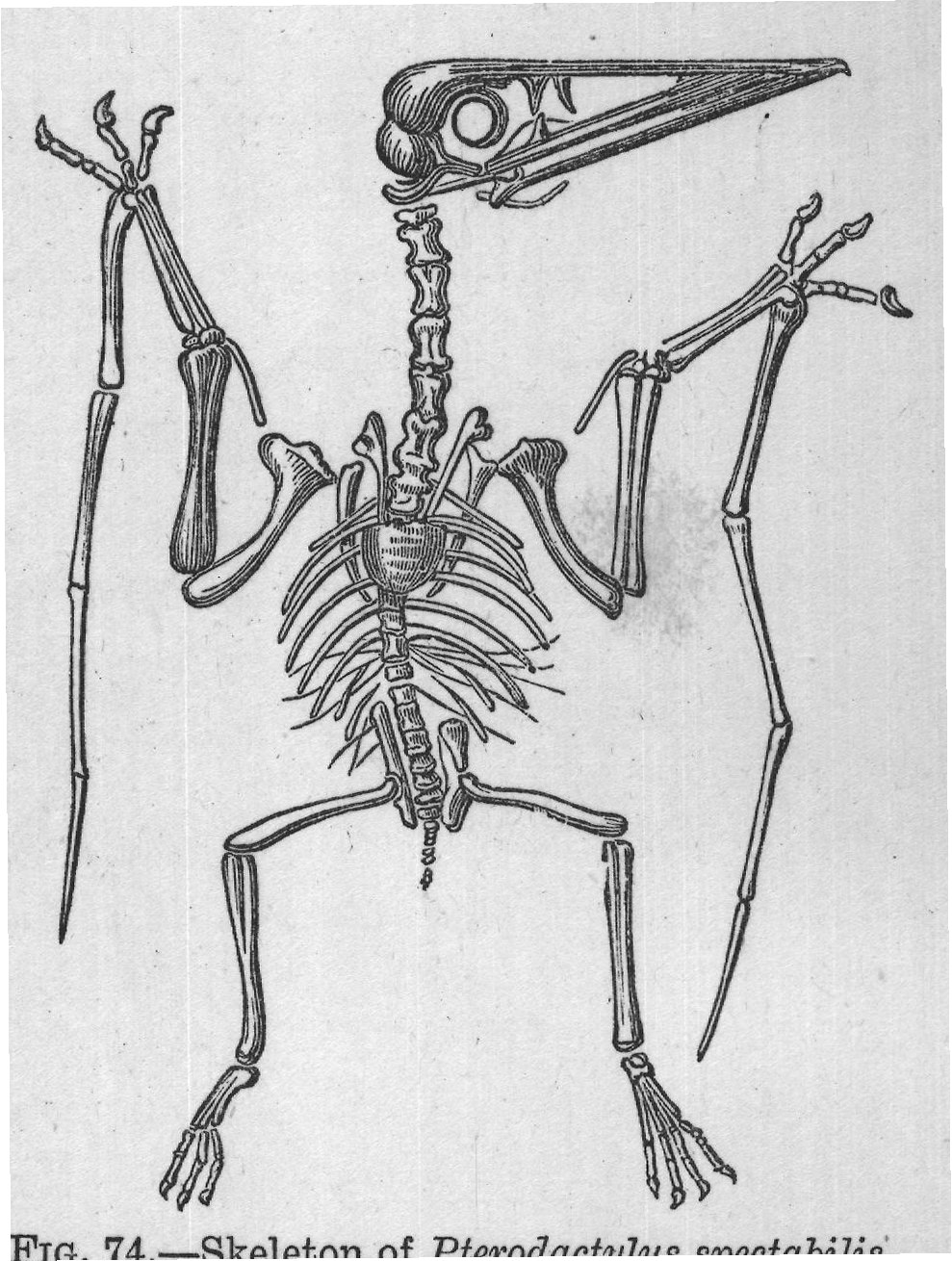
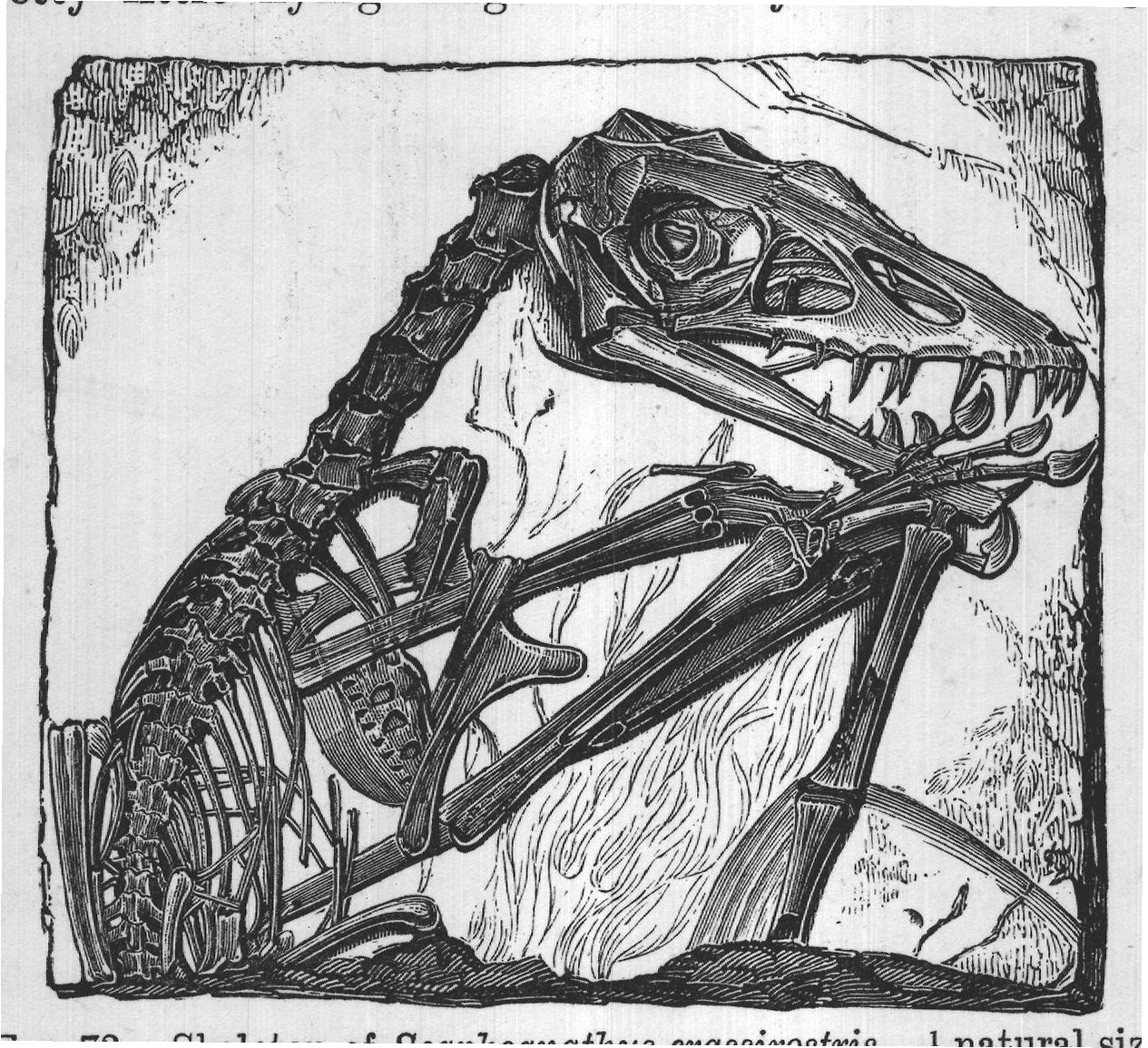
Pterodactylus spectabilis, from the same strata, also possessed a very short tail, but has a more elegant and bird-like skull. This pretty little flying dragon was only about as large as a FIG. 73. Skeleton of Scaphognathus crassirostris. natural size. sparrow (see Fig. 74). Its neck is comparatively short, with but few joints. The long slender beak was probably sheathed in horn, and the skull in several ways approaches that of a bird. Since there are no teeth in the jaws, we may suppose that it devoured dragon-flies or other insects, such as we know were in existence during the period when the lithographic stone of Bavaria was being deposited. Those forms that were provided with teeth probably devoured such fishes as they could catch by swooping down upon the surface of the water.
Cuvier thought, from the magnitude of their eyes, that Pterodactyls were of nocturnal habits. "With flocks of such creatures flying in the air, and shoals of no less monstrous Ichthyosauri and Plesiosauri swarming in the ocean, and gigantic crocodiles and tortoises crawling on the shores of the primæval lakes and rivers FIG. 74. Skeleton of Pterodactylus spectabilis. -air, sea, and land must have been strangely tenanted in these early periods of our infant world." 1 It was thought at one time that Birds differed from Pterodactyls in the absence of teeth; but this only holds good for modern birds. If we go back to the Mesozoic age, we find that birds at that time did possess teeth. The oldest known bird, the Archæopteryx, had teeth in its jaws, and presents some very striking points of resemblance to reptiles (see p. 215). But if 1 Buckland, Bridgewater Treatise.
Pterodactylus crassirostris.
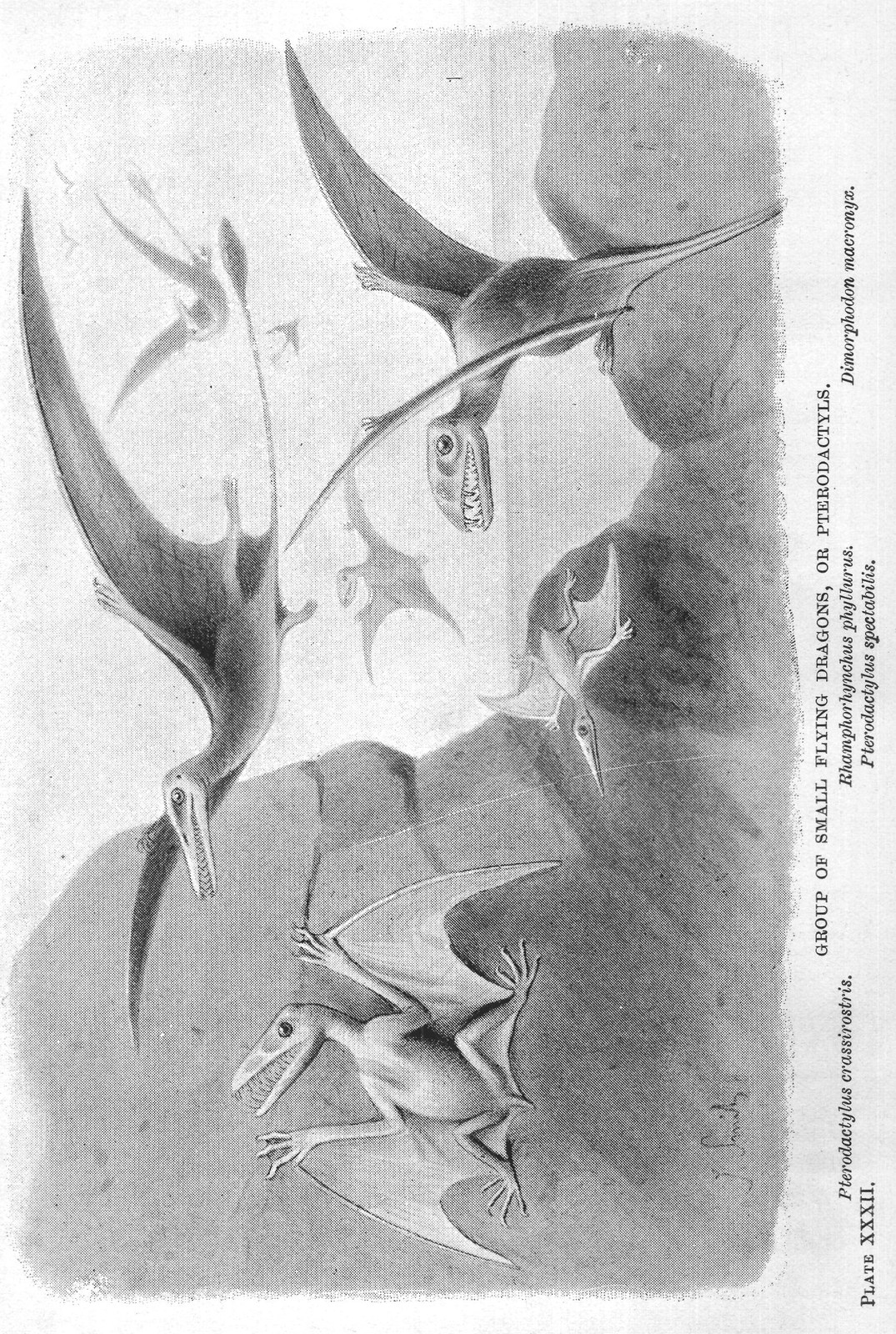
PLATE XXXII, GROUP OF SMALL FLYING DRAGONS, OR PTERODACTYLS.
Rhamphorhynchus phyllurus.
Pterodactylus spectabilis.
Dimorphodon macronyx. we compare the skeleton of a Pterodactyl (such as the P. spectabilis, now under consideration) with that of a bird, we shall see in its fore limbs certain very obvious differences.
In the first place the arm or wing of a bird has only two, or three, bones, instead of four, or five, as here; secondly the outer finger, which corresponds with the human "little finger" is enormously elongated for the purpose of supporting the thin flying membrane. In two ways, however, the skeleton of a Pterodactyl does resemble that of a bird, for the bones are more or less pneumatic (according to von Zittel); and also the position of the skull at right angles to the axis bone (on the top of the neck vertebræ) is a bird-like arrangement. Again, natural casts of the brain cavity prove that the brain was decidedly avian, though smaller in proportion to the size of the skull. The orbits (for the eye) are very large and surrounded by a ring of small sclerotic plates (see Fig. 74).
In order to give rapid movement to their wings during flight, they had powerful muscles in the region of the chest. These were attached to a shield-like breast-bone provided with a keel -as in birds. But this bird-like feature is only a necessary provision to enable them to fly, and does not point to any relationship.
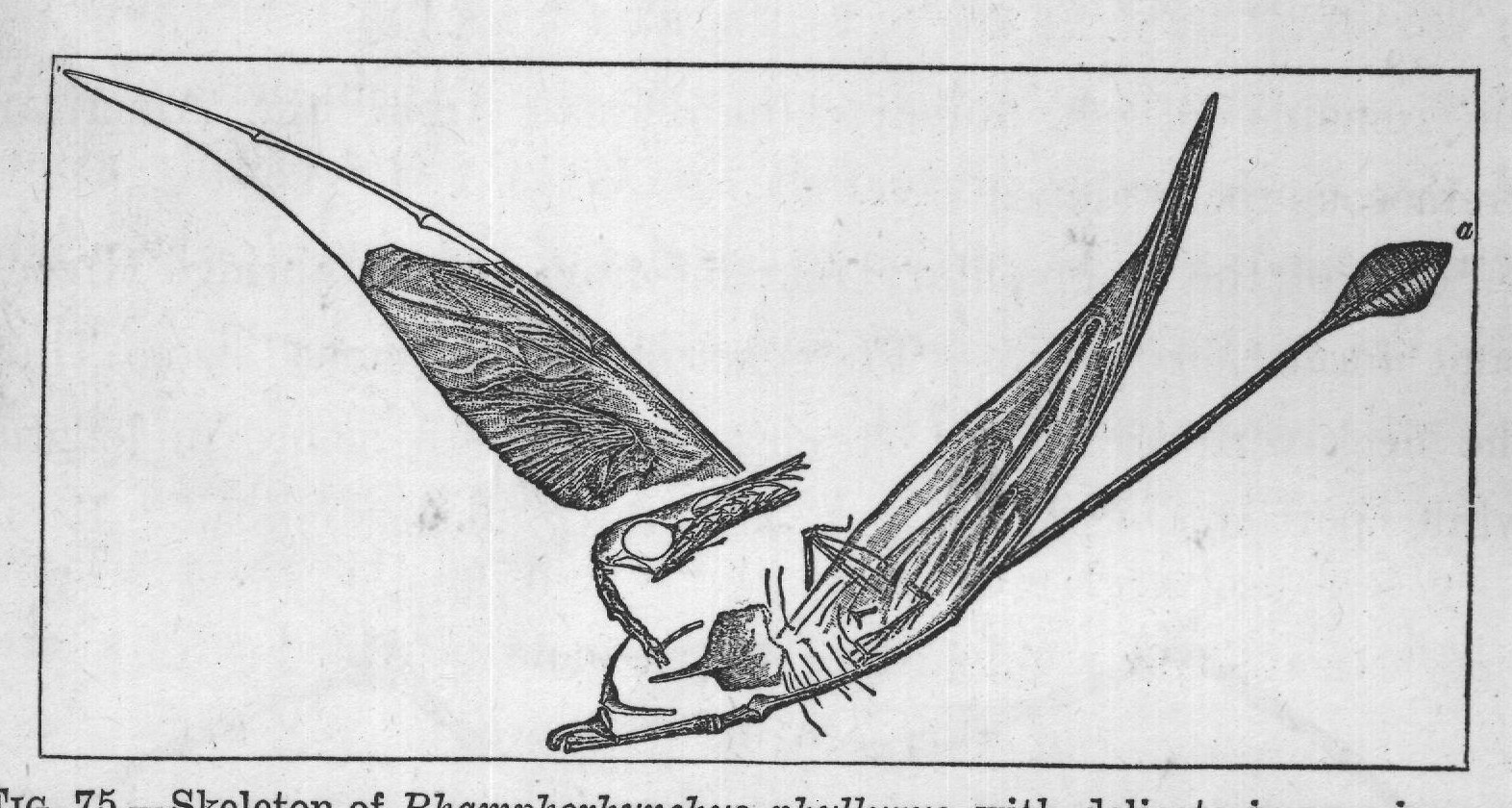
In the year 1873 was discovered, in the lithographic stone of Bavaria, at Eichstädt, a very beautiful new form of Pterodactyl. This was the Rhamphorhynchus phyllurus. The specimen is in a remarkable state of preservation; for the bones of the skeleton are nearly all in position, while those of both wings show very perfect impressions of the membranes attached to them. Its long tail supported another small leaf-like membrane, which was evidently used as a rudder in flight (see Fig. 75). The discovery of this valuable specimen attracted much attention at the time. It was bought, by telegram, for Professor Marsh, and so secured for the Yale College Museum; but a cast may be seen at South Kensington.
Any one who looks carefully at the beautiful impressions of the wings of this specimen can see that they must have been produced by a thin smooth membrane, very similar to that of bats. When this elegant little creature was covered up by the fine soft mud that now forms the lithographic stone, its wings were partly folded, so that the membranes were more or less contracted into folds, like an umbrella only partly open. These a FIG. 75. Skeleton of Rhamphorhynchus phyllurus, with delicate impressions of the flying membranes. (After Marsh.) appear to have been attached all along the arm and to the end of the long finger. They then made a graceful curve backward to the hind foot, and probably were continued beyond the latter so as to join the tail. With its graceful pointed wings and long tail, this little flying saurian must have been a beautiful object, as it slowly mounted upwards from some cliff overlooking the Jurassic seas. (See Plate XXXII.) Like those already described, it was provided with three shortclawed fingers, as well as the one which mainly supported its wing. Some of the Continental museums contain good collections of fossil Pterodactyls; but the largest collection in the world is that of Yale College, where Professor Marsh declares there are I 2 FIG. 76.-Skull of Pteranodon. 1. Side view. 2. Top view. (After Marsh.) the remains of six hundred individuals from the American Cretaceous rocks alone!