Home › Flying Dragons › Flying Dragons: Pterodactyl
Flying Dragons: Pterodactyl
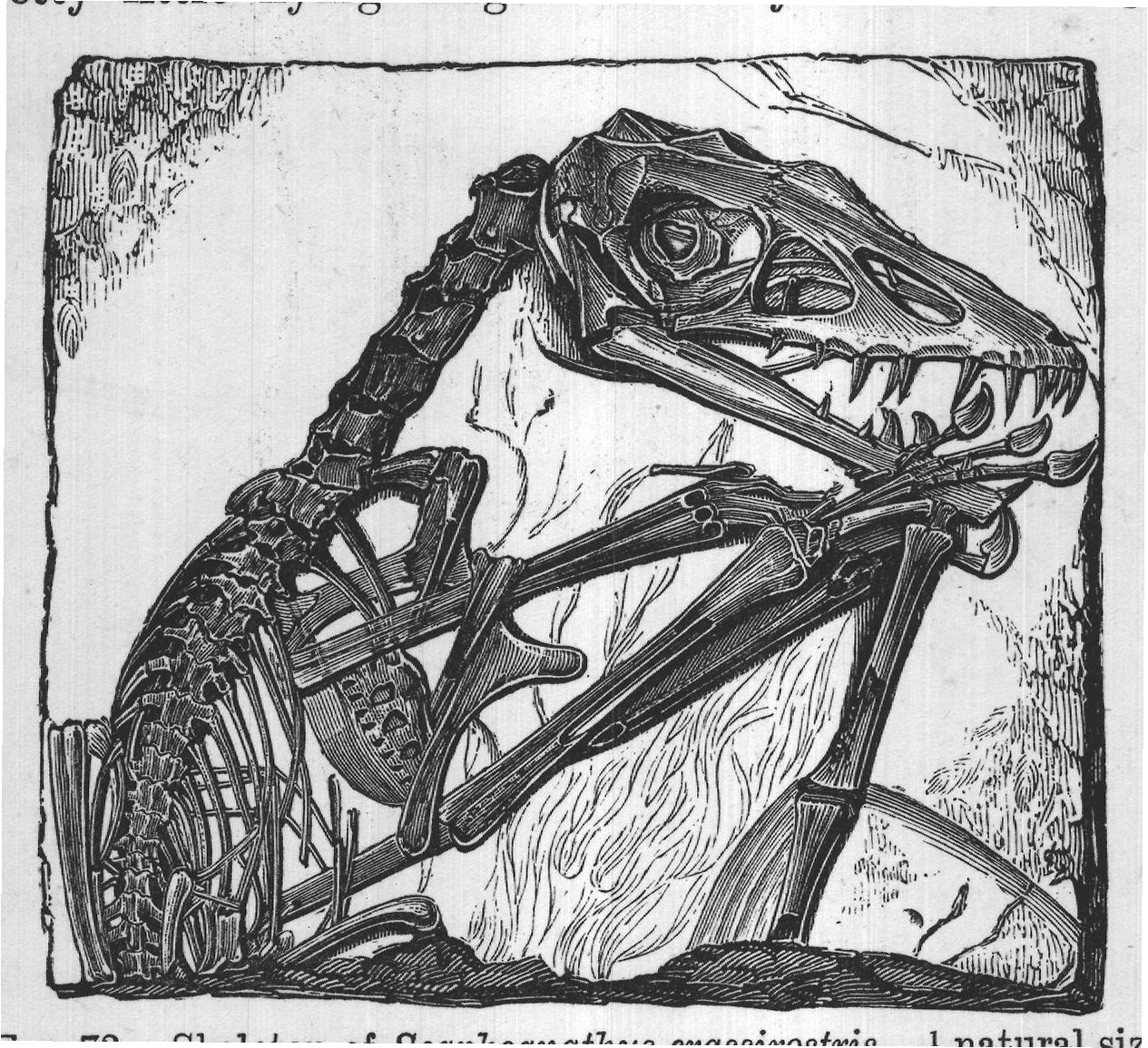
Many forms of Pterodactyl are known. Some were not larger than a sparrow; others about the size of a woodcock; yet others much larger, the largest of all having a spread of wing (or rather of the flying membranes) of twenty-five feet! It has been concluded that they could perch on trees, hang against perpendicular surfaces, such as the edge of a cliff, stand firmly on the ground, 1 From the Greek-pteron, wing, and dactylos, finger. and probably crawl on all fours with wings folded. It may be well at once to point out that the Pterodactyl had no true wings like those of a bird, but a thin membrane similar to that of a bat, only differently supported; so it must be understood that, when we use the word "wing," it is not in the scientific sense that we are using it, but in the popular sense, just as we might speak of the wing of a bat, although the bat has no true wing. Figs. 72, 73, 74, 75, and 77 will give the reader some idea of the various forms presented by the skeletons of Pterodactyls, or, as some authorities call them, Pterosaurians (winged lizards). Great differences of opinion have existed among palæontologists as to whether they are more reptilian than bird-like, or even mammalian. More than a hundred years ago, in 1784, Collini, who was Director of the Elector-Palatine Museum at Mannheim, described a skeleton which he regarded as that of an unknown marine animal. It was a long-billed Pterodactyl from the famous lithographic stone of Solenhofen in Bavaria. The specimen was figured in the Memoirs of the Palatine Academy. Collini was able from this specimen to make out the head, neck, small tail, left leg, and two arms; but beyond that, he was at a loss. His conclusion was that the skeleton belonged neither to a bat nor to a bird, and he inquired whether it might not be an amphibian.
In 1809 this specimen came into Cuvier's hands, who at once perceived that it belonged to a reptile that could fly, and it was he who proposed the name Pterodactyl. Until the oracle at Paris was consulted, the greatest uncertainty prevailed, one naturalist regarding it as a bird, another as a bat. Cuvier, with his penetrating eye and patient investigation, combated these theories, supported though they were by weighty authorities. The principal key by means of which he solved the problem, and detected the saurian relationship of the Pterodactyl, seems to have been a certain bone belonging to the skull, known as the quadrate bone.
Pterodactylus macronyx, or, as it is now called, Dimorphodon macronyx (Fig. 72), was about the size of a raven. It was discovered in 1828 by the late Miss Mary Anning, the well-known collector of fossils from the Liassic rocks that form the cliffs along the coast of Dorsetshire, near Lyme Regis. This important specimen was figured and described by Dr. Buckland, in the Transactions of the Geological Society. He suggested the specific name macronyx on account of the great length of the claws. This authority pointed out an unusual provision for giving FIG. 72. Skeleton of Dimorphodon macronyx. (After Owen.) support and power of movement to the large head at the extremity of a rather long neck, namely, the occurrence of fine long tendons running parallel to the neck-vertebræ. This does not occur in any modern lizards, whose necks are short, and require no such aid to support the head. The restoration of the skeleton seen in the figure is by Professor Owen. It is probable that this Pterodactyl could walk on the ground with its wings folded, and perhaps it was also capable of perching on trees, by clinging on to their branches with its feet and toes. When the flying membrane was stretched out it must, on account of the long tail to which it was also attached, have presented a triangular shape, somewhat like a boy's kite.
Another genus, also from the lithographic slate of Bavaria, namely, Scaphognathus (so called on account of its large beak and jaws), had a very short tail, and its skeleton looks somewhat clumsy for a creature adapted to fly through the air (Fig. 73).