Home › Flying Dragons › Flying Dragons: Pteranodon
Flying Dragons: Pteranodon
Some of the fragmentary remains from our Cambridge Greensand formation indicate Pterodactyls of enormous size. Thus the neck-vertebræ of one species measure two inches in length, while portions of arm-bones are three inches broad. It is FIG. 77. Skeleton of a toothless Flying Reptile (Pteranodon occidentalis), from the Upper Cretaceous of Kansas, U.S.A. Natural History Museum. probable that the creatures to which these bones once belonged measured eighteen or twenty feet from tip to tip of the wings. Other also fragmentary remains from the chalk of Kent testify to the existence of Pterodactyls during that period fully equal in size.
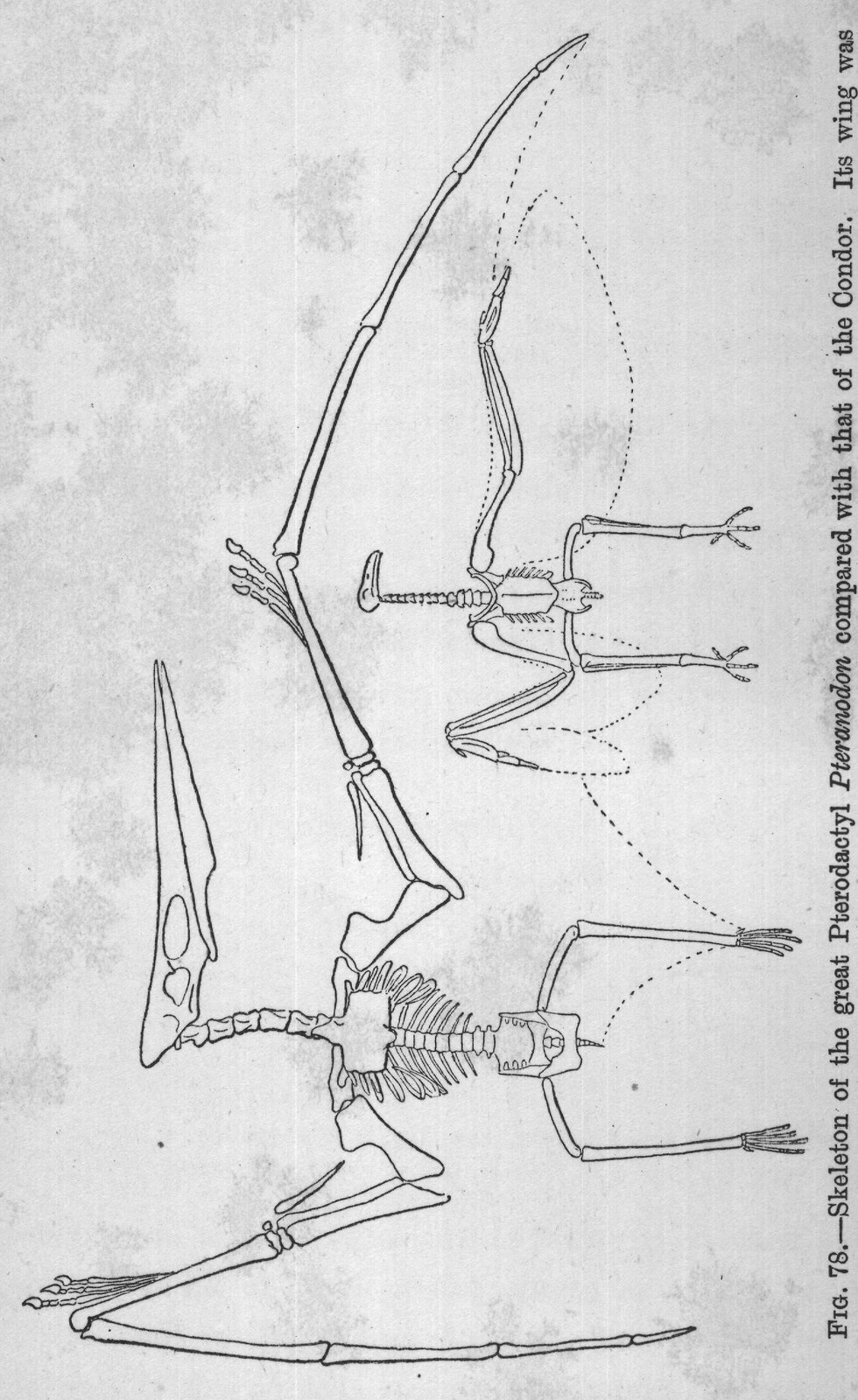
EXTINCT MONSTERS things, from America. Professor Marsh tells us of monsters But the largest Pterodactyls hail, like so many other big 1000 200 FIG. 78. Skeleton of the great Pterodactyl Pteranodon compared with that of the Condor. Its wing was 9 feet long, and its skull nearly 4 feet long. Restoration by Dr. S. W. Williston. From the Smithsonian Report, 1901. The Condor's wing should be longer. in his famous collection with a spread of wings of eighteen PLATE XXXIII.
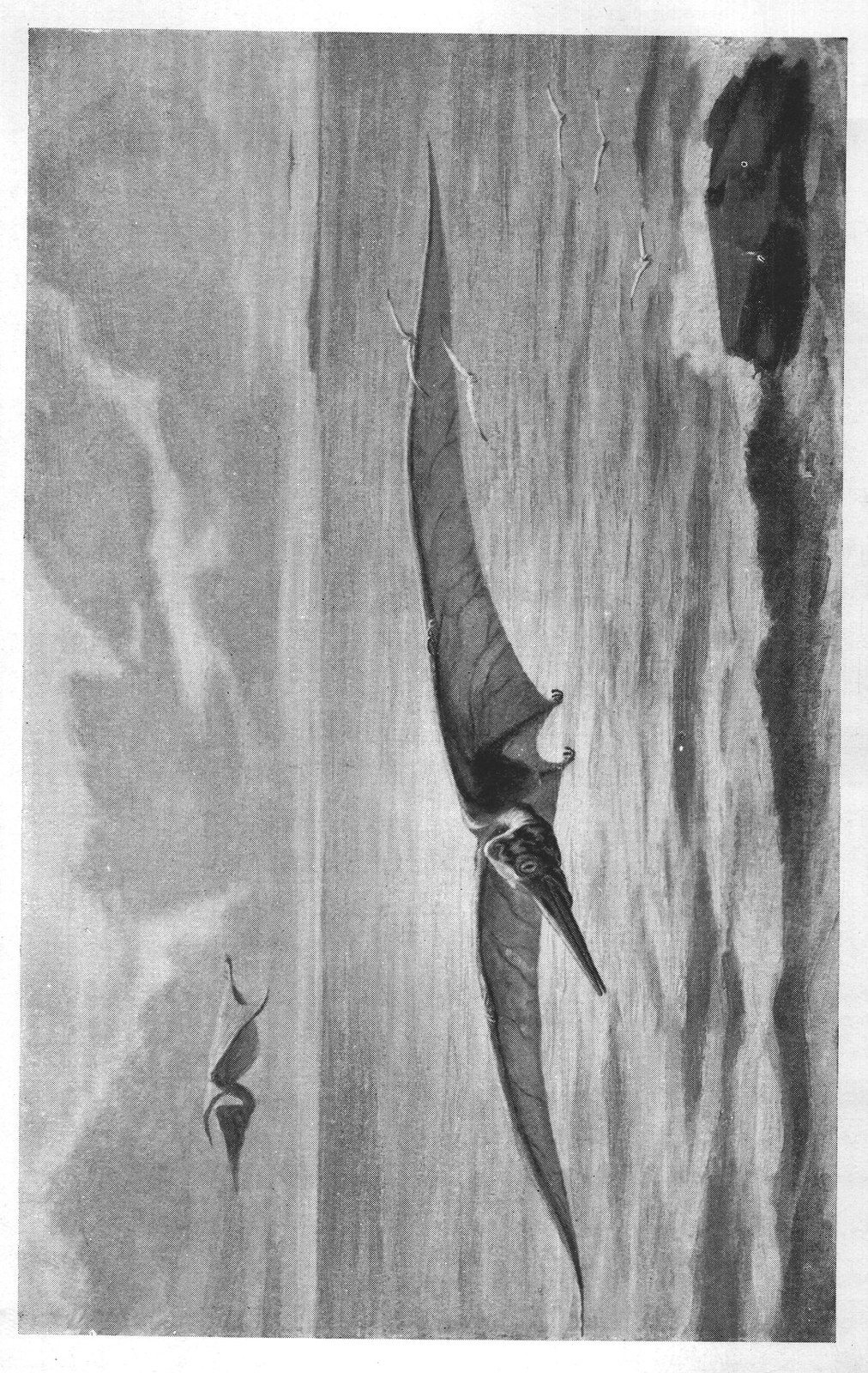
RESTORATION OF THE GIANT PTERODACTYL, PTERANODON, OF CRETACEOUS AGE. Length from tip to tip of wings about 18 feet.
Smithsonian Report, 1901. feet.¹ Plate XXXIII., shows a restoration of the largest known form, viz. Pteranodon, which has been described by Dr. S. W. Williston of the Chicago University. Its wing was nine feet long, and the skull, which is principally beak, was nearly four feet long, the beak being very long, pointed, and quite toothless, which suggests that this Pterodactyl dived after fishes.
Whether Pterodactyls were cold-blooded or warm-blooded is a question on which the authorities are not agreed. Professor Owen argued from the absence of feathers that they could not have been warm-blooded. But, in spite of this great authority, who has defended his opinion somewhat strongly, there are others who argue that the amount of work involved in sustaining a Pterodactyl in the air makes it highly probable that it was warmblooded. Such, at least, is the view of the late Professor H. G. Seeley, who says of the Cambridge specimens: "That they lived exclusively upon land and in air is improbable, considering the circumstances under which their remains are found. It is likely that they haunted the sea-shores, and, while sometimes rowing themselves over the water with their powerful wings, used the wing-membranes, as the bat does, to enclose their prey and bring it to the mouth. "The large Cambridge Pterodactyls probably pursued a more substantial prey than dragon-flies. Their teeth are well suited for fish, but probably fowl and small mammals, and even fruits, made a variety in their food. As lord of the cliff, it may be presumed to have taken toll of all animals that could be conquered with tooth and nail. From its brain it might be regarded as an intelligent animal. The jaws present indications of having been sheathed with a horny covering." 1 Certain books still repeat the over-estimate of Marsh and state that the length from tip to tip was twenty-five feet. This is wrong. P Probably the large Pterodactyls of the Cretaceous period, soaring like albatrosses and giant petrels over the surface of the ocean, co-operated with the marine reptiles, such as Ichthyosaurs, Plesiosaurs, crocodiles, and others, as those sea-birds now do with the whales, porpoises, and dolphins, in reducing the excessive numbers of the teeming tribes of fishes, and in maintaining the balance of oceanic life.
With regard to the place of Pterodactyls in the animal kingdom, Professor Seeley placed them as a distinct sub-class, side by side with birds, and between mammals and reptiles, thus- Mammalia.
Ornithosauria Aves.
Reptilia.
The name Ornithosauria (bird-lizards) is frequently used instead of the other name, because it expresses the idea of their being partly saurian and partly bird-like.
They flourished from the period of the Lias to that of the Chalk; and then, like so many other strange forms, seem to have suddenly disappeared.