Home › Contents › Flicker or Golden-Winged Woodpecker
Flicker or Golden-Winged Woodpecker
All woodpeckers may be classed as carpenters; they all build their homes in the trunks or branches of trees. Usually decayed limbs are chosen but sometimes the larger and stronger species bore into the living wood. The entrances or doors, to these homes are made circular, and just large enough to allow the birds body to slip through. The cavity within is larger and varies in depth from six inches, which is large enough for the little black and white Downy, to a foot for the Flicker and two feet or more for larger woodpeckers like the Pileated. Just as different human beings differ in temperament, so do birds. Some are very cautious especially in all their acts about their homes while others are "happy-go-lucky" and give no thought to danger. A pair of Flickers, that decided to make their home in a large chestnut tree, were of this latter class.
One morning I heard a steady, muffled chopping as I was walking along the edge of the woods. Following the sound, brought me to the foot of this tree. Although it was evident that the bird was pounding away on the inside, it would have been difficult to have located the nest but for the fact that on one side of the tree, the ground was conspicuously covered with chips. Looking upwards from this spot I could see about two inches of the tail of a busy Flicker, protruding from a hole about twenty feet up. Soon she stopped hammering, backed out and more chips came fluttering down.
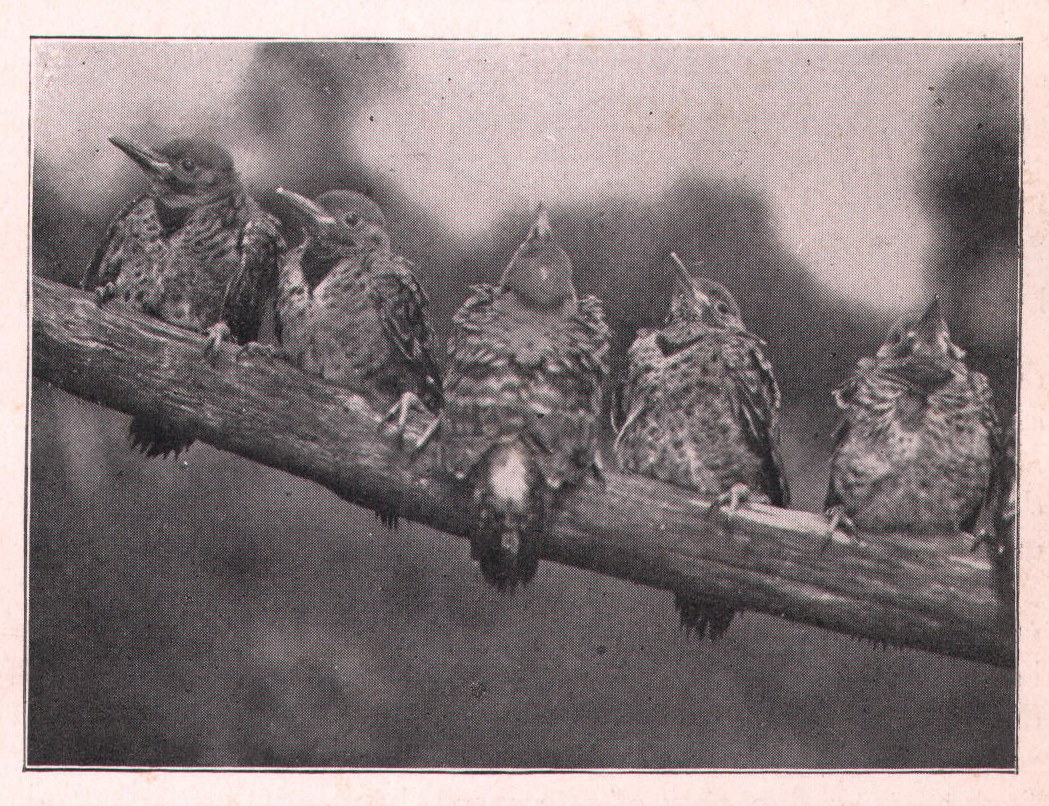
Both Flickers worked on this excavating for about a week before the chamber was large enough to suit them; they both had the same careless habit of simply dropping the chips from the opening. It was an advertisement notifying beast, bird or man that above was the nest of some woodpeckers. Of course these tell-tale chips may have had nothing to do with the outcome, but one day, soon after their set of eggs was completed, I saw a pair of red squirrels playing about the tree and often going into the Flicker nest. An investigation showed that the eggs were missing. More careful were the Flickers that dwelt in a large willow overhanging a swiftly flowing brook. Every chip was Fig. 255. Young flickers do not like to pose before a camera. prudently carried away for a distance of a hundred yards or more before it was dropped.
Flickers are very different in their habits from other woodpeckers. They get more of their food from the ground than they do from trees; they are exceedingly fond of ants, one bird often destroying a whole colony at one meal. They also usually alight on branches crosswise, as a perching bird does, instead of lengthwise like the other members of the family.
Five to eight glossy white eggs are laid, directly upon the bare floor of the house or what few chips happen to remain. For the first week of their lives, little Flickers are fed by regurgitation, that is, food that has been partly digested by the parent. During the remainder of their stay in the nest, the little birds are fed largely upon ants, spiders and small worms or caterpillars. They are very noisy when they are nearly fledged, and their clamor is appalling when their frequent meals come around.
I have never been able to make little Flickers pose before the camera so as to secure a respectable picture. They always get into the most awkward and uncomfortable positions, and bite and claw one another so that it is almost impossible to keep any kind of order. Judging from the squealing and confusion that always greets the return of one of their parents to the nest, I doubt if the old birds can make their youngsters behave much better than I have been able to.