Home › Contents › Cedar Waxwing
Cedar Waxwing
Cedar Birds or "Cherry Birds" as they are very often called, unfortunately are connoiseurs of fine fruit, particularly of the various kinds of cultivated and wild cherries. Unfortunately, too, owners of such trees seldom take any interest in birds except to regard as undesirable all that sometimes steal their fruit. There is no question but what the birds do considerable damage to the cherry crop, consequently it is difficult to reason the farmer out of his habit of setting his hired boy to guarding the trees with a shot gun. Cherries last but a short time and, during the remainder of the year, Cedarbirds eat quantities of insects especially canker worms that are so destructive to orchards. Except during the nesting season they go about in flocks of from six to twenty individuals. The most marked peculiarity about them is their silence. A flock of fifteen or twenty may perch in a wild cherry tree by the hour and not a sound will indicate their presence unless it be the occasional dropping of a cherry. Their only call is a nasal hissing or whistling audible for but a short distance. They remain in flocks until the nesting season, which commences the latter part of June. Even then they often congregate in their favorite cherry trees, but they come and go as individuals.
Their nests are constructed of weeds, grasses, rootlets and moss, skilfully woven together and lined with fine grasses. Although nearly as large as robin nests they are not nearly as easily seen for they are usually cunningly concealed in clusters of leaves. Orchard trees furnish their most frequently chosen nesting sites.
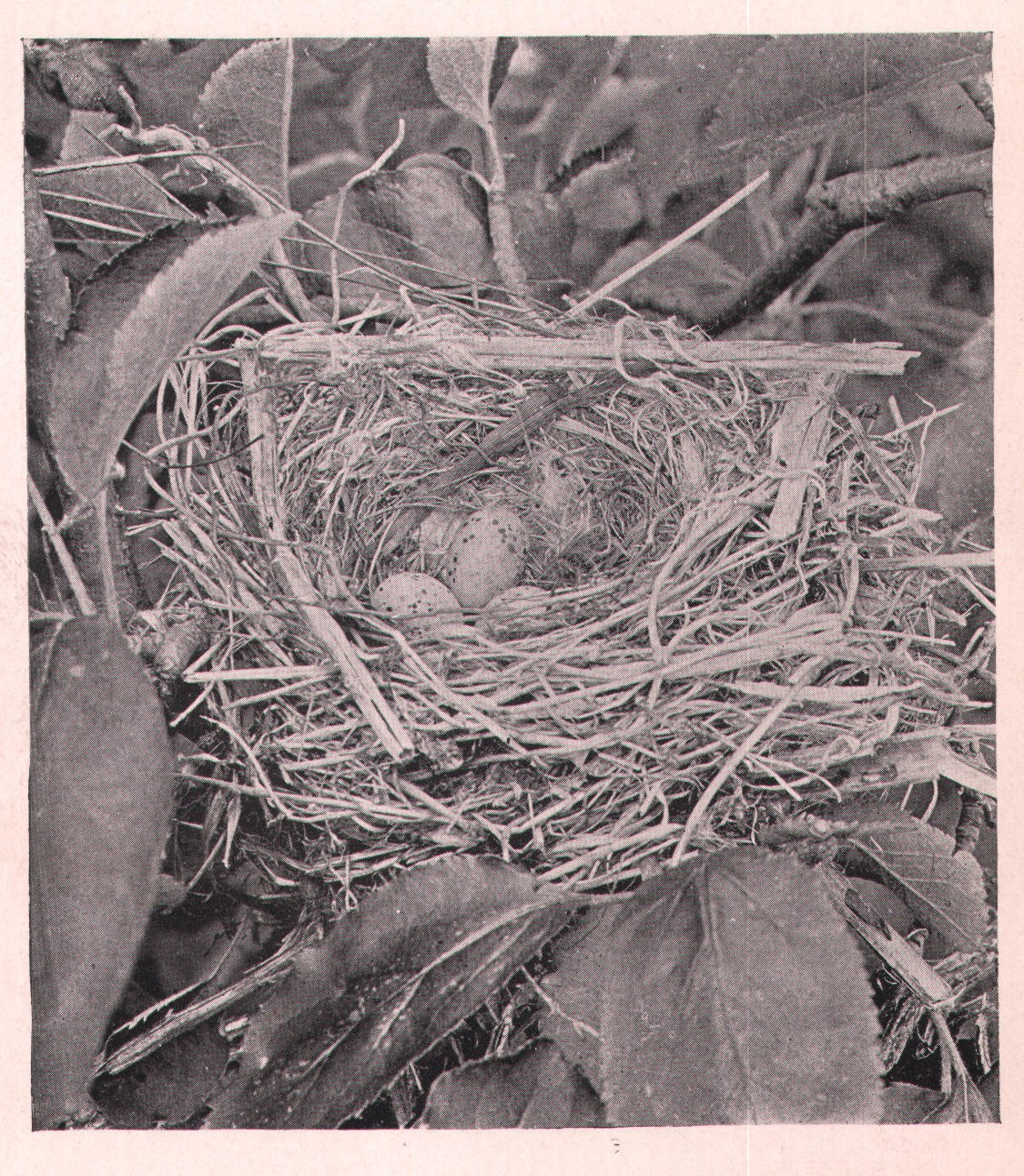
On the fifteenth day of one June, a Cedar Waxwing was observed gathered web from a caterpillar nest. This was carried to an old, lone apple tree standing near the wall in a large field. No investigation was made at the time, but They are very often placed in orchard trees. The composition is chiefly of grasses and string with considerable moss worked into it. The eggs are a gray-blue with black specks. the occurrence was noted to be looked up later. On June thirtieth search of the tree revealed a typical Cherry-bird nest containing four dull bluish eggs with few black spots .
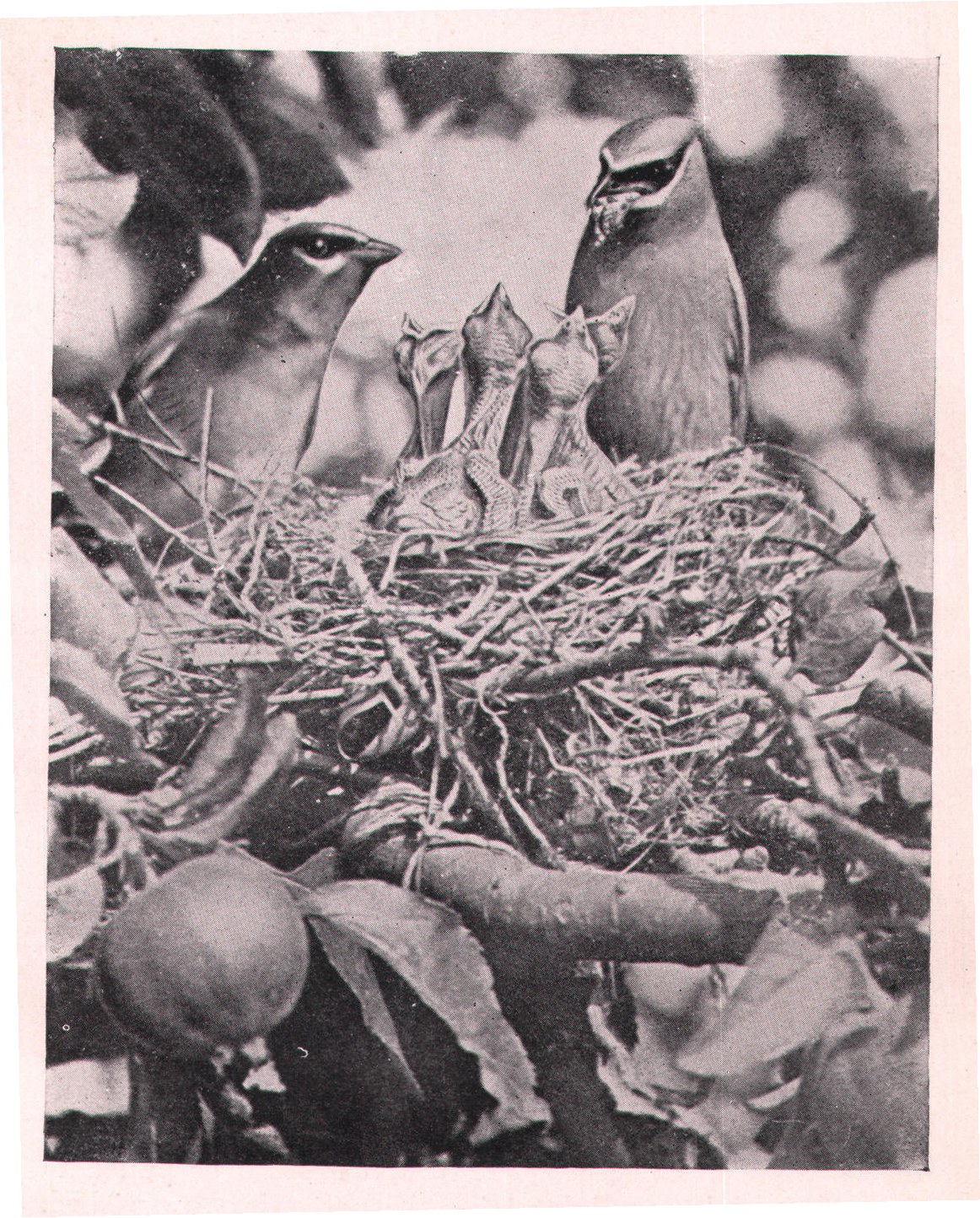
This pair of Cedar-birds made an unfortunate choice of a nesting site, for they had built their house on two crossing limbs. Every time the wind blew, their house tipped back and forth and threatened to spill the contents out. As we did not wish such a calamity to happen, we tied the branches together and then, as an additional precaution, tied the nest more firmly in place. Probably the birds did not appreciate this kindness but it undoubtedly saved the lives of their little ones as will be seen later. While we were engaged in making over their home as we thought it should be, the two Cedar-birds perched on the topmost branches and feebly protested.
It was twenty days before we again visited the nest. We could see from a distance that it was safe and that the parent birds were busy feeding little ones. They both left and flew about overhead until they calmed sufficiently to alight on their lookout perches and watch to see what we were about.
As soon as the branch was touched, up flew four heads with wide open mouths the interior of which was blood-red in color, very different from that of the young of other birds. They were repulsive little things, closed eyes, skin like soft black leather and not a sign of feathers about them.. As soon as they found that no food was forthcoming, they cuddled down in the bottom of the nest and remained quiet while we were making our preparations.
The limbs were weighted with a large stone so as to bring the nest down to a height of about five feet, all intervening branches were tied out of the way and the one that shaded the nest had a string attached so that it could be pulled to one side and let sunlight strike the nest when we wished. After seeing that the picture was satisfactory on the Fig. 125.
Sometimes cherries were fed in their whole state, and again they were crushed.
From a painting