Home › Ruby-Thr. Humming Bird › Ruby-Thr. Humming Bird
Ruby-Thr. Humming Bird
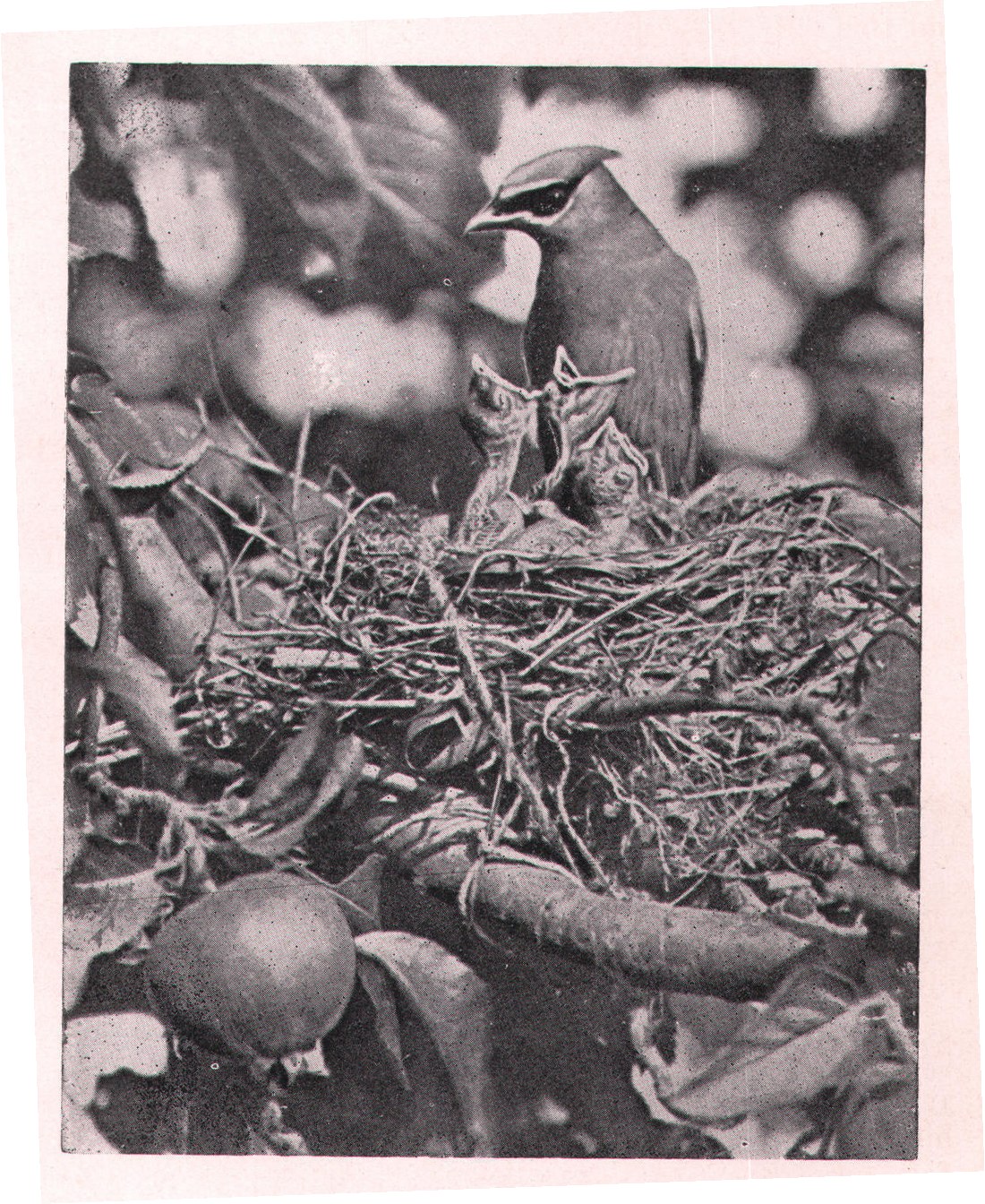
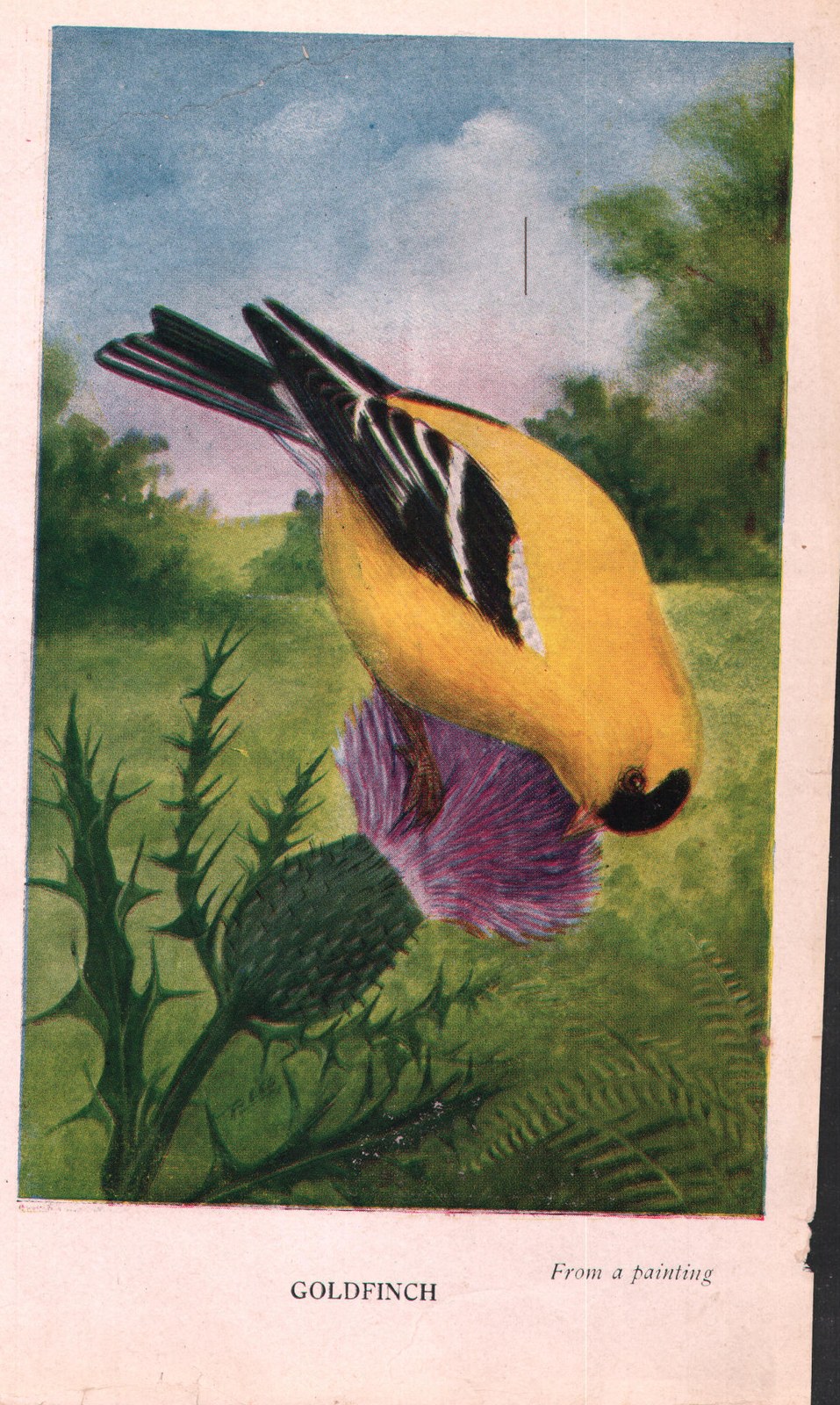
From a painting GOLDFINCH ground glass we retired to the other side of the wall. We found that we needed no concealment; as long as we were out of sight from the tree, the Cedar-birds considered it safe to go to and from the nest without regard to us. After the female had looked the nest over carefully and found that we had not harmed the little ones she flew away leaving her mate on guard.
Upon her return, the two parents talked matters over a few minutes and then she slyly hopped down, branch by branch, until she was beside the nest. Although to all appearances she had brought no food, she had a plentiful supply concealed in her throat. Cedar -birds feed their young by regurgitation; sometimes the food is administered to the little ones in a well masticated state and again it may be in the raw condition.
As she stepped to the edge of the nest all the young heads were elevated and she assumed an attitude of inspection, watching them intently for a few moments possibly to see which was the most in need of food. As each was reaching its very highest and opening its mouth to the greatest possible extent it seemed to be a difficult proposition to decide. At last she made a convulsive movement of the head and, a bright red cherry appeared in her bill.
This was quickly thrust down the throat of the nearest little bird; as it was not instantly swallowed she took it away from him and gave it to the next one. If there is not immediate muscular response in the throat of a young bird, food is at once withdrawn and given to one in a fit condition to receive it; this is done at least by all the song and insectivorous birds with which I am familiar.
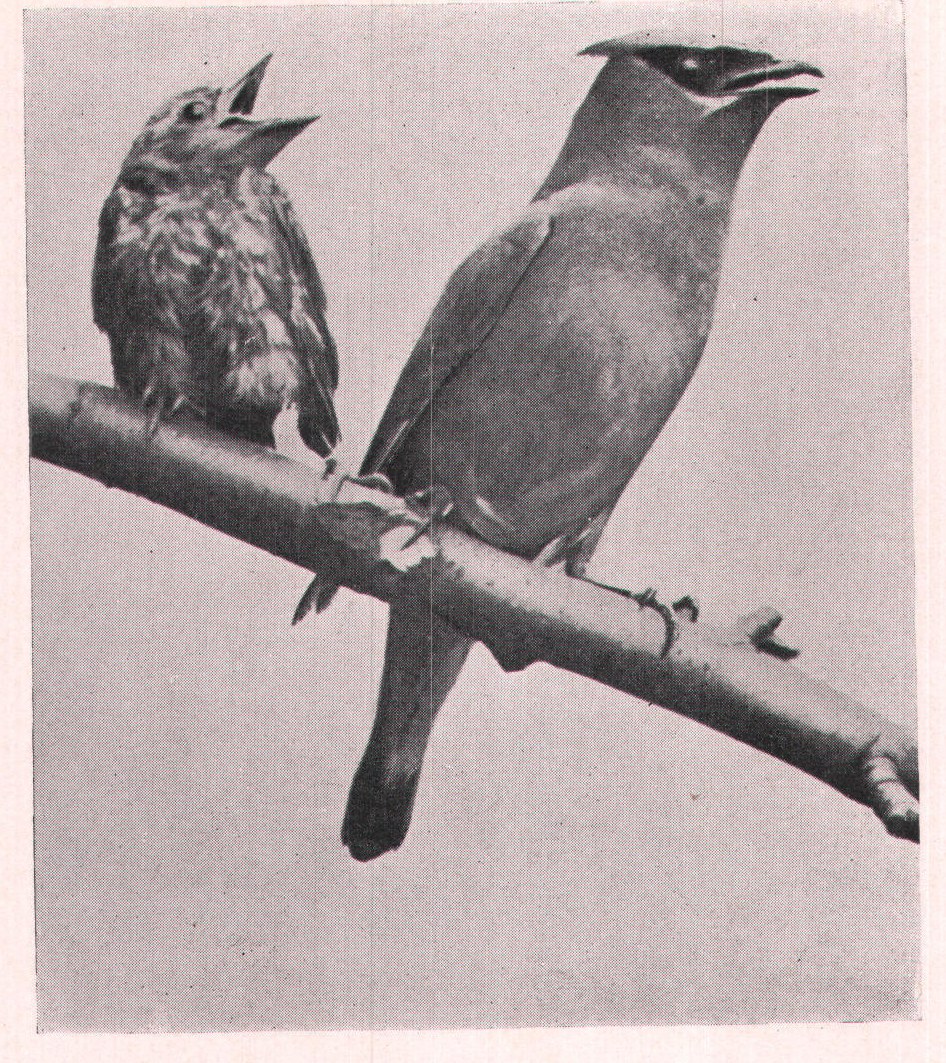
Cedar-birds seem to do everything systematically. One of these always remained on guard and the other joined two more that flew overhead at regular intervals, the three going to a cherry tree about a quarter of a mile away where they managed to find some belated fruit. The politeness of Fig. 126. She would look at them intently as though to decide which was the most in need of food.
Cedar-birds has frequently been noted. Often when a number are feeding, one will seize a cherry, pass it to the next and this one in turn give it to his neighbor. A number of times I have seen cherries thus go the rounds of three or four birds before they were swallowed.
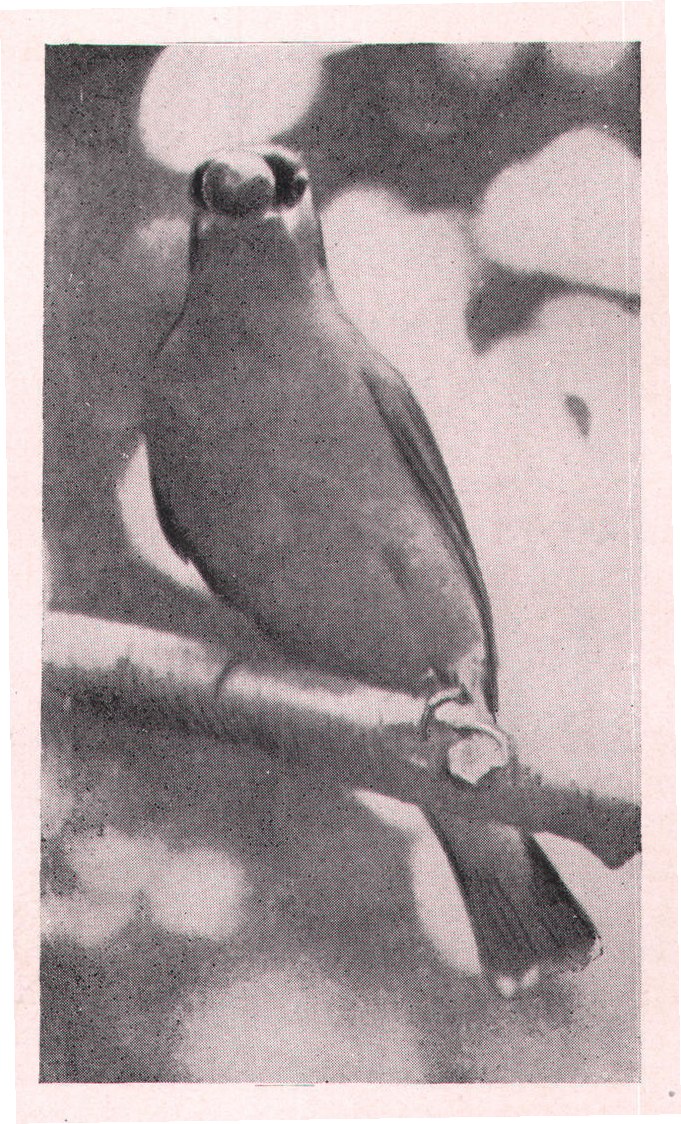
On the return trip, our bird would leave and drop down to the topmost twig of the apple tree while the other two continued down into the valley where they had their homes. Mother Wax-wing fed the little birds several times while her mate kept watch. She was not a bird to be imposed on for very long, however; after calling to him for some time she flew to his side and pecked at him until he went down to the nest and gave his children the cherries he had been hold.. ing in his mouth for so long. She went along with him and we secured a good view of the group just as he was "coughing up" some food. During this day the parent birds fed the young at intervals of about ten minutes for half an hour, then the mother brooded them for the next half hour. Two days later we had a violent thunder storm accompanied by very high winds. I very much feared for the safety of the nest and its occupants and was very glad to find later that our strings had held things in place, although the nest was a little awry. As we approached the parents left the nest and the young birds, now almost large enough to fly, assumed the same motionless attitude, heads well forward, that the adults always take when startled. I never before had young birds act as these did when we placed them side by side on a branch. They were all as "mean" as they could be but one of them was a regular imp; just like a spoiled child, he would bite and kick and throw himself backwards off the branch, regardless of how he fell, usually, however, he would grab a neighbor by the wing or tail and pull it along with him. When we could get them to stay on the branch at all, they looked stiff and unnatural, just like stuffed images. The three little Cedarbirds in the picture that is shown belong to another family; they behaved beautifully, sat perfectly still and would each turn its head just where we wanted it. Unfortunately the parents of these birds could not be induced to return and feed them, while the ones that owned the unruly children would alight on the branch and feed the single little bird we could induce to remain still.
Fig. 128. The little birds were mean subjects; they simply would not pose.
The birds usually brought two, three or four cherries at a time in their throats. They did not, however, feed the little Cedar-birds entirely upon cherries for they sometimes brought different species of moths and caterpillars. Often while one was perched on the lookout twig awaiting the return of its mate, it would dash into the air and snap up a passing insect; sometimes these would be taken to the young, but more often would be eaten by the captor.
CUCKOOS.