Home › The Dinosaurs › The Dinosaurs
The Dinosaurs
"Shapes of all sorts and sizes, great and small."
A few million years ago, geologists and physicists do not agree upon the exact number, although both agree upon the millions, when the Rocky Mountains were not yet born and the now bare and arid western plains a land of lakes, rivers, and luxuriant vegetation, the region was inhabited by a race of strange and mighty reptiles upon whom science has bestowed the appropriate name of Dinosaurs, or terrible lizards. Our acquaintance with the Dinosaurs is comparatively recent, dating from the early part of the nineteenth century, and in America, at least, the date may be set at 1818, when the first Dinosaur remains were found in the Valley of the Connecticut, although they naturally were not recognized as such, nor had the term been devised. The first Dinosaur to be formally recognized as representing quite a new order of reptiles was the carnivorous Megalosaur, found near Oxford, England, in 1824.
The scientific name Dinosauria was used by Richard Owen in 1842, but I do not know when it became anglicized as Dinosaur.
For a long time our knowledge of Dinosaurs was very imperfect and literally fragmentary, depending mostly upon scattered teeth, isolated vertebræ, or fragments of bone picked up on the surface or casually encountered in some mine or quarry. Now, however, thanks mainly to the labors of American palæontologists, thanks also to the rich deposits of fossils in our Western States, we have an extensive knowledge of the Dinosaurs, of their size, structure, habits, and general appearance.
There are to-day no animals living that are closely related to them; none have lived for a long period of time, for the Dinosaurs came to an end in the Cretaceous, and it can only be said that the crocodiles, on the one hand, and the ostriches, on the other, are the nearest existing relatives of these great reptiles.
For, though so different in outward appearance, birds and reptiles are structurally quite closely allied, and the creeping snake and the bird on which it preys are relatives, although any intimate relationship between them is of the serpent's making, and is strongly objected to by the bird.
But if we compare the skeleton of a Dinosaur with that of an ostrich-a young one is preferable and with those of the earlier birds, we shall find that many of the barriers now existing between reptiles and birds are broken down, and that they have many points in common. In fact, save in the matter of clothes, wherein birds differ from all other animals, the two great groups are not so very far apart.
The Dinosaurs were by no means confined to North America, although the western United States seem to have been their headquarters, but ranged pretty much over the world, for their remains have been found in every continent, even in far-off New Zealand.
In point of time they ranged from the Trias to the Upper Cretaceous, their golden age, marking the culminating point of reptilian life, being in the Jurassic, when huge forms stalked by the sea-shore, browsed amid the swamps, or disported themselves along the reedy margins of lakes and rivers.
They had their day, a day of many thousand years, and then passed away, giving place to the superior race of mammals which was just springing into being when the huge Dinosaurs were in the heyday of their existence. And it does seem as if in the dim and distant past, as in the present, brains were a potent factor in the struggle for supremacy; for, though these reptiles were giants in size, dominating the earth through mere brute force, they were dwarfs in intellect.
The smallest human brain that is thought to be compatible with life itself weighs a little over ten ounces, the smallest that can exist with reasoning powers is two pounds; this in a creature weighing from 120 to 150 pounds.
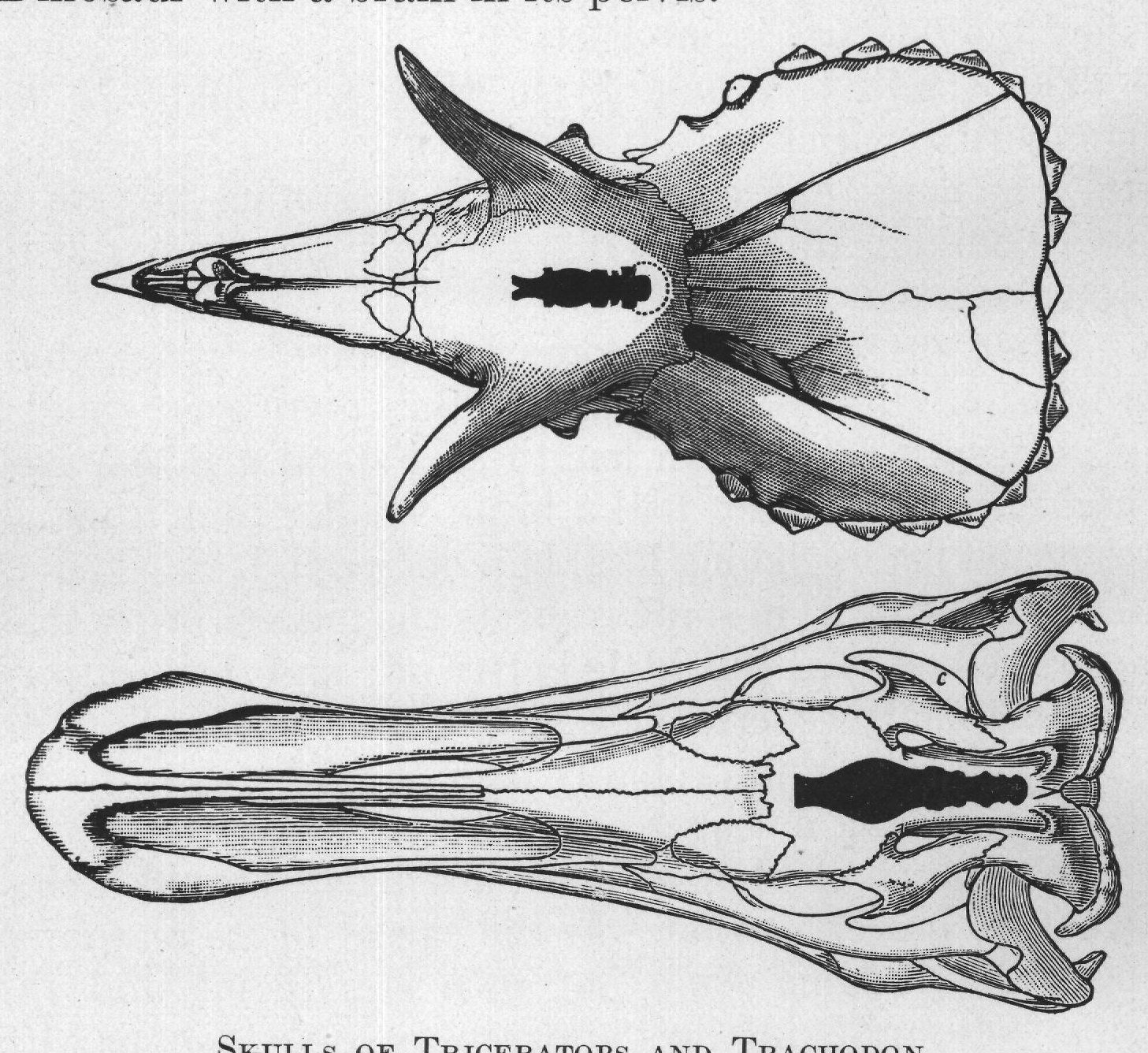
What do we find among Dinosaurs? Trachodon, which may have walked where Baltimore now stands, was twenty-five feet in length and stood a dozen feet high in his bare feet, had a brain smaller than a man's clenched fist, weighing less than one pound.
Brontosaurus, in some respects the biggest brute that ever walked, was but little better off, and Triceratops, and his relatives, creatures having twice the bulk of an elephant, weighing probably over ten tons, possessed a brain weighing not over two pounds!
How much of what we term intelligence could such a creature possess-what was the extent of its reasoning powers? Judging from our own standpoint and the small account of intellect apparent in some humans with much larger brains, these big reptiles must have known just about enough to have eaten when they were hungry, anything more was superfluous.
However, intelligence is one thing, life another, and the spinal cord, with its supply of nerve-substance, doubtless looked after the mere mechanical functions of life; and while even the spinal cord is in many cases quite small, in some places, particularly in the sacral region, it is subject to considerable enlargement. This is notably true of Stegosaurus, where the sacral enlargement is twenty times the bulk of the puny brain-a fact noted by Professor Marsh, and seized upon by the newspapers, which announced that he had discovered a Dinosaur with a brain in its pelvis.
SKULLS OF TRICERATOPS AND TRACHODON Illustrating the small size of the brains, shown in black. The brains of these animals, twice the bulk of an elephant, were the size of a man's fist. In their great variety of size and shape the Dinosaurs form an interesting parallel with the Marsupials of Australia. For just as these are, as it were, an epitome of the class of mammals, mimicking the herbivores, carnivores, rodents and even monkeys, so there are carnivorous and herbivorous Dinosaurs-Dinosaurs that dwelt on land and others that habitually resided in the water, those that walked upright and those that crawled about on all fours; and, while there are no hints that any possessed the power of flight, some members of the group are very bird-like in form and structure, so much so that it has been thought that the two may have had a common ancestry.