Home › Flying Reptiles › Flying Reptiles: Pteranodon
Flying Reptiles: Pteranodon
Later on, in the Cretaceous, Pterodactyls became abundant and in what is now the State of Kansas reached their greatest size in the shape of Pteranodon or Ornithostoma.
Nature's varied ways of making a wing were considered in the chapter on Birds of Old, and it will be remembered that in Pterodactyls the wing was formed by a membrane stretched between the little finger and the side of the body. In Pteranodon this little finger was nine feet long, the wings having a spread of from fifteen to occasionally twenty feet, the maximum reached by any flying animal. The condor and albatross are to-day the largest flying creatures and they have a spread of wing from a little under nine feet to from ten to ten and one-half feet. Albatross are said to exceed this and I have seen some that I should have estimated at twelve feet, but even this is far under the fifteen to twenty feet of Pteranodon.
Structurally, Pteranodon was a marvel of lightness, the great wing bones being scarcely thicker than a sheet of blotting paper, the body little more than an appendage to the wings. For though having twice the spread of wing of a swan, Pteranodon probably did not weigh more than twenty-five pounds, possibly not even so much as that.
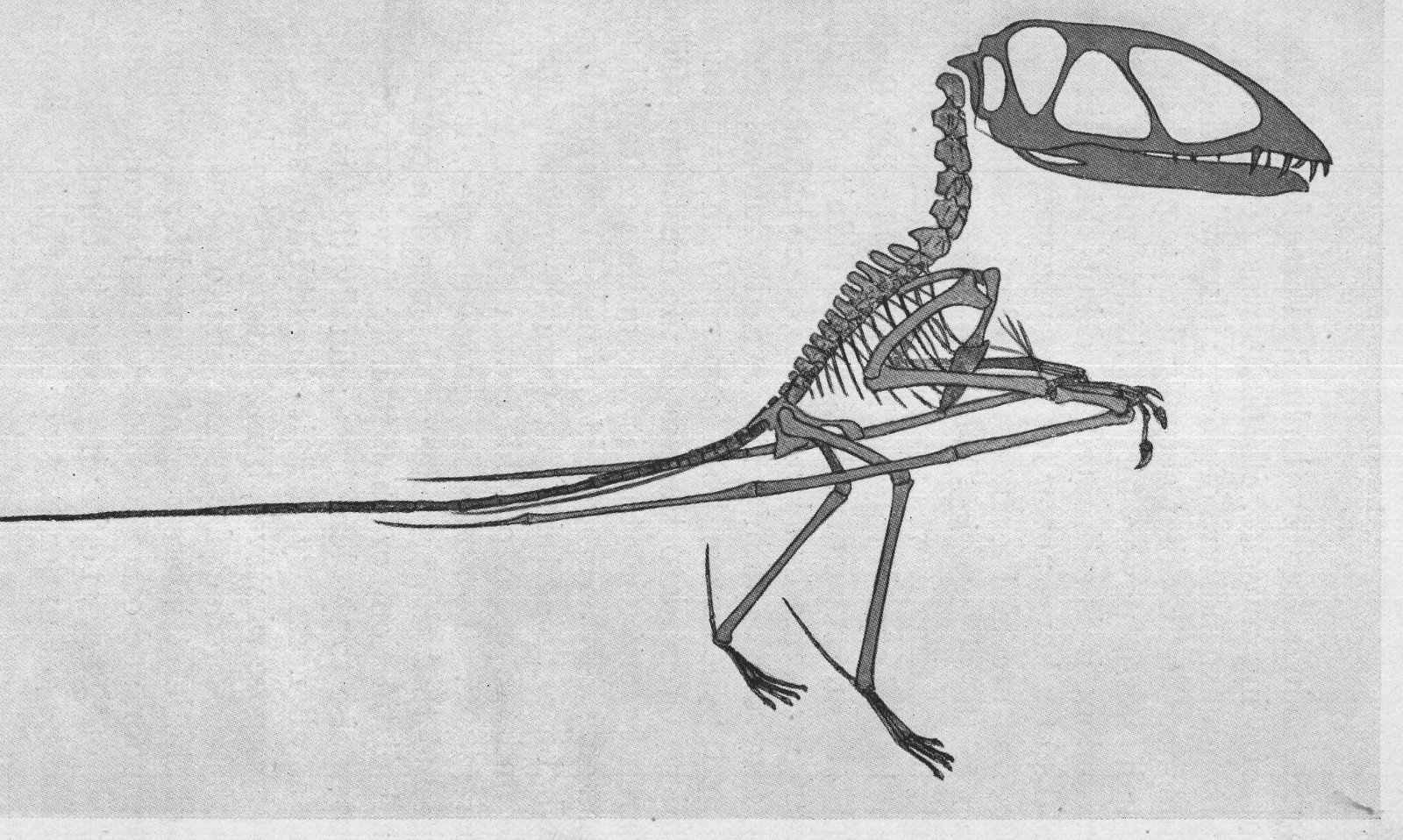
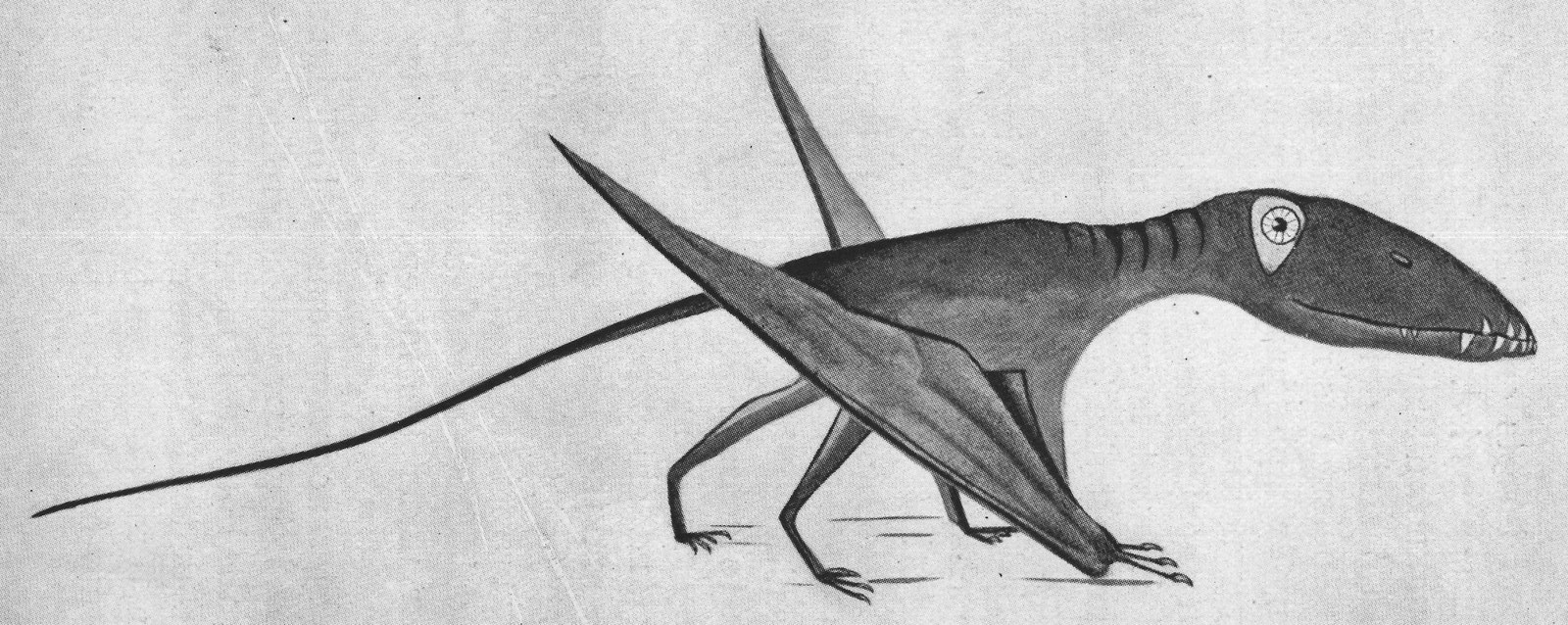
Professor Langley was much interested in Pteranodon because not only was it the greatest flying creature but DIMORPHODON, A LITTLE, LONG-TAILED PTERODACTYL From "Dragons of the Air," by permission of Methuen & Co. Drawn by Miss E. B. Seeley DIMORPHODON As he may have walked when in a hurry. From Seeley's "Dragons of the Air" by permission of Methuen and Co. 75 because, as indicated by the limited area for the attachment of wing muscles, its flight was performed with very small expenditure of power: thus while the model aeroplane, the first that actually flew, required one and one-half horse power for its thirty pounds weight, Pteranodon, it is estimated, used but thirty-six thousandths of a horse power for the same purpose.
One feature of Pteranodon, the extraordinary crest shown in the picture, has been the cause of much argument; for a time it was even a moot question whether or not he had one. Professor Marsh said he did, Professor Williston as vigorously said he didn't, and both were right; some had huge crests, some had none, and why they did or didn't no one really knows. Much ink and paper have been expended in expounding theories in regard to the use of the crest, the writers apparently forgetting that it was quite as often absent as present; furthermore that animals have an unfortunate habit of doing things that are theoretically impossible and are often provided with appendages of no apparent use. To add a few more theories, it is here suggested that the presence or absence of a crest was a sexual distinction, or that it may have served as a counterpoise to the long beak; finally that it does not seem at all necessary that it should have served any useful purpose whatever, being a danger signal that the day of the pterodactyl was drawing to a close.¹
Not the least interesting of the problems concerning Pteranodon and other Pterodactyls is how did he carry himself on land, and having come to earth-or seahow did he get under way again, what did he do with Professor Beecher considers that the development of spines or of superfluous crests and bosses is an indication of deterioration and indicates approaching extinction. those enormous wings? For his joints indicate that these wings could not be folded snugly about the body like those of a bat or a bird; from their very size some other method was necessary and it would seem that he, as well as other flying dragons, walked as shown in the picture with wings pointed upwards.
There have been various speculations as to how the smaller pterodactyls carried themselves and our illustrations show two suggestions as to how they might have walked, on all fours or erect. And Frank Buckland, we think it was he, thought that Pterodactyls might have had almost as varied modes of locomotion as Milton's fiend who With head, hands, wings, or feet, pursues his way And swims, or sinks, or wades, or creeps, or flies.
There is no more reason to suppose that pterodactyls big and little all behaved alike any more than all birds fly, or swim, or run alike.
The albatross, among the modern monarchs of the air, can not rise from the deck of a ship and has great difficulty even in rising from the surface of a calm sea, not infrequently paddling and flapping for a hundred yards or more before clearing the water. On the other hand, the ostrich that can outrun a horse can not fly at all and between these two extremes we have every imaginable condition of flying and running, to say nothing of swimming and jumping.
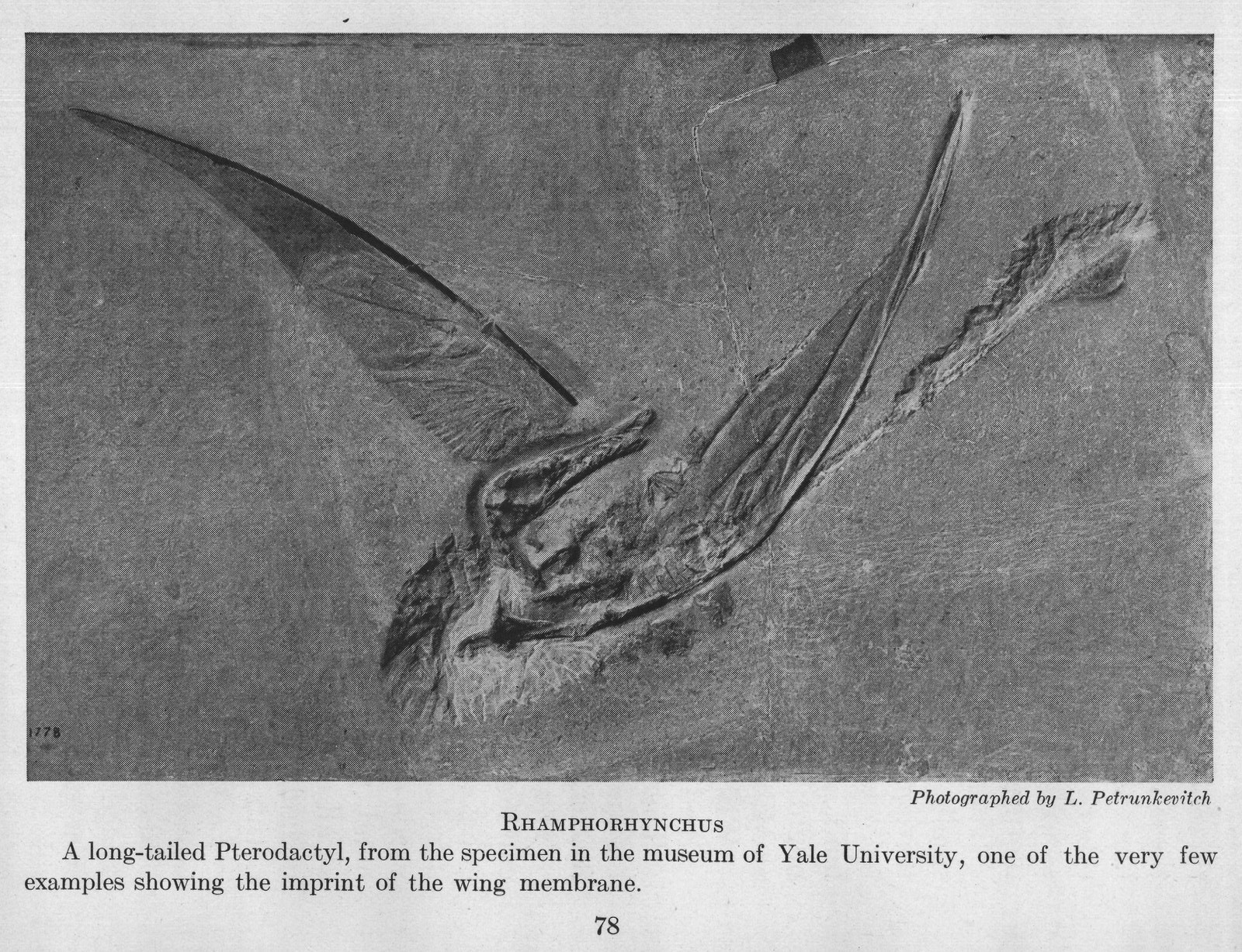
Lastly to repeat an oft propounded query (p. 659 Greatest Flying Creature)-do Pteranodon and the big birds of to-day mark the limit of size that may be attained by flying creatures, do Nature's flying machines stop at a weight of twenty-five or thirty or at the outside forty pounds? To reverse the proposition, is the ostrich big because he doesn't fly or, doesn't he fly because he is big? Photographed by L. Petrunkevitch RHAMPHORHYNCHUS A long-tailed Pterodactyl, from the specimen in the museum of Yale University, one of the very few examples showing the imprint of the wing membrane.
An occasional bold spirit, undeterred by the assertion that feathers could not have been evolved twice, has ventured to suggest that the ostrich never did fly and that he is descended from quite a different ancestor than that from which flying birds are derived.
If nature can put a back fin on a reptile as well as on a porpoise and if it apparently serves no useful purpose in either case, why could she not have developed feathers twice in the course of many million years? It may not be probable but it is surely possible and I for one see no impossibility in ostriches having descended from one group of reptiles and the fan-tailed birds, through Archæopteryx, from another.
REFERENCES The American Museum of Natural History and Yale University Museum each have a fine, mounted skeleton of Pteranodon and Yale University has one of the very few specimens of pterodactyls showing the imprint of the wing membrane. By far the best account of Pterodactyls in general is to be found in Seeley's "Dragons of the Air" in which they are discussed from all points of view. "The Greatest Flying Creature" (Report of the Smithsonian Institution for 1901) gives much information in regard to wing area and other problems of flight. In the "Æronautical Journal' for October, 1914, pages 324- 343, will be found articles by H. B. Hawkins, D. M. S. Watson and G. Howard Short, On the Flight of Pterodactyls and the Wing Adjustments of Pterodactyls in which these subjects are considered at length. BRONTOSAURUS One of the largest of the Amphibious Dinosaurs