Home › The Dinosaurs › The Dinosaurs: Tyrannosaurus
The Dinosaurs: Tyrannosaurus
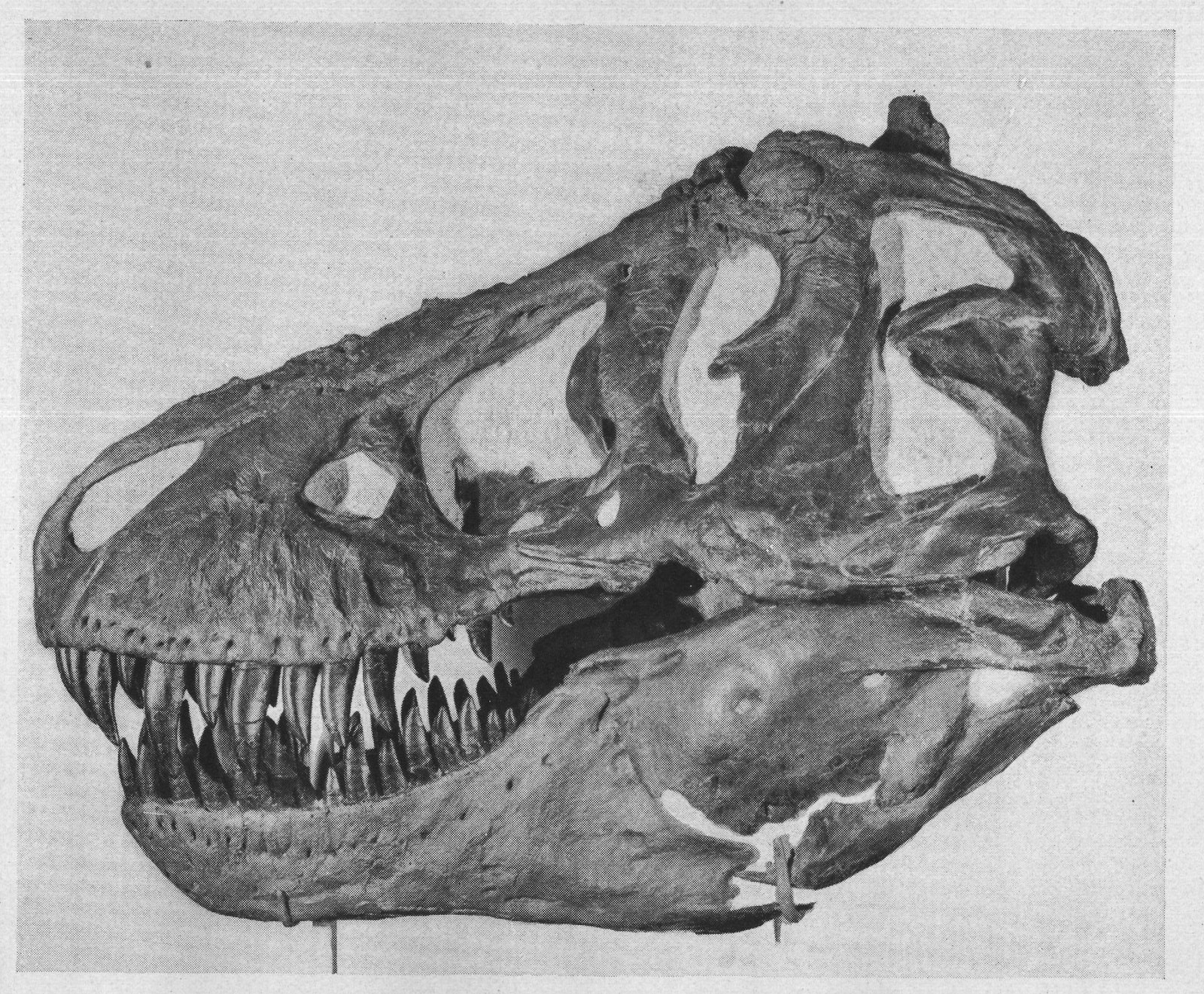
Chief among these is Tyrannosaurus, mightiest of all animals that have walked the face of the earth, reaching to a length of 47 feet, standing 18 to 20 feet high, its powerful legs ending in long, sharp claws and its massive jaws bristling with curved, doubled-edged teeth, three to six inches in length. The creature well deserves the name Tyrannosaurus rex (King of the Tyrant Reptiles) THE SKULL OF THE GREAT CARNIVOROUS DINOSAUR, TYRANNOSAURUS In the American Museum of Natural History bestowed upon him by Professor Osborn, for, apparently nothing could have withstood the attack of this monster beast of prey unless possibly some relative like Triceratops, armed to resist frontal attacks, or that "walking armored citadel," Ankylosaurus, squatting down and striking right and left with club-shaped tail. The existence of this great beast was known from a few leg bones found by Mr. Hatcher before 1890, but these merely hinted at its size and power and it remained for Mr. Barnum Brown to gather the material that made it possible to reconstruct the skeleton, the greatest prize being the huge skull which must really be seen to be appreciated.
Such were some of the strange and mighty animals that once roamed this continent from the valley of the Connecticut, where they literally left their footprints on the sands of time, to the Rocky Mountains, where the ancient lakes and rivers became cemeteries for the entombment of their bones. The labor of the collector has gathered their fossil remains from many a Western canyon, the skill of the preparator has removed them from their stony sepulchres and the study of the anatomist has restored them as they were in life.
REFERENCES
Most of our large museums have on exhibition fine specimens of many Dinosaurs, comprising skulls, limbs, and large portions of their skeletons. The American Museum of Natural History, New York, has by far the largest and finest display, including as it does many unusually complete skeletons and fine skulls: among them are the huge Tyrannosaurus, Brontosaurus, Gorgosaurus, Monoclonius and Struthiomimus. Of special note is the "mummied" Trachodon, showing a great part of the skin of the animal. The first actual skeleton of a Dinosaur to be mounted in this country was the Trachodon at the Yale University Museum, where other striking pieces are also to be seen. The United States National Museum is particularly rich in examples of the great, horned Triceratops, while the Carnegie Museum, Pittsburgh, has the best Diplodocus. The United States National Museum and Yale University have each a mounted skeleton of Stegosaurus. The Field Columbian Museum and the Universities of Wyoming and Colorado have good collections.
The largest single bone of a Dinosaur is the thigh bone of Brachiosaurus in the Field Columbian Museum, this measuring 6 feet 8 inches in length. The height of a complete hind leg of Brontosaurus in the American Museum of Natural History is 10 feet, while a single claw measures 6 by 9 inches. The skeleton of Triceratops in the United States National Museum measures 25 feet from tip of nose to end of tail and is 10 feet 6 inches to the top of the backbone over the hips, this being the highest point. The head is 5 feet 6 inches long in a straight line and 4 feet 3 inches across the frill. There is a skull in the Yale University Museum even larger than this.
Numerous technical articles relating to Dinosaurs are scattered through various scientific journals, notably in the Memoirs and Bulletins of the American Museum of Natural History, where they may be easily found by the student.
If the reader wishes to know more about Dinosaurs, where their remains are found and how they are collected, he will find the information in Handbook No. 5, Dinosaurs, by W. D. Matthew, and also in various articles scattered through the pages of the American Museum Journal, Natural History.
A BIT OF THE SKIN OF TRACHODON Somewhat Reduced. In the American Museum of Natural History.