Home › The Dinosaurs › The Dinosaurs: Brontosaurus
The Dinosaurs: Brontosaurus
The smallest of the Dinosaurs whose acquaintance we have made were little larger than chickens; the largest claim the distinction of being the largest known quadrupeds that have walked the face of the earth, the giants not only of their day, but of all time, before whose huge frames the bones of the Mammoth, that familiar byword for all things great, seem slight. For Brontosaurus, the Thunder Lizard, beneath whose mighty tread the earth shook, and his kindred were from 40 to 70 feet long and 10 to 14 feet high, their thigh bones measuring 5 to 6 feet in length, while some of the vertebræ were 4½ feet high, exceeding in dimensions those of a whale. The group to which Brontosaurus belongs, including Diplodocus and Morosaurus, is distinguished by a large, though rather short, body, very long neck and tail, and, for the size of the animal, a very small head. In fact, the head was so small and, in the case of Diplodocus, so poorly provided with teeth that it must have been quite a task, or a long-continued pleasure, according to the state of its digestive apparatus, for the animal to have eaten its daily meal.
An elephant weighing 5 tons eats 100 pounds of hay and 25 pounds of grain for his day's ration; but, as this food is in a comparatively concentrated form, it would require at least twice this weight of green fodder.
It is a difficult matter to estimate the weight of a live Diplodocus or a Brontosaurus, but it is pretty safe to say that it would not be far from 25 tons, and that one would devour at the very least something over 700 pounds of leaves or twigs or plants each day-more, if the animal felt really hungry.
But here we must, even if reluctantly, curb our imagination a little and consider another point: the coldblooded, sluggish reptiles, as we know them to-day, do not waste their energies in rapid movements, or in keeping the temperature of their bodies above that of the air, and so by no means require the amount of food needed by more active, warm-blooded animals. Alligators, turtles, and snakes will go for weeks, even months, without food, and while this applies more particularly to those that dwell in temperate climes and during their winter hibernation practically suspend the functions of digestion and respiration, it is more or less true of all reptiles. And as there is little reason for supposing that reptiles behaved in the past very differently from what they do in the present, these great Dinosaurs may, after all, not have been gifted with such ravenous appetites as one might fancy. Still, it is dangerous to lay down any hard and fast laws concerning animals, and he who writes about them is continually obliged to qualify his remarks in sporting parlance, to hedge a little, and in the present instance there is some reason, based on the arrangement of vertebræ and ribs, to suppose that the lungs of Dinosaurs were somewhat like those of birds, and that, as a corollary, their blood may have been better aërated and warmer than that of living reptiles. But, to return to the question of food.
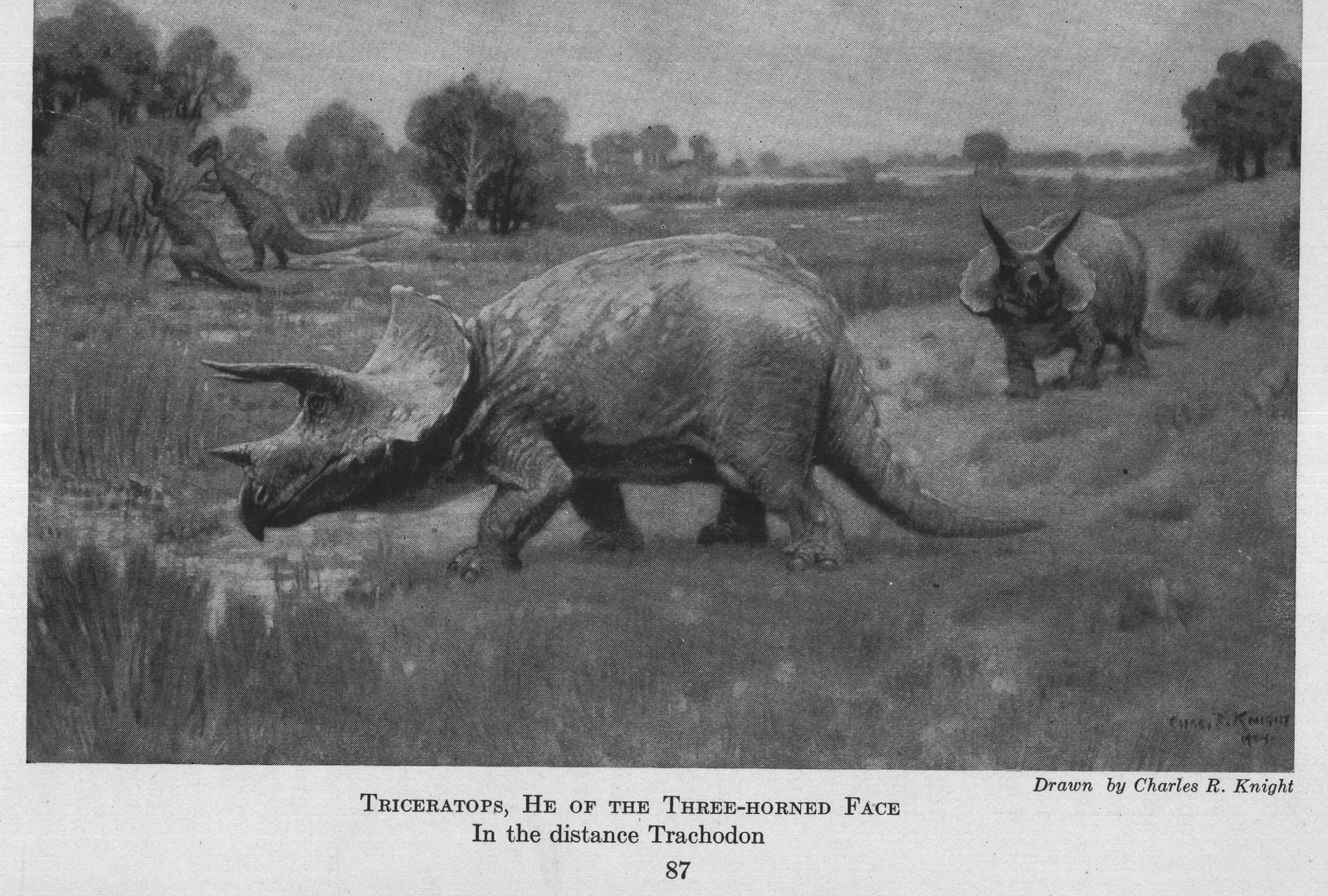
From the peculiar character of the articulations of the limb-bones, it is inferred that these animals were largely aquatic in their habits, and fed on some abundant species of water-plants. One can readily see the TRICERATOPS, HE OF THE THREE-HORNED FACE In the distance Trachodon 87 Drawn by Charles R. Knight advantage of the long neck in browsing off the vegetation on the bottom of shallow lakes, while the animal was submerged, or in rearing the head aloft to scan the surrounding shores for the approach of an enemy. Or, with the tail as a counterpoise, the entire body could be reared out of water and the head be raised some thirty feet in the air.
Triceratops, he of the three-horned face, had a remarkable skull which projected backward over the neck, like a fireman's helmet, or a sunbonnet worn hind side before, while over each eye was a massive horn directed forward, a third, but much smaller horn being sometimes present on the nose. The little "Horned Toad," which isn't a toad at all, is the nearest suggestion we have to-day of Triceratops; but, could he realize the ambition of the frog in the fable and swell himself to the dimensions of an ox, he would even then be but a pigmy compared with his ancient and distant relative.
So far as mere appearance goes he would compare very well, for while so much is said about the strange appearance of the Dinosaurs, it is to be borne in mind that their peculiarities are enhanced by their size, and that there are many lizards of to-day that lack only stature to be even more bizarre; and, for example, were the Australian Moloch but big enough, he could give even Stegosaurus "points" in more ways than one.
Standing before the skull of Triceratops, looking him squarely in the face, one notices in front of each eye a thick guard of projecting bone, and while this must have interfered with vision directly ahead it must have also furnished protection for the eye. So long as Triceratops faced an adversary he must have been practically invulnerable, but as he was the largest animal of his time, excepting always Tyrannosaurus, upward of twenty-five feet in length, it is probable that his combats were mainly with those of this own kind and the subject of dispute some fair female upon whom two rival suitors had cast covetous eyes. What a sight it would have been to have seen two of these big brutes in mortal combat as they charged upon each other with all the impetus to be derived from ten tons of infuriate flesh! We may picture to ourselves horn clashing upon horn, or glancing from each bony shield until some skilful stroke or unlucky slip placed one combatant at the mercy of the other, and he went down before the blows of his adversary "as falls on Mount Alvernus a thundersmitten oak."
A pair of Triceratops horns in the National Museum bears witness to such encounters, for one is broken midway between tip and base; and that it was broken during life is evident from the fact that the stump is healed and rounded over, while the size of the horns shows that their owner reached a ripe old age.
For, unlike man and the higher vertebrates, reptiles and fishes do not have a maximum standard of size which is soon reached and rarely exceeded, but continue to grow throughout life, so that the size of a turtle, a crocodile, or a Dinosaur tells something of the duration of its life.
Before quitting Triceratops let us glance for a moment at its skeleton. Now among other things a skeleton is the solution of a problem in mechanics, and in Triceratops the head so dominates the rest of the structure that one might almost imagine the skull was made first and the body adjusted to it. The great head seems made not only for offence and defence; the spreading frill serves for the attachment of muscles to sustain the weight of the sku'l, while the work of the muscles is made easier by the fact that the frill reaches so far back of the junction of head with neck as to largely counterbalance the weight of the face and jaws. When we restored the skull of this animal it was found that the centre of gravity lay back of the eye. Several of the bones of the neck are united in one mass to furnish a firm attachment for the muscles that support and move the skull, but as the movements of the neck are already restricted by the overhanging frill, this loss of motion is no additional disadvantage.
To support all this weight of skull and body requires very massive legs, and as the fore legs are very short, this enables Triceratops to browse comfortably from the ground by merely lowering the front of the head. These forms we have been considering were the giants of the group, but a commoner species, Trachodon, though less in bulk than those just mentioned, was still of goodly proportions, for, as he stalked about, the top of his head was twelve feet from the ground.
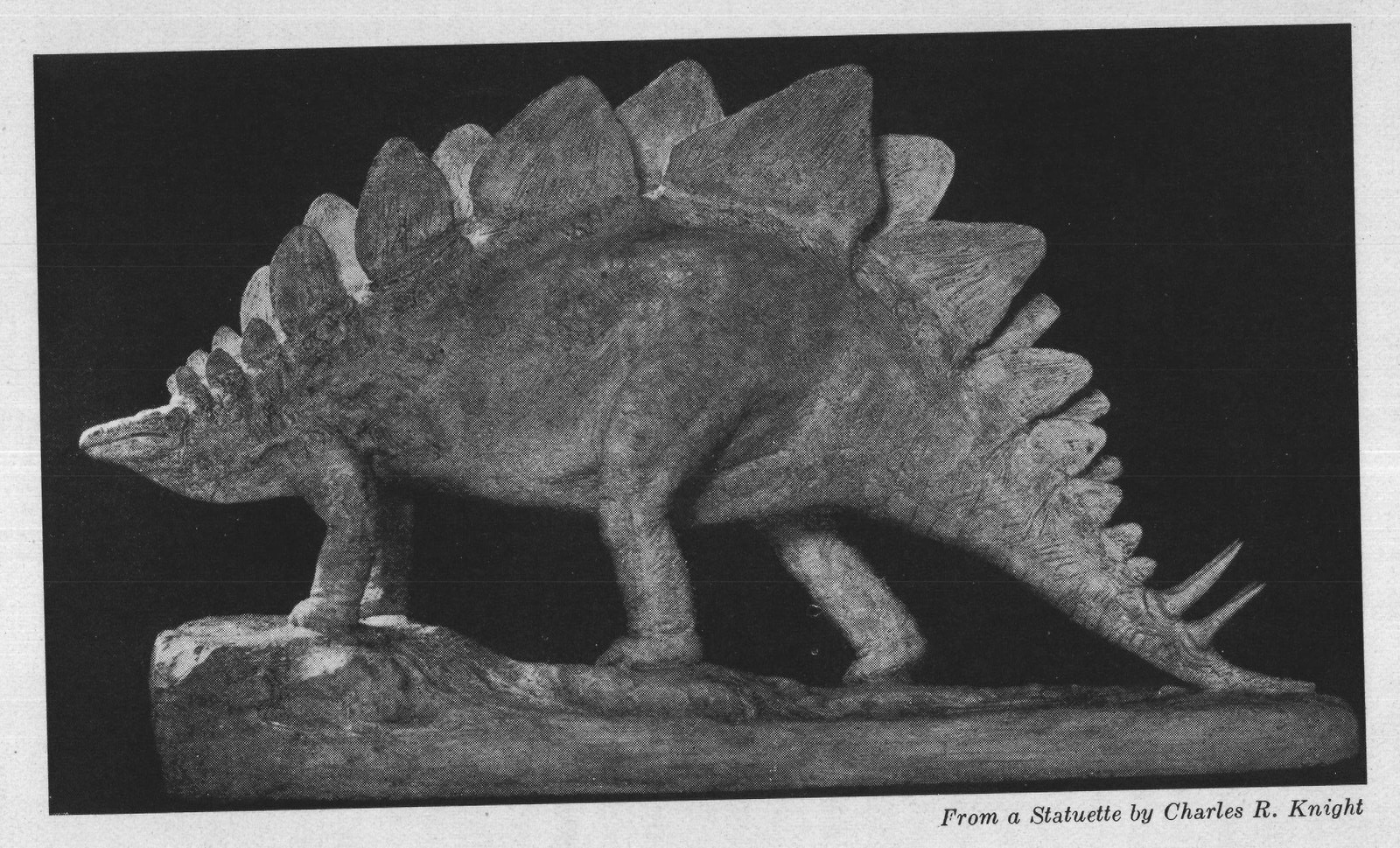
Trachodon and his kin seem to have been abundant, for they have a wide distribution, and many specimens, some almost perfect, have been discovered in this country and abroad. We might say that so far as North America was concerned they were during the Cretaceous period what deer are to-day, the most common and characteristic of herbivores. No less than twenty-nine Iguanodons, a European relative of Trachodon, were found in one spot in mining for coal at Bernissart, Belgium. Here, during long years of Cretaceous time, a river slowly cut its way through the coalbearing strata to a depth of 750 feet, a depth almost twice as great as the deepest part of the gorge of Niagara, and then, this being accomplished, began the work of filling up the valley it had excavated. It was then a sluggish stream with marshy borders, a stream subject to frequent floods, when the water, turbid with STEGOSAURUS An Armored Dinosaur of the Jurassic.
From a Statuette by Charles R. Knight mud and laden with sand, overflowed its banks, leaving them, as the waters subsided, covered thickly with mud. Here, amidst the luxuriant vegetation of a semitropical climate, lived and died the Iguanodons, and here the pick of the miner rescued them from their long entombment to form part of the treasures of the museum at Brussels. Like other reptiles, living and extinct, Trachodon was continually renewing his teeth, so that as fast as one tooth was worn out it was replaced by another, a point wherein Trachodon had a decided advantage over ourselves. On the other hand, as there was a reserve supply of something like 400 teeth in the lower jaw alone, what an opportunity for the toothache!
And then we have a multitude of lesser Dinosaurs, including the active, predatory species with sharp claws and double-edged teeth. Megalosaurus, the first of the Dinosaurs to be really known, was one of these carnivorous species, and from our West comes a near relative, Ceratosaurus, the nose-horned lizard, a queer beast with tiny fore legs, powerful, sharp-clawed hind feet, and well-armed jaws. A most formidable foe he seems, the more that the hollow bones speak of active movements, and Professor Cope pictured him or a near relative, vigorously engaged in combat with his fellows, or preying upon the huge but helpless herbivores of the marshes, leaping, biting, and tearing his enemy to pieces with tooth and claw.
Professor Osborn, on the other hand, is inclined to consider him as a reptilian hyena, feeding upon carrion, although one can but feel that such an armament is not entirely in the interests of peace.
Last, but no means least, are the Stegosaurs, or plated lizards, for not only were they beasts of goodly size, but they were among the most singular of all known animals, singular even for Dinosaurs. They had diminutive heads, small fore legs, long tails armed on either side near the tip, with two pairs of large spines, while from these spines to the neck ran series of large, but thin, and sharp-edged plates standing on edge, so that their backs looked like the bottom of a boat provided with a number of little centreboards. These plates were arranged in two rows down the back, but what is most extraordinary is that they were not disposed in pairs, but alternately, a method not known to occur in any other animal.
The largest of these plates were two feet in height and length, and not more than an inch thick, except at the base, where they were enlarged and roughened to give a firm hold to the thick skin in which they were imbedded. Be it remembered, too, that these plates and spines were doubtless covered with horn, so that they were even longer in life than as we now see them. The tail spines varied in length, according to the species, from eight or nine inches to nearly three feet, and some of them have a diameter of six inches at the base. They were swung by a tail eight to ten feet long, and as a visitor was heard to remark, one wouldn't like to be about such an animal in fly time.
The discoveries of the past twenty years have brought to light many new dinosaurs, as well as material that has enabled us to complete our knowledge of others that were imperfectly known.