Home › Impressions of the Past › Impressions of the Past: Deane
Impressions of the Past: Deane
The now famous tracks in the "brown stone" of the Connecticut Valley seem to have first been seen by Pliny Moody in 1802, when he ploughed up a specimen on his farm, showing small imprints, which later on were popularly called the tracks of Noah's raven. The discovery passed without remark until in 1835 the footprints came under the observation of Dr. James Deane, who, in turn, called Professor Hitchcock's attention to them. The latter at once began a systematic study of these impressions, publishing his first account in 1836 and continuing his researches for many years, in the course of which he brought together the fine collection in Amherst College. At that time Dinosaurs were practically unknown, and it is not to be wondered at that these three-toed tracks, great and small, were almost universally believed to be those of birds. So it is greatly to the credit of Dr. Deane, who also studied these footprints, that he was led to suspect that they might have been made by other animals.
This suspicion was partly caused by the occasional association of four and five-toed prints with the threetoed impressions, and partly by the rare occurrence of imprints showing the texture of the sole of the foot, which was quite different from that of any known bird. In the light of our present knowledge we are able to read many things in these tracks that were formerly more or less obscure, and to see in them a complete verification of Dr. Deane's suspicion that they were not made by birds. We see clearly that the long tracks called Anomӕpus, with their accompanying short fore feet, mark where some Dinosaur squatted down to rest or progressed slowly on all-fours, as does the kangaroo when feeding quietly; and we interpret the curious. heart-shaped depression sometimes seen back of the feet, not as the mark of a stubby tail, but as made by the ends of the slender pubes, bones that help form the hipjoints. Then, too, the mark of the inner, or short first, toe, is often very evident, although it was a long time before the bones of this toe were actually found, and many of the Dinosaurs now known to have four toes were supposed to have but three.
It seems strange, and it is strange, that while so many hundreds of tracks should have been found in the limited area exposed to view, so few bones have been found our knowledge of the veritable animals that
It is to be noted that a leaping kangaroo touches the ground neither with his heel nor his tail, but that between jumps he rests momentarily on his toes only; hence impressions made by any creature that jumped like a kangaroo would be very short. made the tracks being a blank. A few examples have, it is true, been found, but these are only a tithe of those known to have existed; while of the great animals that strode along the shore, leaving tracks fifteen inches long and a yard apart pressed deeply into the hard sand, not a bone remains. The probability is that the strata containing their bones lie out to sea, whither their bodies were carried by tides and currents, and that we may never see more than the few fragments that were scattered along the sea-side.
That part of the Valley of the Connecticut wherein the footprints are found was either part of a river bed or of a long, narrow estuary running southward from Turner's Falls, Mass., where the tracks are most abundant and most clear. The topography was such that this river, or estuary, was subject to sudden and great fluctuations of the water-level, large tracts of shore being now left dry to bake in the sun, and again covered by turbid water which deposited on the bottom a layer of mud. Over and over again this happened, just as today it occurs along such streams as the Potomac, forming layer upon layer of what is now stone, sometimes the lapse of time between the deposits being so short that the tracks of the big Dinosaurs extend through several sheets of stone; while again there was a period of drouth when the shore became so dry and firm as to retain but a single shallow impression.
Something of the wealth of animal life that roamed about this estuary may be gathered from the number of different footprints recorded on the sands, and these are so many and so varied that Professor Hitchcock in two extensive reports enumerated over 150 species, representing various groups of animals. One little point must, however, be borne in mind, that mere size is no sure indication of differences in dealing with reptiles, for these long-lived creatures grow almost continuously throughout life, so that one animal even may have left his footprints over and over in assorted sizes from one end of the valley to the other.
The slab shown on the following page is a remarkably fine example of these Connecticut River footprints; it shows in relief forty-eight tracks of the animal originally called Brontozoum sillimanium and six of a lesser species. It was quarried near Middletown, in 1778, and for sixty years did duty as a flagstone, fortunately with the face downwards. When taken up for repairs the tracks were discovered, and later on the slab, which measures three by five feet, was transferred to the museum of Amherst College.
There is an interesting parallel between the history of footprints in England and America, for they were noticed at about the same time, 1830, in both countries; in each case the tracks were in rocks of Triassic age, and, in both instances, the animals that made them have never been found. In England, however, the tracks first found were those ascribed to tortoises, though a little later Dinosaur footprints were discovered in the same locality. Oddly enough these numerous tracks all run one way, from west to east, as if the animals were migrating, or were pursuing some well-known and customary route to their feeding grounds.
For some reason Triassic rocks are particularly rich in footprints; for from strata of this same age in the Rhine Valley come those curious examples so like the mark of a stubby hand that Dr. Kaup christened the beast supposed to have made them Cheirotherium, beast with a hand, suggesting that they had been made by some gigantic opossum. As the tracks measure five by eight inches, it would have been rather a large specimen, but the mammals had not then arisen, and it is generally believed that the impressions were made by huge (for their kind) salamander-like creatures, known as labyrinthodonts, whose remains are found in the same strata. Footprints may aid greatly in determining the attitude assumed by extinct animals, and in this way they have been of great service in furnishing proof that many of the Dinosaurs walked erect. The impressions on the sands of the old Connecticut estuary may be said to show this very plainly, but in England and Belgium is evidence still more conclusive, in the shape of tracks ascribed to the Iguanodon. These were made on soft soil into which the feet sank much more deeply than in the Connecticut sands, and the casts made in the natural moulds show the impression of toes very clearly. If the animals had walked flat-footed, as we do, the prints of the toes would have been followed by a long heel mark, but such is not the case; there are the sharply defined marks of the toes and nothing more, showing plainly that the Iguanodons walked, like birds, on the toes alone. More than this, had these Dinosaurs dragged their tails there would have been a continuous furrow between the footprints; but nothing of this sort is to be found; on the contrary, a fine series of tracks, uncovered at Hastings, England, made by several individuals and running for seventy-five feet, shows footprints only. Hence it may be fairly concluded that these great creatures carried their tails clear of the ground, as shown in the pictures of Trachodon, the weight of the tail counterbalancing that of the body. Where crocodilians or some of the short-limbed Dinosaurs have crept along there is, as we should expect, a continuous furrow between the imprints of the feet. This is what footprints tell us when their message is read aright; when improperly translated they only add to the enormous bulk of our ignorance.
Some years ago we were treated to accounts of wonderful footprints in the rock of the prison-yard at Carson City, Nev., which, according to the papers, not only showed that men existed at a much earlier period than the scientific supposed, but that they were men of giant stature. This was clearly demonstrated by the footprints, for they were such as might have been made by huge moccasined feet, and this was all that was necessary for the conclusion that they were made by just such feet. For it is a curious fact that the majority of mankind seem to prefer any explanation other than the most simple and natural, particularly in the case of fossils, and are always looking for a primitive race of gigantic men.
Bones of the Mastodon and Mammoth have again and again been eagerly accepted as those of giants; a salamander was brought forward as evidence of the deluge (homo diluvii testis); ammonites and their allies pose as fossil snakes, and the "petrified man" flourishes perennially. However, in this case the prints were recognized by naturalists as having most probably been made by some great ground sloth, such as the Mylodon or Morotherium, these animals, though belonging to a group whose headquarters were in Patagonia, having extended their range as far north as Oregon. That the tracks seemed to have been made by a biped, rather than a quadruped, was due to the fact that the prints of the hind feet fell upon and obliterated the marks of the fore. Still, a little observation showed that here and there prints of the fore feet were to be seen, and on one spot were indications of a struggle between two of the big beasts. The mud, or rather the stone that had been mud, bears the imprints of opposing feet, one set deeper at the toes, the other at the heels, as if one animal had pushed and the other resisted. In the rock, too, are broad depressions bearing the marks of coarse hair, where one creature had apparently sat on its haunches in order to use its fore limbs to the best advantage. Other footprints there are in this prison-yard; the great round "spoor" of the mammoth, the hoofs of a deer, and the paws of a wolf (?), indicating that hereabout was some pool where all these creatures came to drink. More than this, we learn that when these prints were made, or shortly after, a strong wind blew from the southeast, for on that face of the ridges bounding the margin of each big footprint, we find sand that lodged against the squeezed-up mud and stuck there to serve as a perpetual record of the direction of the wind. REFERENCES
Almost every museum has some specimen of the Connecticut Valley footprints, but the largest and finest collections are in the museums of Amherst College, Mass., and Yale University, although, owing to lack of a Museum building, none of the Yale specimens are now on exhibition. The collection at Amherst comprises most of the types described by Professor E. Hitchcock in his "Ichnology of New England," a work in two fully illustrated quarto volumes. Other footprints are described and figured by Dr. J. Deane in "Ichnographs from the Sandstone of the Connecticut River." They have been carefully re-studied by Dr. R. S. Lull who has gathered much new information in regard to the animals represented. The results of his studies are recorded in a book entitled "Triassic Life of the Connecticut Valley," published by the State of Connecticut.
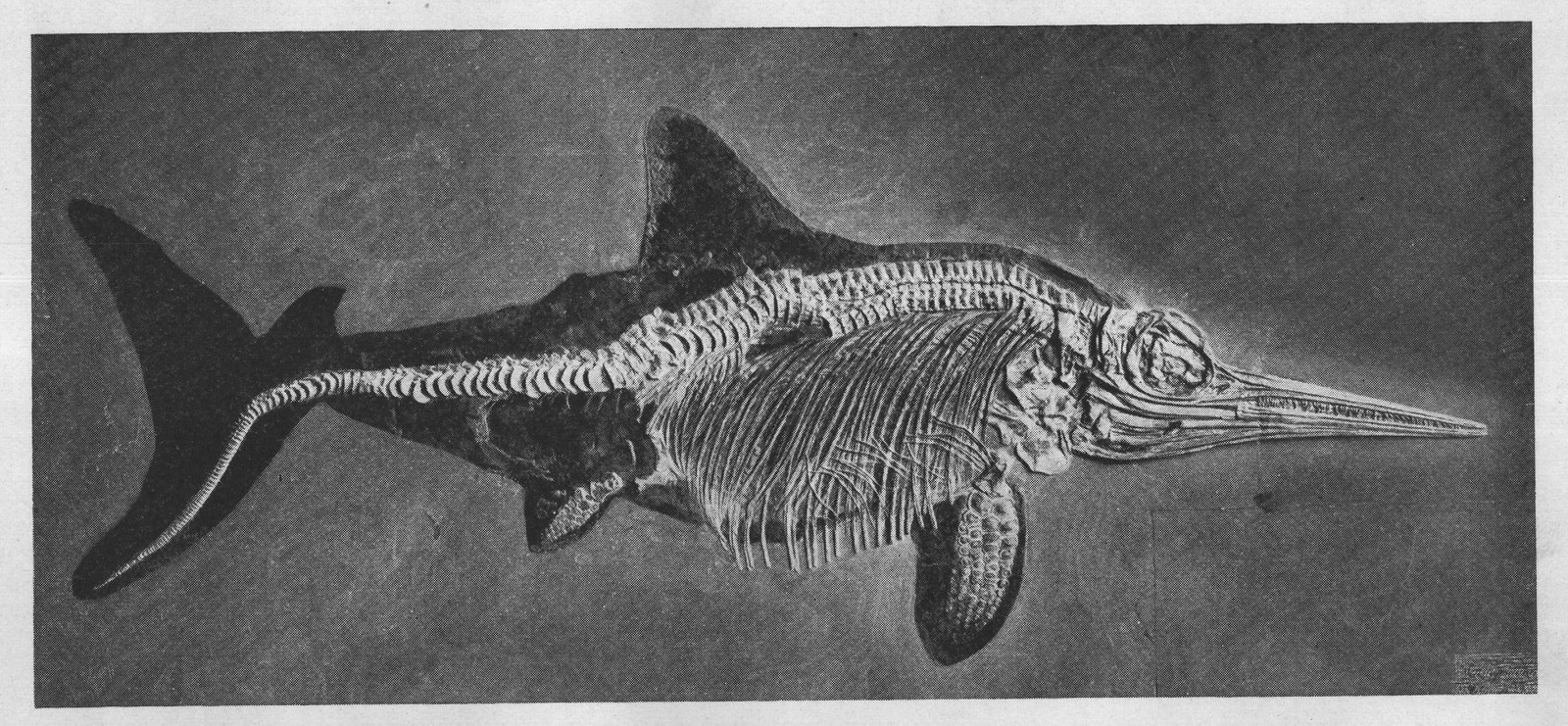
The Track of a Three-toed Dinosaur AN ICHTHYOSAUR OR SEA LIZARD From a specimen in the American Museum of Natural History. 32