Home › The Mastodon › The Mastodon: Warren
The Mastodon: Warren
There are at least a dozen mounted skeletons of the Mastodon in the United States, and the writer trusts he may be pardoned for mentioning only those which are most accessible. These are in the American Museum of Natural History, New York, which now possesses the famous and practically perfect Warren Mastodon; the Brooklyn Museum; the State Museum, Albany, N. Y.; U. S. National Museum, Washington, D. C.; Field Columbian Museum, Chicago; Carnegie Museum, Pittsburg; Museum of Comparative Zoology, Cambridge, Mass.
The heaviest pair of tusks is in the possession of T. O. Tuttle, Seneca, Mich., and they are nine and one-half inches in diameter, and a little over eight feet long; very few tusks, however, reach eight inches in diameter. The thigh-bone of an old male mastodon measures from forty-five to forty-six and one-half inches long, the humerus from thirty-five to forty inches. The height of the mounted skeleton is of little value as an indication of size, since it depends so much upon the manner in which the skeleton is mounted. The grinders of the mastodon have three cross ridges, save the last, which has four, and a final elevation, or heel. This does not apply to the teeth of very young animals. The presence or absence of the last grinder will show whether or not the animal is of full age and size, while the amount of wear indicates the comparative age of the specimen.
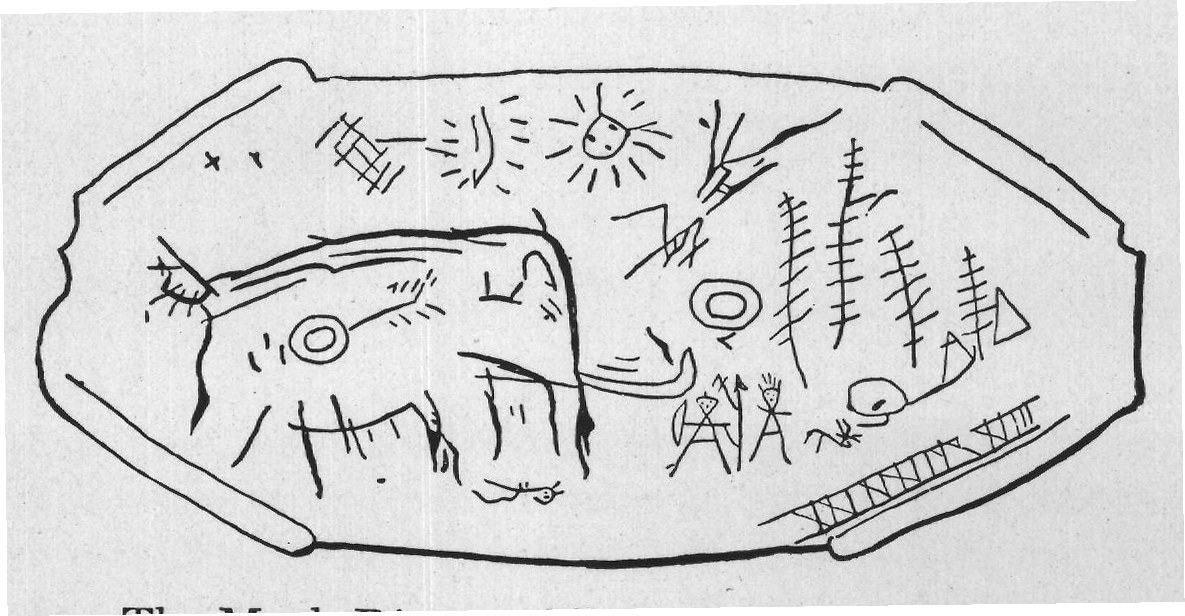
The skeleton of the "Warren Mastodon" is described at length by Dr. J. C. Warren, in a quarto volume entitled "Mastodon Giganteus." There is much information in a little book by J. P. MacLean, "Mastodon, Mammoth, and Man," but the reader must not accept all its statements unhesitatingly. The first volume, 1887, of the New Scribner's Magazine contains an article on "American Elephant Myths," by Professor W. B. Scott, but he is under an erroneous impression regarding the size of the mastodon, and photographs of the Maya carvings show that their resemblance to elephants has been exaggerated in the wood cuts. The story of the Lenape Stone is told at length by H. C. Mercer in "The Lenape Stone, or the Indian and the Mammoth."
The Much Discussed Lenape Stone, Reduced.
WHY DO ANIMALS BECOME EXTINCT? "And Sultan after Sultan with his Pomp Abode his destined Hour and went his way."
It is often asked "why do animals become extinct?" but the question is one to which it is impossible to give a comprehensive and satisfactory reply; this chapter does not pretend to do so, merely to present a few aspects of this complicated, many-sided problem.
In very many cases it may be said that actual extermination has not taken place, but that in the course of evolution one species has passed into another; species may have been lost, but the race, or phylum endures, just as in the growth of a tree, the twigs and branches of the sapling disappear, while the tree, as a whole, grows onward and upward. This is what we see in the horse, which is the living representative of an unbroken line reaching back to the little Eocene Eohippus. So in a general way it may be said that much of what at the first glance we might term extinction is really the replacement of one set of animals by another better adapted to surrounding conditions.
Again, there are many cases of animals, and particularly of large animals, so peculiar in their make up, so very obviously adapted to their own special surroundings that it requires little imagination to see that it would have been a difficult matter for them to have responded to even a slight change in the world about them. Such great and necessarily sluggish brutes as Brontosaurus and Diplodocus, with their tons of flesh, small heads, and feeble teeth, were obviously reared in easy circumstances, and unfitted to succeed in any strenuous struggle for existence. Stegosaurus, with his bizarre array of plates and spines, and huge-headed Triceratops, had evidently carried specialization to an extreme, while in turn the carnivorous forms must have required an abundant supply of slow and easily captured prey.
Coming down to a more recent epoch, when the big Titanotheres flourished, it is easy to see from a glance at their large, simple teeth that these beasts needed an ample provision of coarse vegetation, and as they seem never to have spread far beyond their birthplace, climatic change, modifying even a comparatively limited area, would suffice to sweep them out of existence. To use the epitaph proposed by Professor Marsh for the tombstone of one of the Dinosaurs, many a beast might say, "I, and my race perished of over specialization." To revert to the horse it will be remembered that this very fate is believed to have overtaken those almost horses the European Hippotheres; they reached a point where no further progress was possible, and fell by the wayside.
There is, however, still another class of cases where species, families, orders, even, seem to have passed out of existence without sufficient cause. Those great marine reptiles, the Ichthyosaurs, of Europe, the Plesiosaurs and Mosasaurs, of our own continent, seem to have been just as well adapted to an aquatic life as the whales, and even better than the seals, and we can see no reason why Columbus should not have found these creatures still disporting themselves in the Gulf of Mexico. The best we can do is to fall back on an unknown "law of progress," and say that the trend of life is toward the replacement of large, lower animals by those smaller and intellectually higher.
But why there should be an allotted course to any group of animals, why some species come to an end when they are seemingly as well fitted to endure as others now WHY DO ANIMALS BECOME EXTINCT? living, we do not know, and if we say that a time comes when the germ-plasm is incapable of further subdivision, we merely express our ignorance in an unnecessary number of words. The mammoth and mastodon have already been cited as instances of animals that have unaccountably become extinct, and these examples are chosen from among many on account of their striking nature. The great ground sloths, the Mylodons, Megatheres, and their allies, are another case in point. At one period or another they reached from Oregon to Virginia, Florida, and Patagonia, though it is not claimed that they covered all this area at one time. And, while it may be freely admitted that in some portions of their range they may have been extirpated by a change in food-supply, due in turn to a change in climate, it seems preposterous to claim that there was not at all times, somewhere in this vast expanse of territory, a climate mild enough and a food-supply large enough for the support of even these huge, sluggish creatures. We may evoke the aid of primitive man to account for the disappearance of this race of giants, and we know that the two were coeval in Patagonia, where the sloths seem to have played the rôle of domesticated animals, but again it seems incredible that early man, with his flint-tipped spears and arrows, should have been able to slay even such slow beasts as these to the very last individual.
Of course, in modern times man has directly exterminated many animals, while by the introduction of dogs, cats, pigs, and goats he has indirectly not only thinned the ranks of animals, but destroyed plant life on an enormous scale. But in the past man's capabilities for harm were infinitely less than now, while of course the greatest changes took place before man even existed, so that, while he is responsible for the great changes that have taken place in the world's flora and fauna during recent times, his influence, as a whole, has been insignificant. Thus, while man exterminated the great northern sea-cow, Rytina, and Pallas's cormorant on the Commander Islands, these animals were already restricted to this circumscribed area¹ by natural causes, so that man but finished what nature had begun. The extermination of the great auk in European waters was somewhat similar. There is, however, this unfortunate difference between extermination wrought by man and that brought about by natural causes: the extermination of species by nature is ordinarily slow, and the place of one is taken by another, while the destruction wrought by man is rapid, and the gaps he creates remain unfilled.
Not so very long ago it was customary to account for changes in the past life of the globe by earthquakes, volcanic outbursts, or cataclysms of such appalling magnitude that the whole face of nature was changed, and entire races of living beings swept out of existence at once. But it is now generally conceded that while castatrophes have occurred, yet, vast as they may have been, their effects were comparatively local, and, while the life of a limited region may have been ruthlessly blotted out, life as a whole was but little affected. The eruption of Krakatoa shook the earth to its centre and was felt for hundreds of miles around, yet, while it caused the death of thousands of living beings, it remains to be shown that it produced any effect on the life of the region taken in its entirety.
Changes in the life of the globe have been in the main slow and gradual, and in response to correspondingly It is possible that the cormorant may always have been confined to this one spot, but this is probably not the case with the sea-cow. WHY DO ANIMALS BECOME EXTINCT? slow changes in the level of portions of the earth's crust, with their far-reaching effects on temperature, climate, and vegetation. Animals that were what is termed plastic kept pace with the altering conditions about them and became modified, too, while those that could not adapt themselves to their surroundings died out.