Home › What I Saw in an Ant's Nest › What I Saw in an Ant's Nest
What I Saw in an Ant's Nest
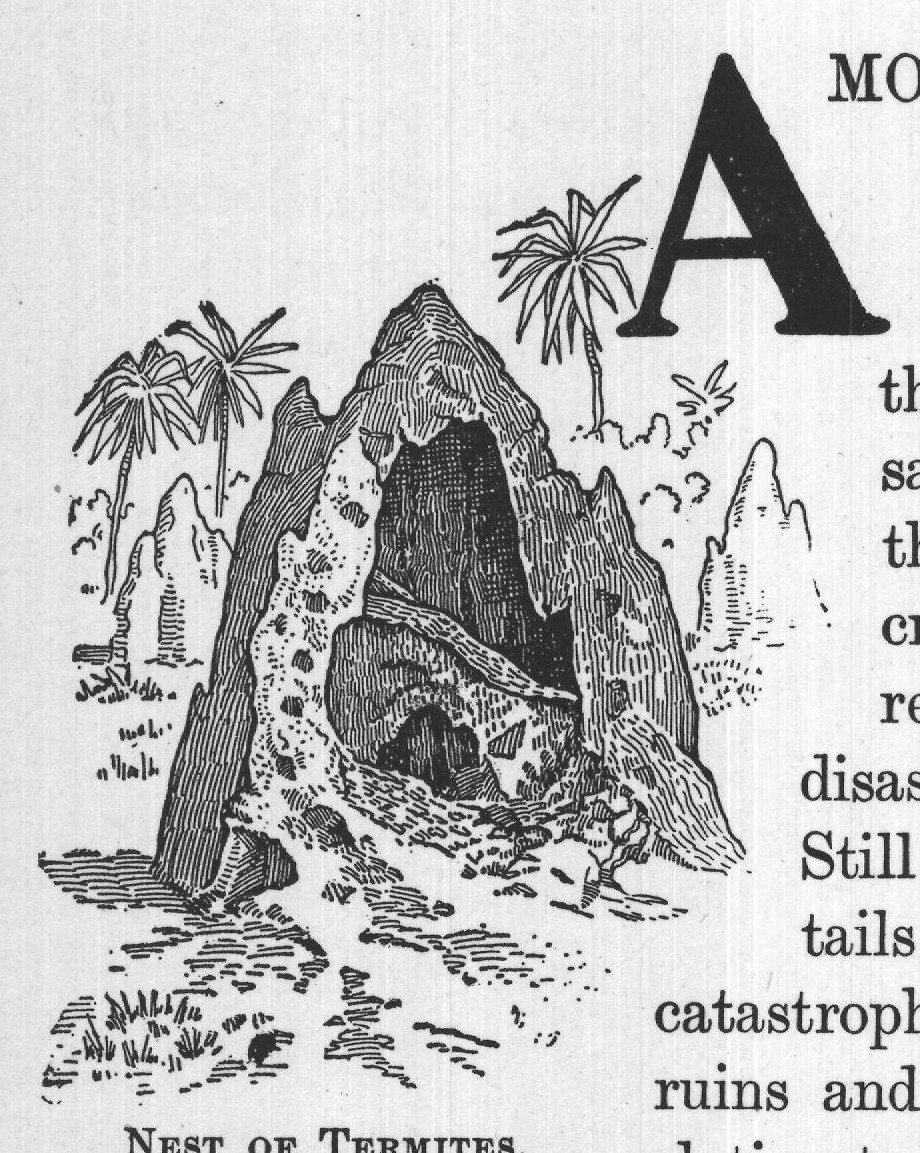
(FROM FACTS AND FICTIONS OF ZOÖLOGY.) BY ANDREW WILSON. mah NEST OF TERMITES.
MONGST those spectacles and incidents in human existence which remain fixed on the memory of the spectator from their sad or unwonted nature, that of a panic-stricken crowd, gathered by the report of some national disaster, stands pre-eminent.
Still more terrible in its details is the history of some catastrophe which has laid a city in ruins and wrought death and desolation to thousands of the inhabitants. A deadly epidemic, or fatal plague, searing a nation with its dread, mysterious power, is a calamity appalling enough; but the spectacle of a city overthrown at one fell swoop by the earthquake shock may perhaps rank foremost amongst the untoward incidents which environ the sphere of man. A certain event, occurring during a recent holiday by the sea, tended forcibly to impress upon the mind that the great catastrophes of life are not limited to humanity's special sphere, and that in lower life panic and alarm seem to exercise no small influence, as in man's estate; whilst the incident referred to also afforded food for reflection on topics not far removed from some weighty matters in the history of man's own nature and constitution. In this latter view, it is especially hoped the observations of a brief period of leisure-time may not be without their due meed of interest. The chance removal from its secure site, of a large stone placed in close proximity to the sea-beach, where the bliss of idleness was being fully exemplified by a small party of holiday-makers, proved, on close examination, to be the cause of a literal revolution in lower life. Imagine a city to be totally unroofed, try to conceive of the sudden downfall of houses and buildings, and the consequent panic of the inhabitants, and you may obtain an idea of the disturbance on simple procedure effected in the peaceable, well-ordered colony of ants which had located themselves securely beneath the friendly shelter of the stone. The scene presented to view was one of the most curious and interesting which could engage the attention of an observer in any field of inquiry, and the occurrence certainly banished the idle mood of the time, and lent a zest to the subsequent hours of our holiday. Running hither and thither in wild confusion were the denizens of this underground colony; their six little legs carrying their curious globular bodies backward and forward over the disturbed area from which the What I Saw in an Ant's Nest stone had been removed. At first the movements of the ants were extremely erratic and purposeless. Panic and alarm appeared to be the order of the day during the few minutes which elapsed after removal of the stone. But soon the eye could discern movements of purposive kind on the part of the alarmed residents. There was "racing and chasing" in all directions: but the ants which had at first radiated from the centre of disturbance, as if on some definite quest, soon returned thereunto, and continued to advance and retire from the field of action with tolerable regularity. Not less than sixty or seventy ants appeared to be engaged in this labor of scouring the country around. The object of their repeated journeys in all directions was soon discovered. They were the self-appointed scouts, engaged in the work of reconnoitring. Such at least is a fair interpretation of the acts of the ants, and such also is the conclusion borne out by the subsequent course of events. For, after the scouts had spent a considerable time in their rapid journeys to the environments of the nest, a new set of ants appeared upon the scene, destined to perform a highly important series of labors. The scouts continued their journeyings, and gave one the idea of a set of fussy individuals who were superintending, or even bullying, their new neighbors, who appeared from amongst the ruins and débris of the ant city, carrying in their mouths certain oval bodies of a dirty-white color, and measuring each about one-third of an inch in length. Each of these bodies closely resembled a grain of corn in shape, size, and appearance. The spectacle of these small insects carrying off these bodies in their powerful jaws impressed one forcibly with the idea that, relatively to its size, an ant is an herculean insect.
Occasionally there might be seen certain rather ludicrous incidents connected with the removal of the objects in question. One ant might be witnessed in the endeavor to hoist the oval body it was carrying in its mouth over some obstacle lying in the path, and the staggering gait of the insect seemed very accurately to mimic the similar disposition of a human porter struggling under a burdensome load. Another ant, carrying the oval body before it, would arrive at a steep incline formed of loose sand, and presenting a treacherous surface even to the light feet of the insect. The efforts of the ant to carry the body upward being found to be fruitless, the insect might be seen to whirl about with great rapidity of action, and ascend the hill backward, pulling the body after it, instead of pushing it as before.
Another instance might be witnessed in which an ant which had literally come to grief with its burden would be assisted by a kindly neighbor; but it was no uncommon sight to behold in the excessive eagerness of the insects an actual means of defeating the object they had in view, since two ants would in some cases seize the same burden, and then came the tug of war. One pulled one way whilst the other tugged in the opposite direction; and the observer could almost have supposed that the burden itself might have been parted in twain by the treatment to which it was subjected the incident affording a new application of the remark that a surfeit of zeal is destructive of the best intentions. The nature of the bodies which the ants What I Saw in an Ant's Nest 205 seemed so excessively anxious to preserve from injury was readily determined. The oval bodies, resembling grains of corn, were the pupæ or chrysalides of the ants the sleeping babies and young hopefuls, on whom the hopes of the colony were, and I may say, are, founded. It is noteworthy, however, that upon some mistaken notions regarding the nature of these bodies many of the ideas concerning the frugal care of these insects were founded. Solomon's advice that the sluggard should "go to the ant," with the view of considering her ways and gaining wisdom as a result of the study, was in days of old thought to be approved by the observation that the ants husbanded their stores of food in the shape of the grains of corn they had gained from the autumnal store. There can be little doubt that some species of ants do store food; but their praiseworthy actions in this direction have been greatly exaggerated, and there appears, indeed, to be some danger of idle persons being prepared with the retort to the wise man, that the ant is by no means the model creature he thought her to be. If, however, the supposed corn-grains turn out to be the rising generation of ants in their chrysalis-state, it may be said that what the ants may have lost in the way of fame in this direction has been amply compensated for by the discovery of more wonderful traits of character than Solomon could possibly have dreamt of.
The work of removing the developing population thus appeared in our ant's nest to absorb the entire energies of the alarmed denizens. Pupa after pupa was carried out from amongst the débris and taken for a considerable distance - certainly fifteen inches - to a place of security, beneath a small sloping stone of flat shape, which roofed over a hollow in the ground. So far as I could observe, the scouts must have discovered this place of refuge, and have communicated the intelligence to their neighbors. The regularity with which the slumbering innocents were conveyed to the same spot would appear to point to concerted work and to a definite idea, if one may so term it, having animated the laborers. I was careful to ascertain at an early stage of the proceedings that the place of refuge had no communications with the nest. It was, in point of fact, an entirely new habitation, and, as far as human judgment might venture upon an opinion, the new residence appeared to give promise of being a safe and convenient domicile. Now and then an ant would emerge from the ruins of the nest carrying a younger hopeful in the larva or caterpillar stage. This latter was a little white grub, which corresponds in its development to the grub or caterpillar of the butterfly or fly; the ants thus exemplifying insects which undergo a complete "metamorphosis." It was rather a difficult matter to ascertain clearly if the ants were actually excavating the chrysalides from amongst the débris. Bearing in mind what Sir John Lubbock has told us concerning the apparent inability of ants to discover the whereabouts of companions buried under earth, I rather lean to the belief that my ants simply conveyed to a place of safety those chrysalides which were at hand and readily obtainable. The latter fact I could not ascertain, since I feared to disturb the ants at their interesting labors; but a simple experiment served to show the feasibility of the idea What I Saw in an Ant's Nest 207 that the crysalides were probably within easy reach of the ants.
Taking possession of one chrysalis which was being conveyed to the new domicile, I buried it about half an inch deep in the sand, directly in the track over which the ants were journeying to their new residence, and a second chrysalis I placed at a little distance from this track, but in a spot over which numerous ants were running apparently without any definite aim. The second pupa ant was not buried in any sense, and was covered merely with a sprinkling of sand. The result in both cases was negative. No attempt was made to disinter the chrysalis from the beaten track, although numberless ants walked directly over it; and I extricated the chrysalis five hours after its interment, and when the busy scene of the morning had been replaced by a dull prospect, over which only a single ant now and then hurried in a rapid fashion. The other chrysalis was also unnoticed, despite its proximity to the surface of the sand. Whether or not ants want a sense of smell or other means of guiding them to the whereabouts of their neighbors or children, is a subject difficult of determination either toward a positive or negative result. And I am the more inclined to wonder at the incapacity of the insects to discover their buried companions, since they appear to be perfectly capable of detecting them at a considerable distance above ground. When a chrysalis was placed in a spot remote from the nest, and an ant placed within a foot or so of the chrysalis, the insect would occasionally seem to be attracted to the neighborhood of the object. I frequently observed that if an ant happened to crawl within two or three inches of the chrysalis as it lay on the ground, it appeared to become conscious of the object, although at the same time it seemed ignorant of its precise locality. In such a case the insect would proceed hither and thither in an erratic fashion, but would continue to hover or rotate around the chrysalis until it seized the object and bore it off in triumph in its jaws. Relatively to the size of the ant, we must consider this latter incident by no means a slight tribute to its acuteness. The busy scene resulting from the disturbance of the nest proceeded actively during at least two hours. The nest appeared to be by no means a large one. At the end of two hours, however, the ants were still rushing hither and thither, bent on errands unkown to their observers, although the work of conveying the chrysalides had at the lapse of the period just mentioned entirely ceased. Five and a half hours after the nest had been alarmed, not an ant was visible over the disturbed area, and our next task was that of investigating the manner in which the insects had dispersed themselves and their belongings in their new habitation by carefully removing the flat sloping stone already mentioned as that beneath which the main stream of the ants had disappeared. Not an insect was to be seen after this operation was performed, and it was only after the removal of several small stones which lay below the flat stone that the colony in its new sphere was brought into view. Our investigation once again excited the restless beings. Then ensued, for the second time, the seizure of the chrysalides, which, however, were to be seen packed together in a secure position and already What I Saw in an Ant's Nest 209 partly covered with particles of earth and sand. To have reached the position in which we found them, the insects must have descended at least three inches after entering below the stone, and the labor of the continual ascent in search of fresh chrysalides must therefore have been of no light kind. We saw enough to convince us that the ants had already settled down in a new organization, which, with an undisturbed history, might repeat the peaceful state of their former life; and we also had the thought presented, that in the exercise of their duties under the pressure of an unwonted exigency, the insect behaved and acted with no small degree of intelligence, and apparently in harmonious concert to the desired end.
But the thoughts suggested by the brief observation of the disturbed ant's nest hardly end thus. We may very naturally proceed to inquire into the regular organization and constitution of the ant colony, and also, as far as fact and theory may together lead, into the analogies - if analogies there be - which exist between the social instincts of ants and the ways of the higher animals, man included.
The common ants and their neighbors belong to the order of insects known as the Hymenoptera, a group represented by other insects of "social" habits, such as bees, wasps, and hornets. The termites, or white ants of the tropics, are the only "ants" foreign to this order of insects, the white ants being near relations of the dragonflies, may-flies, etc. The family history of the latter, as told by Mr. Bates, may serve to introduce us agreeably to ant society at large. The nests of the termites may attain a height of five feet, and present the appearance of conical hillocks, formed of earth particles "worked," says Mr. Bates, "with a material as hard as stone."
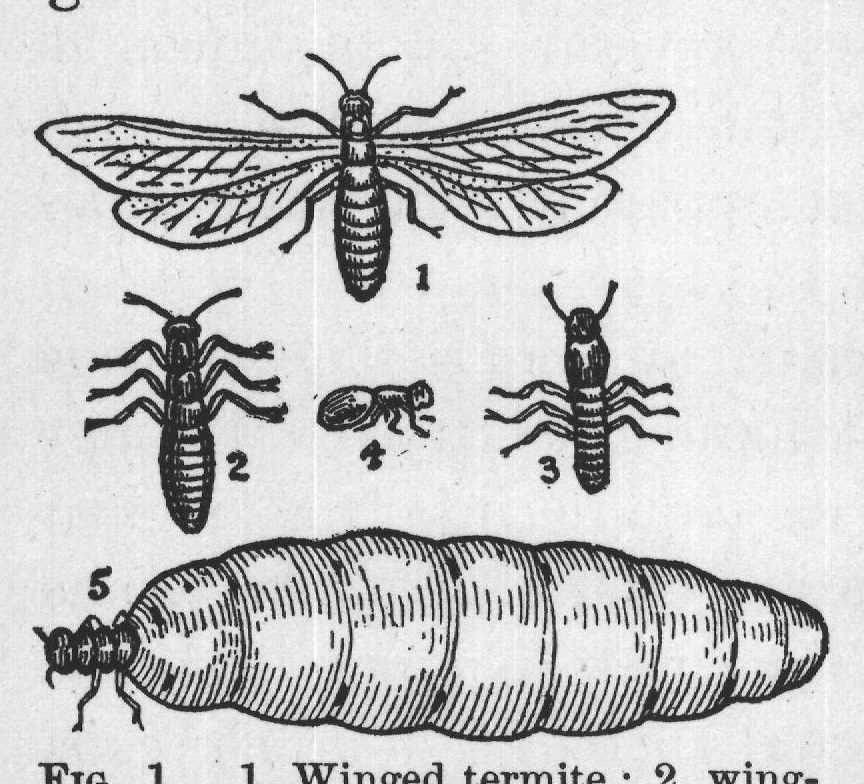
In the neighborhood of the nests, narrow covered galleries or underground ways are everywhere to be seen, these latter being the passages along which the materials used for building the nests are conveyed. The termites are small soft-bodied animals of a pale color, but resemble the common or true ants in that they live in colonies, composed, like those of bees, of three chief grades of individuals. These grades are known as males, females, and blind "neuters," the latter forming at once the largest bulk of the population, and including in their numbers the true "working classes” of this curious community. In the common ants, the "neuters" are regarded as being undeveloped female insects. These 5 2 3 FIG. 1. 1, Winged termite; 2, wingless termite; 3, soldier; 4, worker; 5, female swollen with eggs. neuters exhibit in the termites a further division into ordinary "workers" (Figs. 1, 4), which perform the multifarious duties connected with the ordinary life of the colony, and "soldiers" (3), which perfectly exemplify the laws of military organization in higher life, in that they have no part in the common labor, but devote themselves entirely to the defence of the colony and to the "Pride, pomp, and circumstance of glorious war."