Home › Contents › Humming Birds
Humming Birds
(FROM THE NATURALIST IN NICARAGUA.) BY THOMAS G. BELT, F. G. S.
S OON after crossing the muddy Artigua below Pavon, a beautifully clear and sparkling brook is reached, coming down to join its pure waters with the soiled river below. In the evening this was a favorite resort of many birds that came to drink at the pellucid stream, or catch insects playing above the water. Amongst the last was the beautiful blue, green and white humming-bird; the head and neck deep metallic-blue, bordered on the back by a pure white collar over the shoulders, followed by deep metallic-green; on the underside the blue neck is succeeded by green, the green from the centre of the breast to the end of the tail by pure white; the tail can be expanded to a half circle, and each feather widening towards the end makes the semicircle complete around the edge. When catching the ephemeridæ that play above the water, the tail is not expanded: it is reserved for times of courtship. I have seen the female sitting quietly on a branch, and two males displaying their charms in front of her. One would shoot up like a rocket, than suddenly expanding the snow-white tail like an inverted parachute, slowly descend in front of her, turning round gradually to show off both back and front. The effect was heightened by the wings being invisible from a distance of a few yards, both from their great velocity of movement and from not having the metallic lustre of the rest of the body. The expanded white tail covered more space than all the rest of the bird, and was evidently the grand feature in the performance. Whilst one was descending, the other would shoot up and come slowly down expanded. The entertainment would end in a fight between the two performers; but whether the most beautiful or the most pugnacious was the accepted suitor, I know not. Another fine humming-bird seen about this brook was the long-billed, fire-throated Heliomáster pallidiceps, Gould, generally seen probing long, narrow-throated red flowers, forming, with their attractive nectar, complete traps for the small insects on which the humming-birds feed, the bird returning the favor by carrying the pollen of one flower to another. A third species, also seen at this brook, Petasophora delphinae, Less., is of a dull brown color, with brilliant ear-feathers and metallic-green throat. Both it and the Florisuga mellivora are short billed, generally catching flying insects, and do not frequent flowers so much as other humming-birds. I have seen the Petasophora fly into the centre of a dancing column of midges and rapidly darting first at one end then at another secure half a dozen of the tiny flies before the column was ...
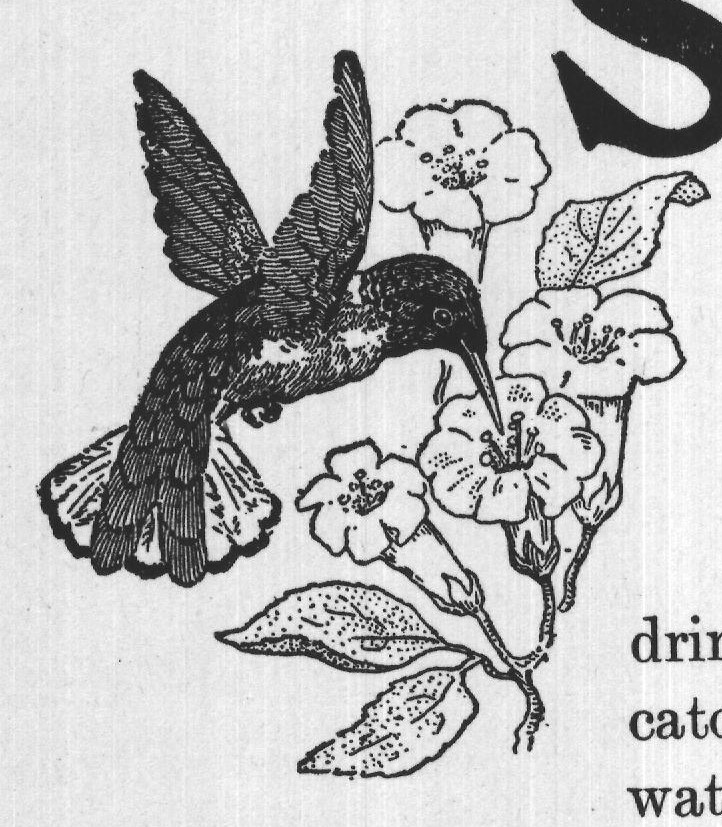
Humming Birds broken up; then retire to a branch and wait until it was re-formed, when it made another sudden descent on them.
I have no doubt many humming-birds suck the honey from flowers, as I have seen it exude from their bills when shot; but others do not frequent them; and the principal food of all is small insects. I have examined scores of them, and never without finding insects in their crops. Their generally long bills have been spoken of by some naturalists as tubes into which they suck the honey by a piston-like movement of the tongue; but suction in the usual way would be just as effective; and I am satisfied that this is not the primary use of the tongue, nor of the mechanism which enables it to be exerted to a great length beyond the end of the bill. The tongue, for one-half of its length, is semi-horny and cleft in two, the two halves are laid flat against each other when at rest, but can be separated at the will of the bird and form a delicate pliable pair of forceps, most admirably adapted for picking out minute insects from amongst the stamens of the flowers.