Wasps
(FROM THE NATURALIST IN NICARAGUA.) BY THOMAS G. BELT, F.G.S.
I ONE day saw a small black and yellow banded wasp hunting for spiders; it approached a web where a spider was stationed in the centre, made a dart towards it - apparently a feint to frighten the spider clear of its web; at any rate it had that effect, for it fell to the ground, and was immediately seized by the wasp, who stung it, then ran quickly backwards, dragging the spider after it, up a branch reaching to the ground until it got high enough, when it flew heavily off with it. It was so small, and the spider so heavy, that it probably could not have raised it from the ground by flight. All over the world there are wasps that store their nests with the bodies of spiders for their young to feed on. In Australia, I often witnessed a wasp combating with a large flat spider that is found on the bark of trees. It would fall to the ground, and lie on its back, so as to be able to grapple with its opponent; but the wasp was always the victor in the encounters I saw, although it was not always allowed to carry off its prey in peace. One day, sitting on the sandbanks on the coast of Hobson's Bay, I saw one dragging along a large spider. Three or four inches above it hovered two minute flies, keeping a little behind, and advancing with it. The wasp seemed much disturbed by the presence of the tiny flies, and twice left its prey to fly up towards them, but they darted away with it. As soon as the wasp returned to the spider, there they were hovering over and following it again. At last, unable to drive away its small tormentors, the wasp reached its burrow and took down the spider, and the two flies stationed themselves one on each side the entrance, and would, doubtless, when the wasp went away to seek another victim, descend and lay their own eggs in the nest.
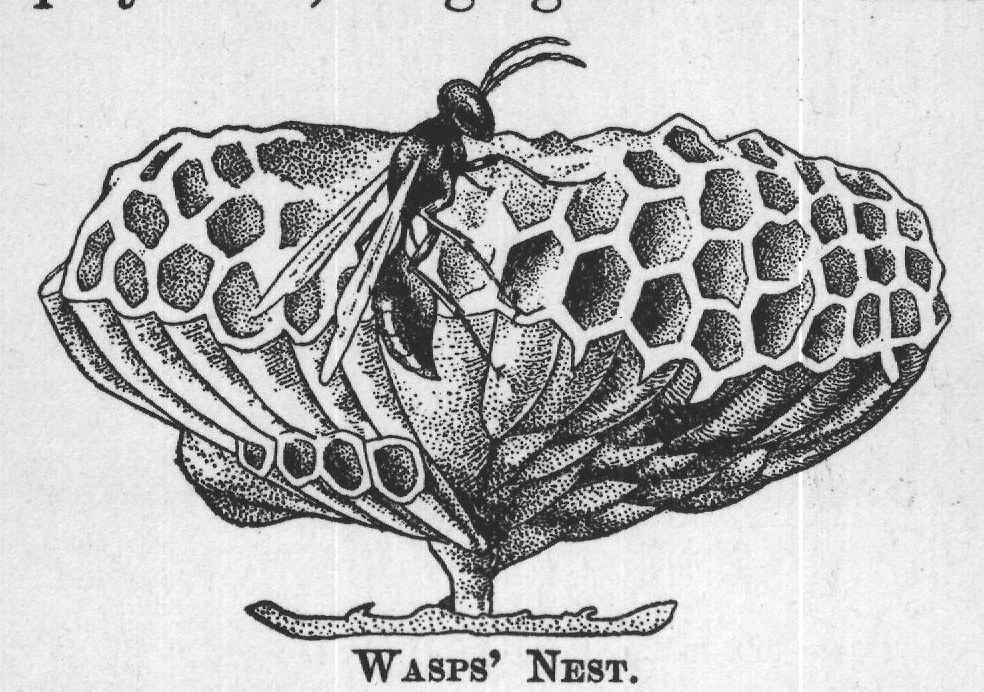
The variety of wasps, as of all other insects, was very great around Santo Domingo. Many made papery nests, hanging from the undersides of large leaves. WASPS' NEST.
Others hung their open cells underneath verandahs and eaves of houses.
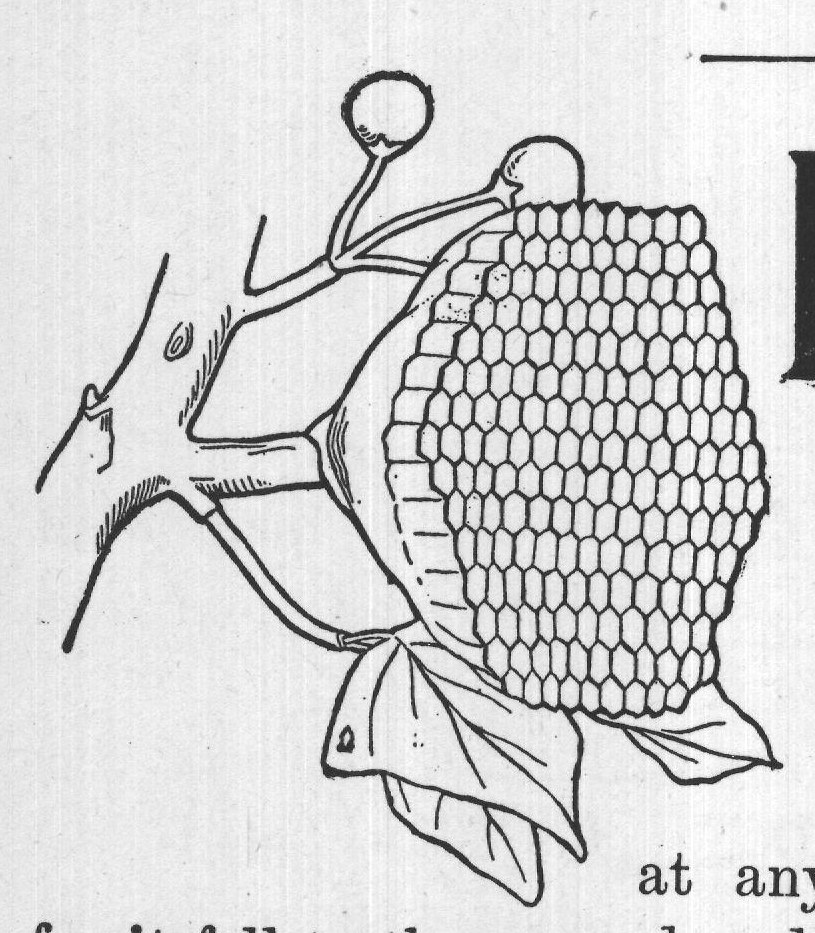
One large black one was particularly abundant about houses, and many people got stung by them. They also built their pendent nests in the orange and lime trees, and it is not always safe to gather the fruit. Fortunately they are heavy flyers, and can Wasps often be struck down or evaded in their attacks.
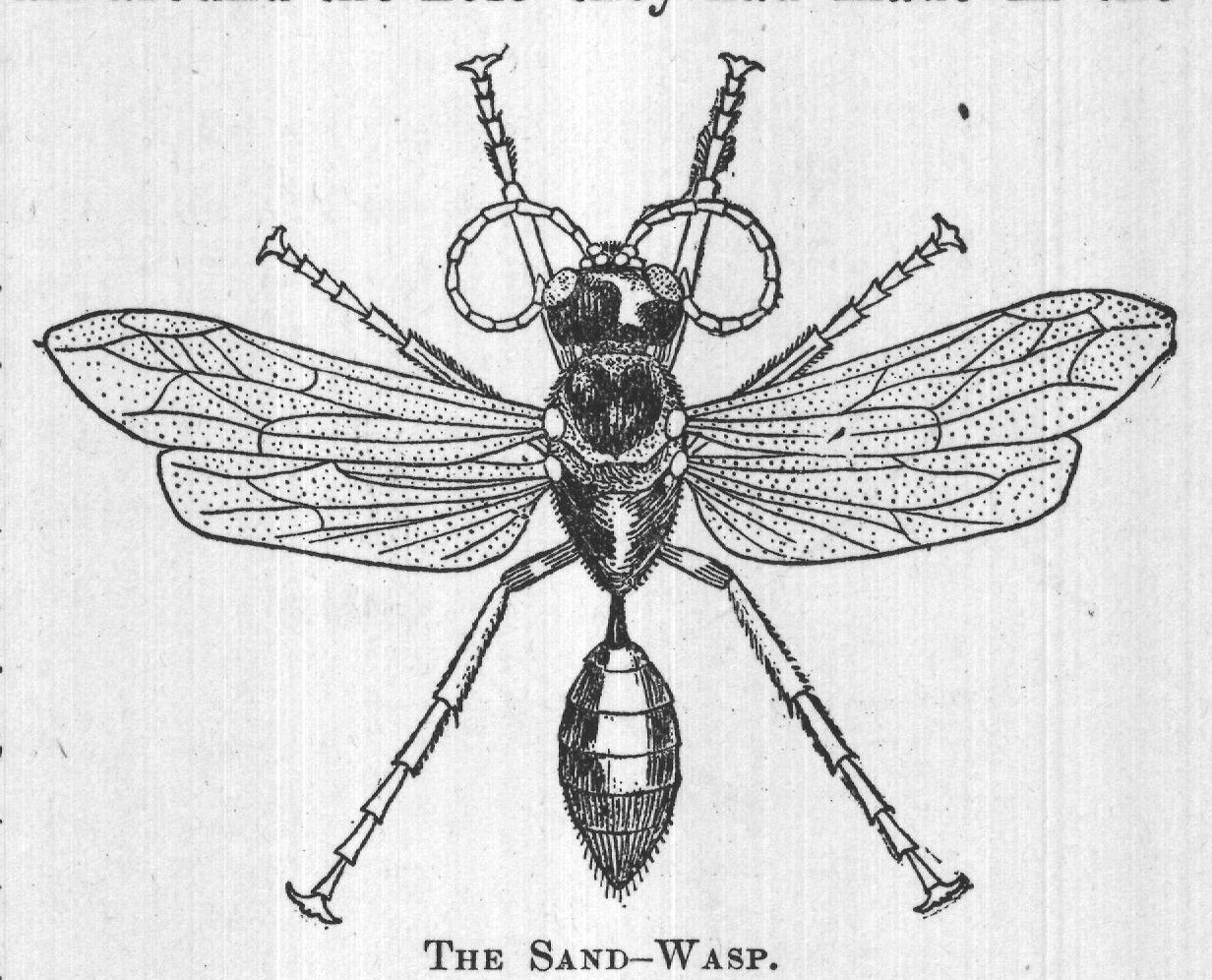
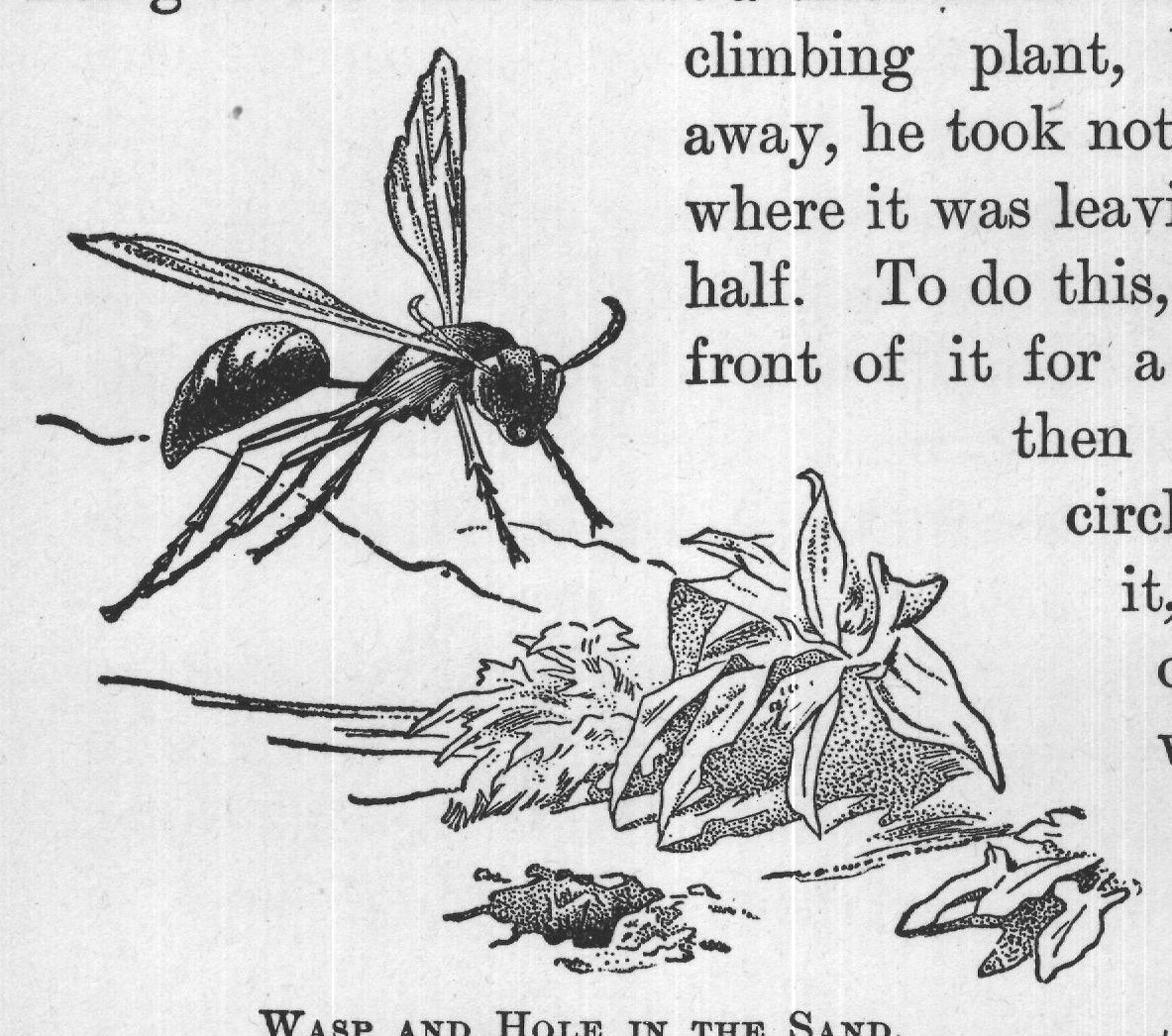
They do good where there are gardens, as they feed their young on caterpillars, and are continually hunting for them. Another species, banded brown and yellow (Polistes carnifex), has similar habits but is not so common, Bates, in his account of the habits of the sand-wasps at Santarem, on the Amazon, gives an interesting account of the way in which they took a few turns in the air around the hole they had made in the sand before leaving to seek for flies in the forest, apparently to mark well the position of the burrow, so that on their return they might find it THE SAND-WASP. without difficulty. He remarks that this precaution would be said to be instinctive, but that the instinct is no mysterious and unintelligible agent, but a mental process in each individual differing from the same in man only by its unerring certainty. I had an opportunity of confirming his account of the proceedings of wasps when quitting a locality to which they wished to return, in all but their unerring certainty. I could not help noting how similar they were to the way in which a man would act who wished to return to some spot not easily found out, and with which he was not previously acquainted. A specimen of the Polistes carnifex was hunting about for caterpillars in my garden. I found one about an inch long, and held it out towards it on the point of a stick. It seized it immediately, and commenced biting it from head to tail, soon reducing the soft body to a mass of pulp. It rolled up about one-half of it into a ball, and prepared to carry it off. Being at the time amidst a thick mass of a fine-leaved climbing plant, before flying away, he took note of the place where it was leaving the other half. To do this, it hovered in front of it for a few seconds, then took small circles in front of it, then larger ones round the whole plant.
WASP AND HOLE IN THE SAND.
I thought it had gone, but it returned again, and had another look at the opening in the dense foliage down which the other half of the caterpillar lay. It then flew away, but must have left its burden for distribution with its comrades at the nest, for it returned in less than two minutes, and making one circle around the bush, descended to the opening, alighted on a leaf, and ran inside. The green remnant of the caterpillar was lying on another leaf inside, but not connected with the one on which the wasp alighted, Wasps so that in running in it missed it, and soon got hopelessly lost in the thick foliage. Coming out again, it took another circle, and pounced down on the same spot again, as soon as it came opposite to it. Three small seed-pods, which here grew close together, formed the marks that I had myself taken to note the place, and these the wasp seemed also to have taken as its guide, for it flew directly down to them, and ran inside; but the small leaf on which the fragment of caterpillar lay, not being directly connected with any on the outside, it again missed it, and again got far away from the object of its search. It then flew out again, and the same process was repeated again and again.
Always when in circling round it came in sight of the seed-pods down it pounced, alighted near them, and recommenced its quest on foot. I was surprised at its perseverance, and thought it would have given up the search; but not so, it returned at least half a dozen times, and seemed to get angry, hurrying about with buzzing wings. At last it stumbled across its prey, seized it eagerly, and as there was nothing more to come back for, flew straight off to its nest, without taking any further note of the locality. Such an action is not the result of blind instinct, but of a thinking mind: and it is wonderful to see an insect so differently constructed using a mental process similar to that of man. It is suggestive of the probability of many of the actions of insects that we ascribe to instinct being the result of the possession of reasoning powers.