Home › The Foundations of a Wonderful City › The Foundations of a Wonderful City: Buffon
The Foundations of a Wonderful City: Buffon
Buffon had a theory which has been revived once more, that the bees did not intend to make hexagonal cells, but rather round ones, and that owing to the crowding of the workers all around, the round ones became hexagonal. It is said also that crystals, fishscales of certain kinds, soap-bubbles, etc., follow the same law, and Buffon advances this experiment to prove The Foundations of a Wonderful City 169 it. "Take a vessel and fill it full with peas or any other round grains, pour as much water upon them as will fill the spaces between them, close the vessel tightly, and boil the water. It will be found that the round peas have become six-sided. One sees clearly that this must be so from purely mechanical causes; each one of the round grains tends in the course of swelling as it boils to fill up the utmost space that it can, and by the extension and pressure of all alike they become hexagonal. Each bee wishes to occupy as much room as possible in its allotted space, therefore as the bodies of the bees are round or cylindrical, their cells become hexagonal because of the extension and pressure of all alike."
Here then we see reciprocal obstacles working a wonder, somewhat in the same way perhaps as the vices of men bring about a general virtue, so that the race odious, often so far as individuals are concerned, is tolerable in the mass. Broughman, Kirby, and Spence and others claim that the observations of soap-bubbles and peas prove nothing in this connection, for the effect of compression is only to produce irregular hexagonal forms, and does not explain the earlier form of the base of the cells.
To this one might rejoin that there are more ways than one of dealing with the blind law of necessity, for the wasp and the bumble-bee and many other species in similar circumstances and with the same end in view, arrive at very different, and manifestly inferior, results. Indeed it might be said further that even if the beecells did conform to the laws of crystallization as in the case of snow, or Buffon's soap-bubbles, or boiled peas, they show also in their general symmetry, in their well-determined angle of inclination, etc., that there are many other laws not followed by inert matter to which they also conform. In order to assure myself that the hexagonal form of the cell was the outcome of the bee-brain, I cut out from the centre of a honey-comb a round piece not quite so large as a silver dollar, containing both broodcells and honey-cells. I cut into this disc, at the point where the pyramidal bases of the cells were joined, and I fixed on the base of the section thus exposed a piece of tin of the same size, and so stout that the bees could not bend or twist it. Then I replaced the disc of comb, with the piece of tin as described. One side of the comb showed, of course, nothing extraordinary, but on the other side was to be seen a hole at the bottom of which was a round piece of tin occupying the place of about thirty cells. At first the bees were disconcerted, and came in crowds to examine and study this wonderful abyss; for some days they wandered about it in agitation without coming to any decision. But as I fed them well every evening, the time soon came when they needed more cells in which to store their provisions. Then most likely the famous engineers, the sculptors, and the waxmakers, were summoned to show the way to fill up this useless chasm.
A heavy curtain, or garland, of the wax-making bees covered the spot so as to develop the necessary heat; others went down into the hole and began the work of solidly fixing the metal in place by means of little claws of wax around its entire circumference, attaching them to the walls of the cells which surrounded it.
The Foundations of a Wonderful City 171 • Then they set to work to make three or four cells in the upper part of the disc, attaching them to these waxen claws. Each of these new cells was more or less unfinished at the top, so as to leave material wherewith to fasten it to the next cell, but below on the piece of tin was always three very clear, and precise angles from which would grow the three upright lines which regularly marked the outline of the first half of the next cell. After about forty-eight hours, although three or four bees at most could work at the same time in the opening, the whole surface of the piece of tin was covered with the outlines of the new cells. They were certainly somewhat less regular than those in an ordinary comb. But they were all perfectly hexagonal; not a line was bent, not an angle out of shape; nevertheless all the ordinary conditions of bee-life were changed. The cells were not dug out of a block of wax as Huber described, nor were they made according to Darwin, circular at first, and then made into hexagons by the pressure of their neighbors. Here was no question of reciprocal obstacles, seeing that the cells were made one by one, and these first outlines were sketched on a kind of table. It would appear therefore that the hexagonal form is not the result of any mechanical necessity, but that it forms the plan resulting from the experience, the intelligence, and the will of the bee. Another curious thing which I accidentally noticed was that the cells built upon the tin were not provided with any other floor than the tin itself. The engineers of the working party evidently reasoned that the tin was sufficient to retain the liquid honey, and that it was not necessary, therefore, to line it with wax. But a little while after, when some honey was placed in the cell, they probably found that the metal effected some change in it, for upon taking counsel together they covered the surface of the tin with a kind of diaphanous varnish.
If we wish to throw light on all the secrets of this geometrical architecture, we shall find many more interesting questions to examine - for example, that of the form of the first cells, which are attached to the roof of the hive - a form which is modified so that the cells can fit its curve and touch the roof at the greatest possible number of points.
It would be necessary to notice also, not only the direction in which the main streets of the hive run, but the alley-ways and passages which run in and out and around the comb, as much for the circulation of the air as for the traffic; and it should be remarked that these are planned so as to avoid long detours or confusion in the traffic. Before we leave this subject let us, only for a minute, stop to consider the wonderful and mysterious way in which the bees make their plans and work together when they are occupied in carving out their cells, on both sides of the comb, where neither can see the other. Look through one of these transparent combs, and you will see clearly and sharply cut out in this diaphanous wax a network of prisms arranged in so perfectly fitting a manner that one might think they were stamped out of steel.
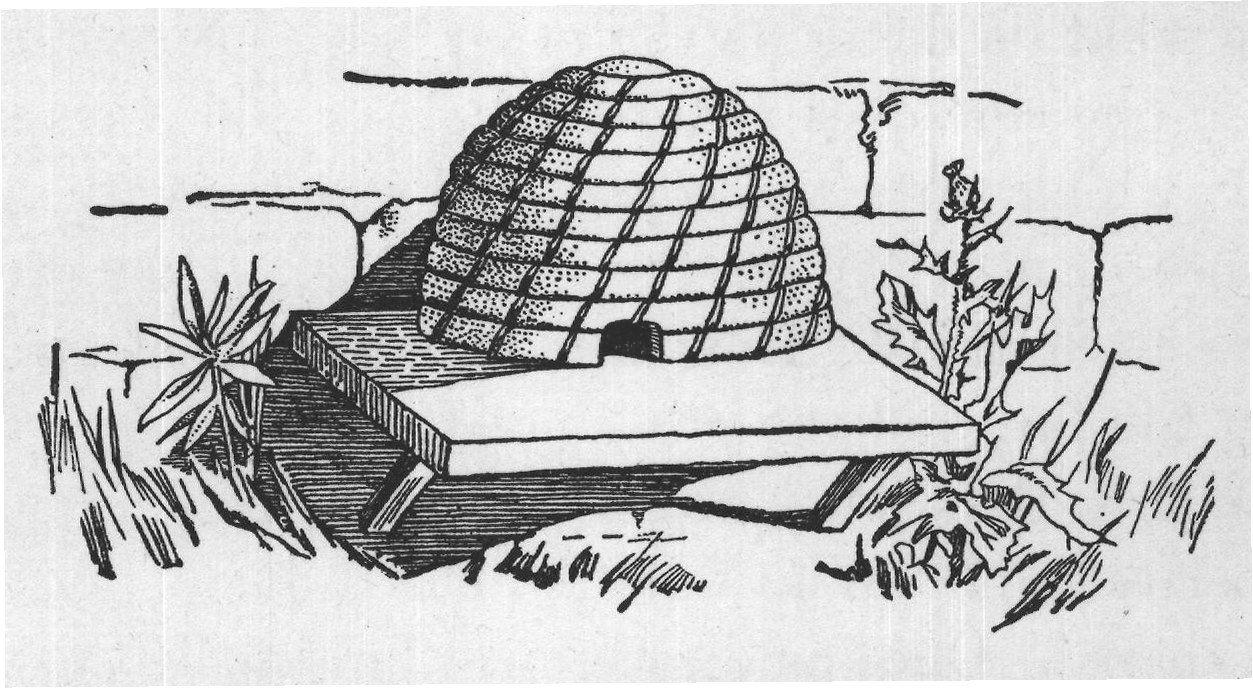
Those who have never seen the inside of a hive can have little idea of the appearance of these honeycombs. Let us take a countryman's hive in which the bee has The Foundations of a Wonderful City 173 been left free to work as he pleases. This bell-like shape is divided from top to bottom by five, six, eight, and sometimes ten, slices of wax, so to speak, perfectly parallel with each other, which take the exact shape of the curve of the walls of the hive. Between each one of these slices is a space of about half an inch in which the bees move about. When they begin to build one of these slices at the top of the hive, the wall of wax is quite thick, and hides entirely the fifty or sixty bees who are working on one side from the fifty or sixty at work on the other. Unless they have a sight which can pierce the most opaque bodies, neither can see what is doing on the other side. Nevertheless, a bee on one side does not dig a hole or add a fragment of wax which does not correspond exactly with a protuberance or a cavity on the other side. How do they contrive to do this? How does it happen that one does not dig too far, and the other not far enough?
How is it that every angle coincides in such magnificent perfection? Who tells the bee to begin here and to end there? Once again we must be satisfied with the reply that does not answer: "It is one of the mysteries of the hive." Huber has tried to explain it by saying that at certain intervals, by the pressure of their feet or their teeth, they produce a slight projection of the wax on the other side of the comb, or that they can determine the thickness of the block of wax by its flexibility, its elasticity, or some other physical property which it may possess; or, again, that their antennæ are able to serve as compasses in enabling them to examine what is going on in the darkness of the other side; or, last of all, he suggests that all the cells mathematically derive their shape and dimensions from those of the first row, which is built without the need of further concert on the part of the workers. But one can easily see that these explanations are not sufficient; the first are guesses which cannot be verified; the others simply change but do not remove the mystery. But if it is good to change a mystery as often as possible, it is never good to flatter one's self that to change it means to remove it!