Home › Contents › A Wasp and Its Prey
A Wasp and Its Prey
(FROM THE INSTINCTS AND HABITS OF THE SOLITARY WASPS.)1 BY G. W. AND E. G. PECKHAM.
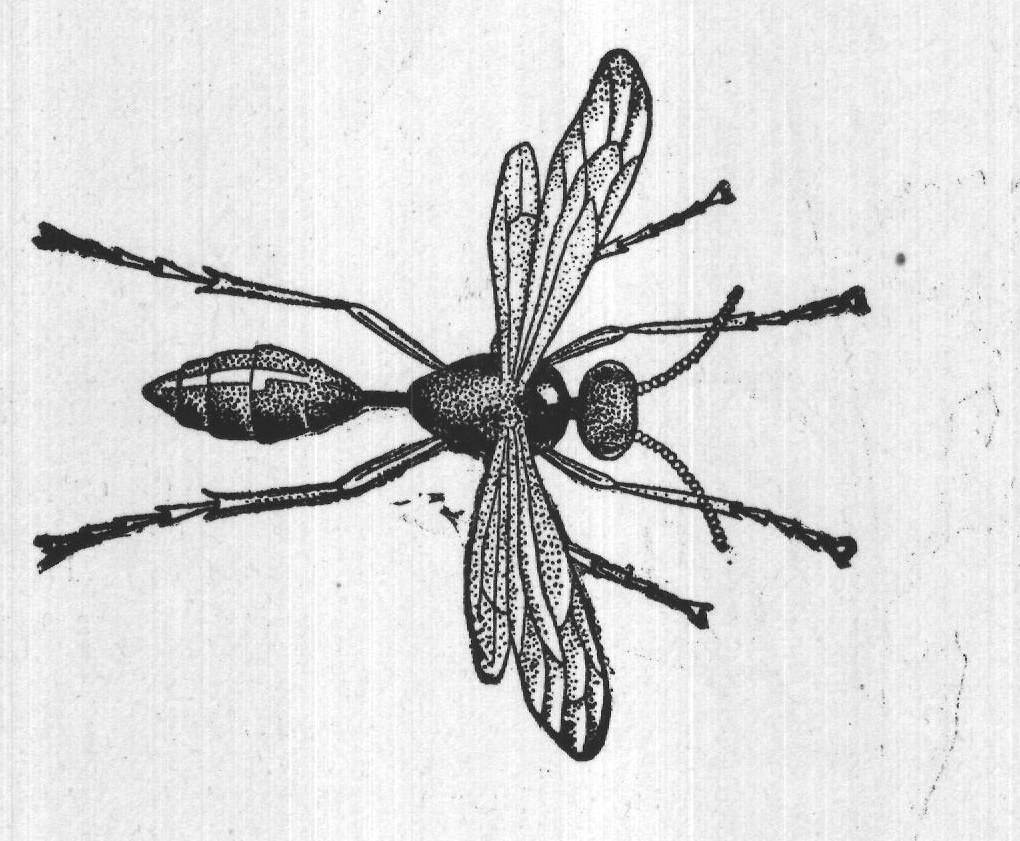
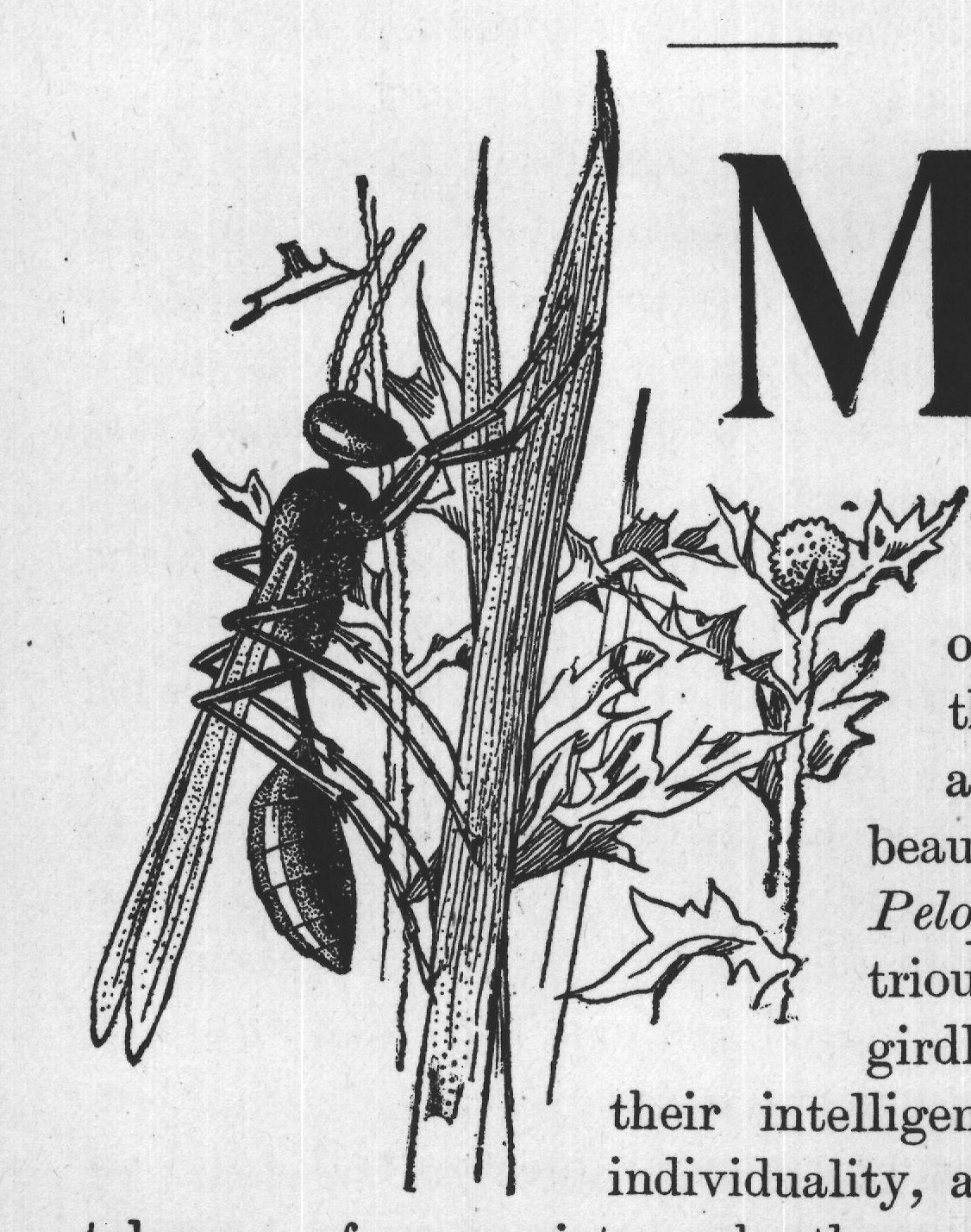
A M OST graceful and attractive of all as the wasps Fabre describes them, the Ammophiles, of all the inhabitants of the garden, hold the first place in our affections. Not so beautiful as the blue Pelopaeus nor so industrious as the little redgirdled Trypoxylon, their intelligence, their distinct individuality, and their obliging tolerance of our society make them an unfailing source of interest. They are, moreover, the most remarkable of all genera in their stinging habits, and few things have 1 Reprinted by permission from Bulletin No. 2, Series I, of The Wisconsin Geological and Natural History Survey, 1898. A Wasp and Its Prey given us deeper pleasure than our success in following the activities and penetrating the secrets of their lives. In our neighborhood we have but two species of Ammophila, urnaria Cresson and gracilis Cresson, both of them being very slender bodied wasps of about an inch in length, gracilis all black, and urnaria with a red band around the front end of the abdomen. With two exceptions our observations relate to urnaria.
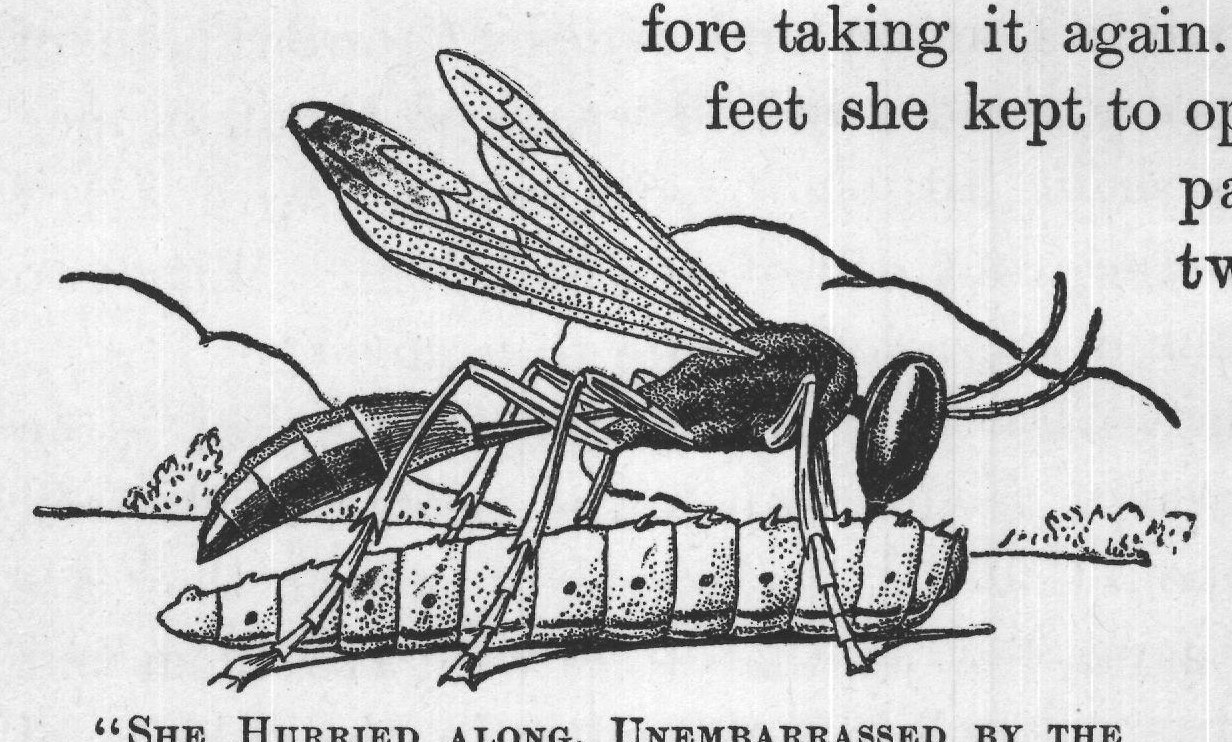
During the earlier part of the summer we had often seen these wasps feeding upon the nectar of flowers, especially upon that of the sorrel of which they are particularly fond, but at that time we gave them but passing notice. One bright morning in the middle of July, however, we came upon one that was so evidently hunting, and hunting in earnest, that we gave up everything else to follow her. The ground was covered, more or less thickly, with patches of purslane, and it was under these weeds that our Ammophila was eagerly searching for her prey. After thoroughly investigating one plant she would pass to another, running three or four steps and then bounding as though she were made of thistledown and were too light to remain upon the ground. We followed her easily, and as she was in full view nearly all of the time we had every hope of witnessing the capture, but in this we were destined to disappointment. We had been in attendance on her for about a quarter of an hour when, after disappearing for a few moments under the thick purslane leaves, she came out with a green caterpillar. We had missed the wonderful sight of the paralyzer at work, but we had no time to bemoan our loss for she was making off at so rapid a pace that we were well occupied in keeping up with her. She hurried along with the same motion as before, unembarrassed by the weight of her victim. Twice she dropped it and circled over it a moment before taking it again. For sixty feet she kept to open ground, passing between two "SHE HURRIED ALONG, UNEMBARRASSED BY THE WEIGHT OF HER VICTIM." rows of bushes, but at the end of this division of the garden, she plunged, very much to our dismay, into a field of standing corn. Here we had great difficulty in following her, since far from keeping to her former orderly course, she zigzagged among the plants in the most bewildering fashion, although keeping a general direction of northeast. It seemed quite impossible that she could know where she was going. The corn rose to a height of six feet all around us; the ground was uniform in appearance, and, to our eyes, each group of corn stalks was just like every other group, and yet, without pause or hesitation, the little creature passed quickly along, as we might through the familiar streets of our native town.
At last she paused and laid her burden down. Ah! the power that has led her is not a blind, mechanically perfect instinct, for she has travelled a little too far. She must go back one row into the open space that she has already crossed, although not just at this point. A Wasp and Its Prey Nothing like a nest is visible to us. The surface of the ground looks all alike, and it is with exclamations of wonder that we see our little guide lift two pellets of earth which have served as a covering to a small opening running down into the ground.
The way being thus prepared she hurries back with her wings quivering and her whole manner betokening joyful triumph at the completion of her task. We, in the meantime, have become as much excited over the matter as she is herself. She picks up the caterpillar, brings it to the mouth of the burrow and lays it down. Then, backing in herself, she catches it in her mandibles and drags it out of sight, leaving us full of admiration and delight. How clear and accurate must be the observing powers of these wonderful little creatures! Every patch of ground must, for them, have its own character; a pebble here, a larger stone there, a trifling tuft of grass these must be their landmarks. And the wonder of it is that their interest in each nest is so temporary. A burrow is dug, provisioned and closed up, all in two or three days, and then another is made in a new place with everything to learn over again.
From this time (July thirteenth) on to the first of September our garden was full of these wasps, and they never lost their fascination for us, although owing to a decided difference between their taste and ours as to what constituted pleasant weather all our knowledge of them was gained by the sweat of our brows. When we wished to utilize the cool hours of the morning or of the late afternoon in studying them, or thought to take advantage of a cloud which cast a grateful shade over the sun at noonday, where were our Ammophiles? Out of sight entirely, or at best only to be seen idling about on the flowers of the onion or sorrel. At such a time they seemed to have no mission in life and no idea of duty. But when the air was clear and bright and the mercury rose higher and higher, all was changed. Their favorite working hours were from eleven in the morning to three in the afternoon, and when they did work they threw their whole souls into it. It was well that it was so, for they certainly needed all the enthusiasm and perseverance that they could muster for such wearisome and disappointing labor. Hour after hour was passed in search, and often there was nothing to show at the end of it, for, since the caterpillars that they wanted were nocturnal species, most of them were under ground in the day-time. The species observed by Fabre knew, by some subtle instinct, where to find the worm, and unearthed it from its burrow. Urnaria, on the contrary, never dug for her prey, but hunted on bare ground, on the purslane, and most of all on the bean-plants. These were examined carefully, the wasp going up and down the stems and looking under every leaf, but the search was so frequently unsuccessful that in estimating their work we are inclined to think that they can scarcely average one caterpillar a day. When they were hunting over bare ground they often paused and seemed to listen, and in the beginning we expected to see them burrow down and drag a victim from under the soil, but this never happened.
In this species, as in every one that we have studied, we have a most interesting variation among the dif- A Wasp and Its Prey ferent individuals, not only in methods but in character and intellect. While one was beguiled from her hunting by every sorrel blossom she passed, another stuck to her work with indefatigable perseverance.
While one stung her caterpillar so carelessly and made her nest in so shiftless a way that her young could only survive through some lucky chance, another devoted herself to these duties, not only with conscientious thoroughness, but with an apparent craving after artistic perfection that was touching to see.
The method employed by the Ammophilæ in stinging their prey is more complex than that of any other predatory wasp. The larvæ with which they provision their nests are made up of thirteen segments, and each of these has its own nervous centre or ganglion. Hence if the caterpillar is to be reduced to a state of immobility, or to state so nearly approaching immobility that the egg may be safely laid upon it, a single sting, such as is given by some of the Pompilidæ to their captured spiders, will be scarcely sufficient. All this we knew from Fabre's "Souvenirs," and yet we were not at all prepared to believe that any plain American wasp could supply us with such a thrilling performance as that of the Gallic hirsuta, which he so dramatically describes. We were, however, most anxious to be present at the all-important moment that we might see for ourselves just how and where Ammophila urnaria stings her victim. For a whole week of scorching summer weather we lived in the bean patch, scorning fatigue. We quoted to each other the example of Fabre's daughter Claire, whose determination to solve the problem of Odynerus led to a sun-stroke. We followed scores of wasps as they hunted; we ran, we threw ourselves upon the ground, we scrambled along on our hands and knees in our desperate endeavors to keep them in view, and yet they escaped us. After we had kept one in sight for an hour or more some sudden flight would carry her far away and all our labor was lost.
At last, however, our day came. We were doing a little hunting on our own account, hoping to find some larvæ which we could drop in view of the wasps and thus lead them to display their powers, when we saw an urnaria fly up from the ground to the underside of a bean leaf and knock down a small green caterpillar. Breathless with an excitement which will be understood by those who have tasted the joy of such a moment, we hung over the actors in our little drama. The ground was bare, we were close by and could see every motion distinctly. Nothing more perfect could have been desired.
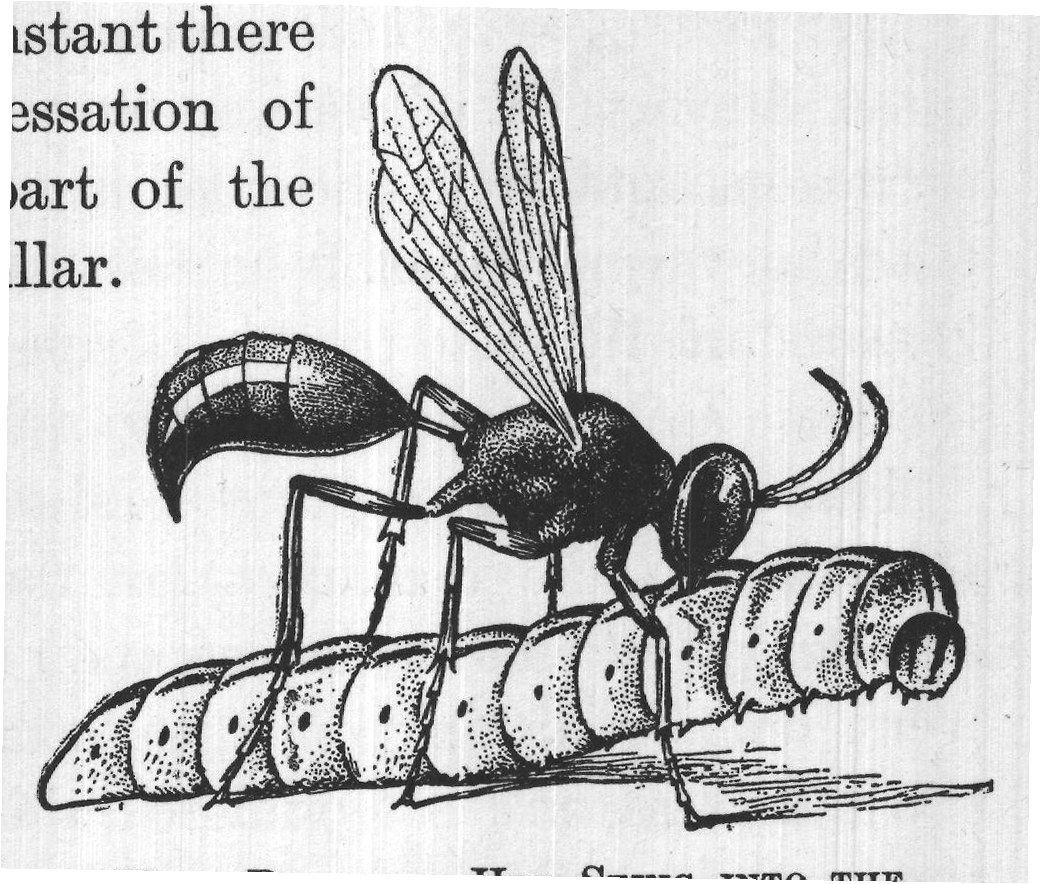
The wasp attacked at once but was rudely repulsed, the caterpillar rolling and unrolling itself rapidly and with the most violent contortions of the whole body. Again and again its adversary descended but failed to gain a hold. The caterpillar in its struggles, flung itself here and there over the ground, and had there been any grass or other covering near by it might have reached a place of partial safety, but there was no shelter within reach, and at the fifth attack the wasp succeeded in alighting over it, near the anterior end, and in grasping its body firmly in her mandibles. Standing high on her long legs and disregarding the continued struggles of her victim, she lifted it from A Wasp and Its Prey the ground, curved her abdomen under its body, and darted her sting between the third and fourth segments. From this instant there was a complete cessation of movement on the part of the unfortunate caterpillar.
Limp and helpless, it could offer no further opposition to the will of its For conqueror. For some moments the wasp remained motionless, and then, withdrawing her WASP PLUNGING HER STING INTO THE CATERPILLAR. sting, she plunged it successively between the third and the second, and between the second and the first segments.
The caterpillar was now left lying on the ground.
For a moment the wasp circled above it and then, descending, seized it again, further back this time, and with great deliberation and nicety of action gave it four more stings, beginning between the ninth and tenth segments and progressing backward.
Urnaria, probably feeling - as we certainly did a reaction from the strain of the last few minutes, and a relief at the completion of her task, now rested from her labors. Standing on the ground close by she proceeded to smooth her body with her long hind legs, standing in the meantime, almost on her head, with her abdomen directed upward. She then gave her face a thorough washing and rubbing with her first legs, and not until she had made a complete and satisfactory toilet did she return to the caterpillar. We saw Ammophila capture her prey only three times during the whole summer, but from these observations and from the condition of her caterpillars taken at various times from nests, her method seems to be wonderfully close to that of hirsuta, with just about the same amount of variation in different individuals. Thus in our second example, she stung the first three segments in the regular order, the third, the second, and lastly (and most persistently) the first. She then went on, without a pause, to sting the fourth, fifth, sixth, and seventh, stopping at this point and leaving the posterior segments untouched. In our first example, it will be remembered, the middle segments were spared. The sting being completed, she proceeded to the process 'known as malaxation, which consists in repeatedly squeezing the neck of the caterpillar, or other victim, between the mandibles, the subject of the treatment being turned around and around so that all sides may be equally affected.
In our third case a caterpillar which we had caught was placed in front of a wasp just after she had carried the second larva into her nest. She seemed rather indifferent to it, passing it once or twice as she ran about, but finally picked it up and gave it one prolonged sting between the third and fourth segments. She then spent a long time in squeezing the neck, pinching it again and again. It was then left on the ground, and as she showed no further interest in it we carried it home for further study.
In the three captures, then, that came under our ob- A Wasp and Its Prey servation, all the caterpillars being of the same species and almost exactly of the same size, three different methods were employed. In the first, seven stings were given at the extremities, the middle segments being left untouched, and no malaxation was practised. In the second, seven stings again but given in the anterior and middle segments, followed by slight malaxation. In the third, only one sting was given but the malaxation was prolonged and severe.