Home › The Foundations of a Wonderful City › The Foundations of a Wonderful City: Huber
The Foundations of a Wonderful City: Huber
Huber, who was the first to study these operations with marvellous patience, and sometimes not without personal danger, has written more than fifty pages on the subject, but they are very confused. For myself, as I am not writing a scientific book, I shall confine myself to describing what anybody can see if he will watch the movements of a swarm in a glass hive. At the same time I shall not fail to avail myself of Huber's studies whenever they may prove to be of service. We must admit at the very outset that the process by which the honey is transformed into wax in the bodies of this mysterious curtain of bees is still hidden in mystery. All that we know is that after about eighteen or twenty-four hours in a temperature so high that one might almost imagine there was a fire in the hive, small, white, transparent scales appear at the opening of the four little pockets which are to be found on each side of the abdomen of the bee. When the larger part of those who form the reversed cone have their abdomens decorated with these little ivory plates, one of them may be seen, as if under the influence of a sudden inspiration, to detach itself from the crowd and climb over the backs of its passive brethren until it reaches the apex of the cupola of the hive; attaching herself firmly to the top, she immediately sets to work to brush away those of her neighbors who may interfere with her movements. Then she seizes with her mouth one of the eight scales on the side of her abdomen and chews it, clips it, draws it out, steeps it in saliva, kneads it, crushes it, and makes it again into shape as dexterously as a carpenter would handle a piece of veneering. Then when the substance has been treated so as to bring it to the desired size and to the desired consistency, it is affixed to the very summit of the interior of the dome, and thus the first stone is laid of the new city, or rather the key-stone of the new The Foundations of a Wonderful City 163 city is placed in the arch, for we are considering a city turned upside down, which descends from the sky and which does not arise from the bosom of the earth as do terrestrial cities. Then she proceeds to apply to this key-stone more of the wax which she takes from her body, and having given to the whole of her part of the work one last finishing stroke, she retires as quickly as she came and is lost in the crowd; another replaces her and immediately takes up the work where she has left it off, adds her own to it, puts that right which appears to her to be not in conformity with the general plan, and disappears in her turn, while a third and a fourth and a fifth succeed her in a series of sudden and inspired apparitions, not one of whom finishes a piece of work, but all bring to it their common share.
Now there hangs from the top of the vault a small block of wax which is yet without form. As soon as it appears to be thick enough there comes out of the group another bee bearing an entirely different aspect from that of those which have preceded it. One may well believe on seeing the certainty, the determination, with which he goes about his work and the manner in which those who stand round about him look on, that he is an expert engineer who has come to construct in space the place which the first cell shall occupy, the cell from which must mathematically depend everything which is afterwards constructed. Whatever he may be, this bee belongs to a class of the sculpturing, of chisel working bees who produce no wax and whose function seems to be to employ the materials with which the others furnish them. This bee then chooses the place of the first cell. She digs for a moment in the block of wax which has already been placed in position, and builds up the side of the cell with the wax that she picks from the cavity. Then in exactly the same way as her predecessors have done, she suddenly leaves the work she has designed; another impatient worker replaces her and carries it on another step, which is finished by a third one. In the meantime others are working round about her according to the same method of division of labor until the outer sides of each wall is finished. It would almost seem that an essential law of the hive was that every worker should take a pride in its work, and that all the work should be done in common, and so to speak, unanimously, in order that the fraternal spirit should not be disturbed by a sense of jealousy. Very soon the outline of the comb may be seen. In form it is still lenticular, for the little prismatic tubes of which it is composed are unequally prolonged, and they diminish as they get away from the centre towards the extremities. At this moment it might be compared, both in form and in thickness, to a human tongue hanging down from two of the sides of the hexagonal cells which are placed back to back.
As soon as the first cells are constructed, the workers add a roof to the second and so on to the third and to the fourth. These sets of cells are divided by irregular intervals, and they are calculated in such a manner that when they are made to receive their full complement, the bees always have room enough to move about between the parallel walls of the honeycombs.
It follows then that in making their original plan the different thicknesses of every honeycomb must be fixed upon, and at the same time the alley-ways which sepa- The Foundations of a Wonderful City 165 rate each must be different in turn, and this width must be twice the height of a bee since they have to pass each other between the upright combs.
But even the bees are not infallible, and they do not always work with exact mechanical certainty. When they find themselves in a difficult place they sometimes make very great blunders. One often finds that they leave too much, and often too little, space between the honeycombs, and they remedy these faults as well as they can sometimes in finishing the comb which is too near another in an oblique line, or sometimes when they have left too much space they interpose a smaller comb between it. - Réamur, on this subject, says:- "Since bees sometimes make mistakes and rectify them, this must be a proof that they possess the power of reason."
It is known that bees make four different kinds of cells. There are first the "royal cells" which are exceptional and are of acorn shape.
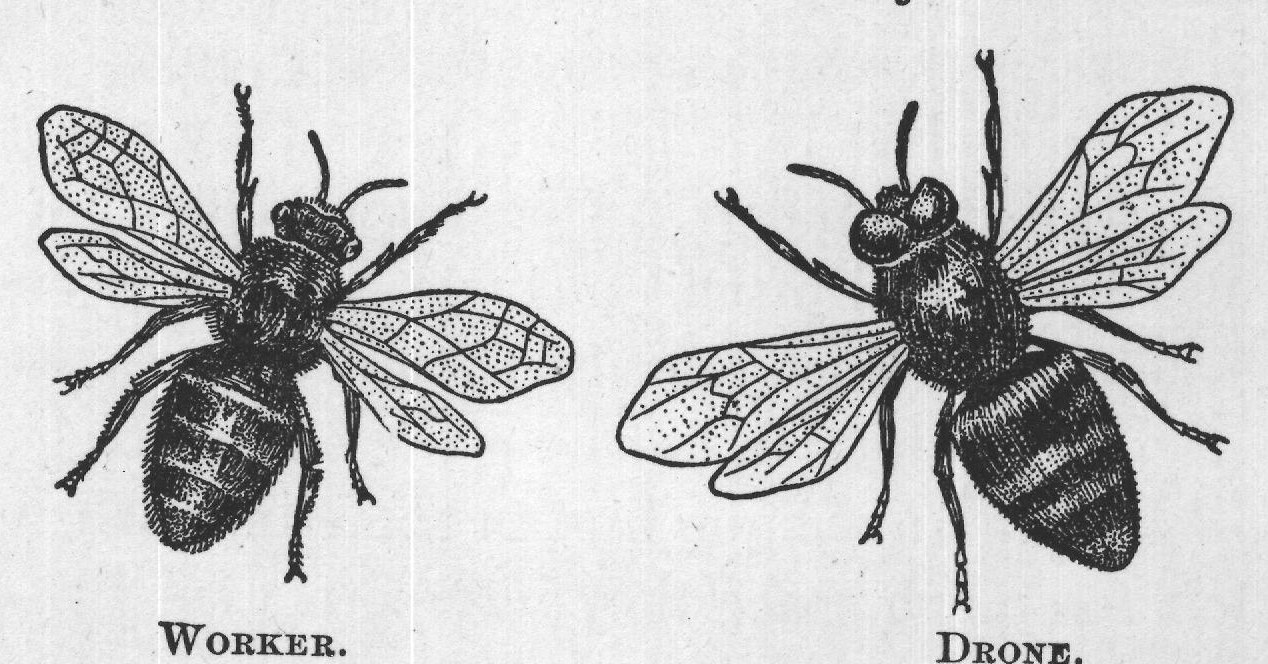
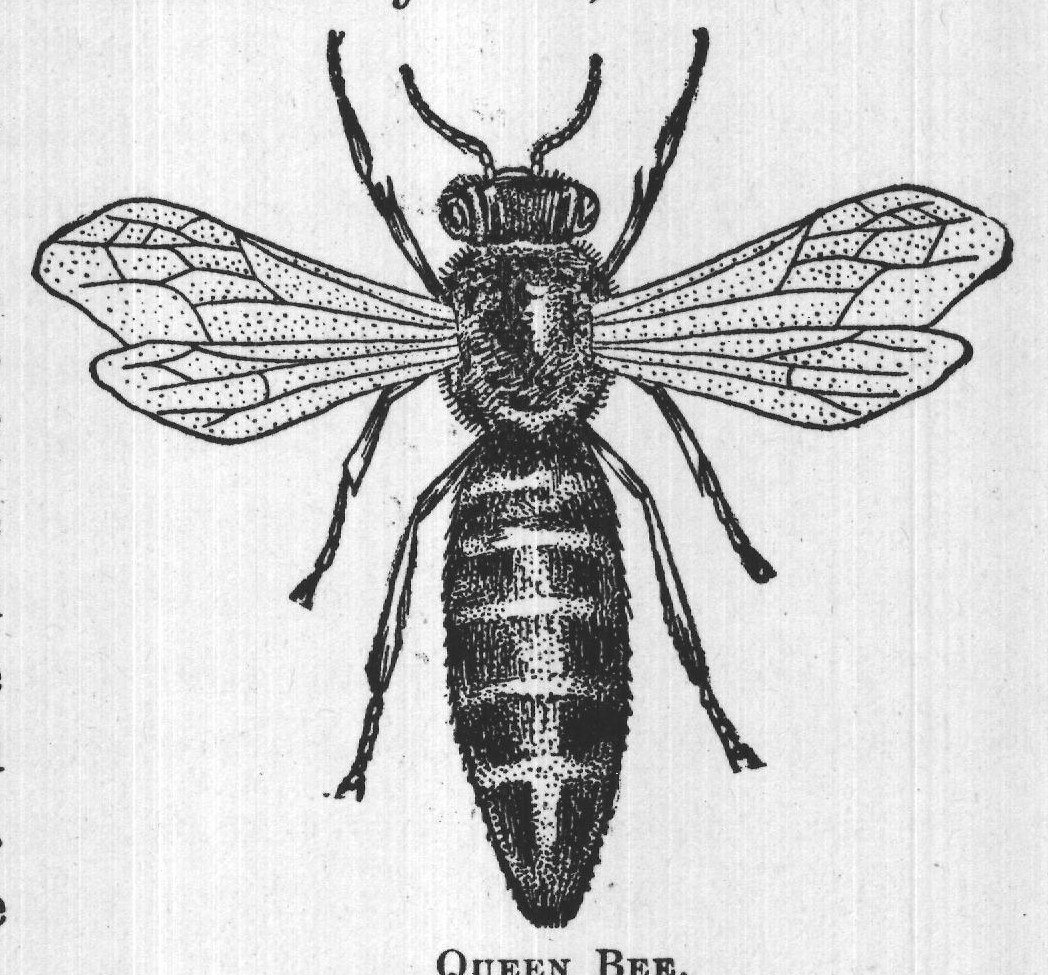
Then there are the large cells in which the male bees are reared, and in which provisions are stored when the flowers furnish forth of their abundance. Then there are the little cells which may be called the "cradles of the working bees," QUEEN BEE. which are also employed as ordinary store-rooms.
These generally occupy about eight-tenth's of the total surface of the combs in a hive; and finally there are a certain number of what may be called tran- WORKER.
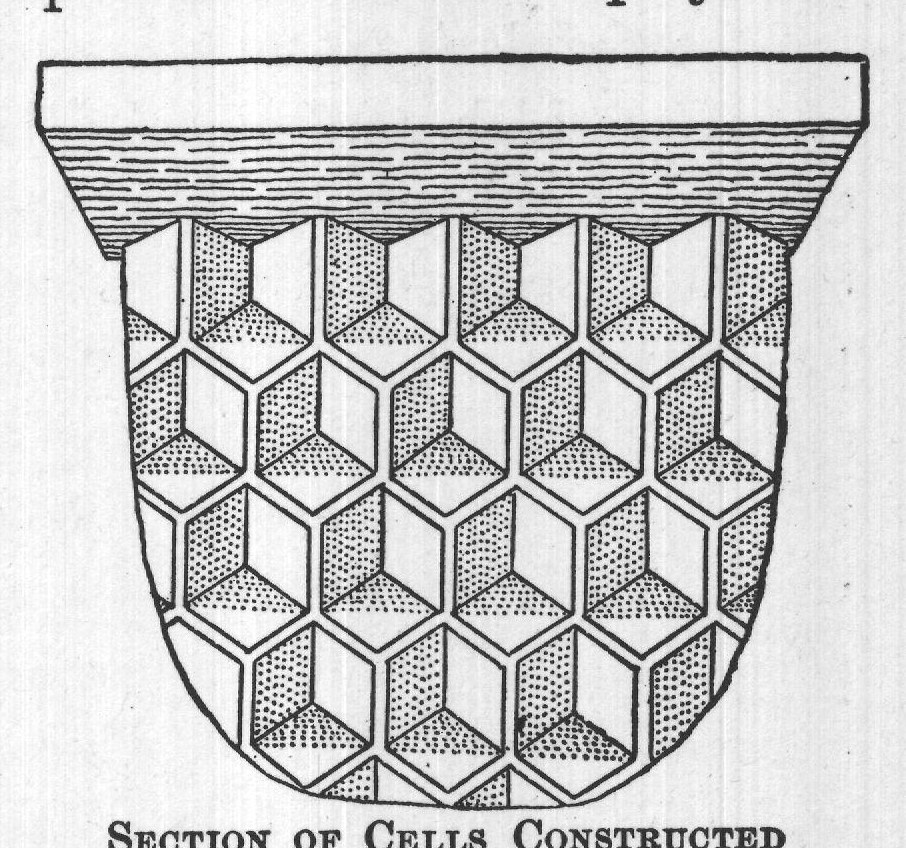
DRONE. sition cells. Although these latter are inevitably irregular, the dimensions of the second or third type are so well calculated that when the decimal system was first established, and people were seeking an incontestable standard of measurement, it was the cell of the bee which was proposed first of all by Réamur. Each one of these cells is an hexagonal tube placed upon a pyramid form, and each honeycomb is formed of two strata of these tubes, base to base, in such a way that the three lozenges which make the pyramid-like base of one cell form at the same time the pyramid-like bases of the three cells on the other side.
In these prismatic tubes the honey is stored away and so that the honey shall not trickle out as it would be likely to do if they were built strictly horizontal — they are tilted up at the outer edge of an angle of four or five degrees. "Besides the saving in wax," says Réamur, speaking of this marvellous building, "which is effected by this The Foundations of a Wonderful City 167 arrangement of the cells, - besides the fact that by this plan the comb may be filled without a single gap, there are other advantages in the way of the solidity thus given.... Every possible advantage in the way of the solidity of each cell is brought about by the manner of its construction, and by its place with reference to the rest of the cells in the comb." "Students of geometry know," says Dr. Reid, "that there are only three shapes that can be employed to divide a surface into uniform spaces, that shall be regular in shape, and without interstices.
They are the equilateral triangle, the square, and the regular hexagon, which latter, in the matter of cell construction, is superior to the two first both from SECTION OF CELLS CONSTRUCTED BY BEES. the point of view of strength and utility, and it is just this form that the bees have adopted, precisely as though its advantages were familar to them. "Furthermore, the bottoms of the cells form three planes meeting at one point, and it has been demonstrated that both in economy of labor and material this system of construction is the best - again, the angle of the inclination of the planes affects this question of economy: this problem has been solved by the bees and confirmed by Maclaurin by abstruse mathematical calculations published in the "Transactions of the Royal Society of London."
Of course I do not suppose for a moment that the bees themselves have made these calculations, but on the other hand I do not believe that chance, or accidental circumstance has brought about these results. The wasps, for instance, have built hexagonal cells, but they have not displayed such ingenuity as the bees have done. Their combs have only one course of cells, and they have not the foundation which serves the bees for their double rows. Hence there is less strength, more irregularity, and a loss of time, of material, and of room, which really means that a quarter of the labor employed and a third of the space occupied is lost. We also find certain other domesticated bees, not so far progressed in civilization, which only build one row of cells for rearing their young, and which support horizontal combs one above another on costly columns of wax. Their food store-cells, are like a row of round pots, and the bees make but a clumsy use of the spaces between them. Indeed, when we compare their City with the Wonderful City of the bees of which we are speaking, it is like comparing a row of huts with a modern laid out city. If the result is not charming, it is severely logical, and demonstrates the genius of the race which is forever fighting to get the most out of matter, space, and time.