Home › Birds in Their Relation to Agriculture › Birds in Their Relation to Agriculture
Birds in Their Relation to Agriculture
(FROM THE PROCEEDINGS OF THE NEBRASKA ORNITHOLOGISTS' UNION, JANUARY, 1901.) 1 BY LAWRENCE BRUNER.
W HEN civilized man takes possession of new regions and begins cultivating the soil and establishes his sovereignty there, the equilibrium as it existed upon his arrival is very quickly disturbed. One or more of the many forms of life - plant and animal - that were previously held within certain limits gain ascendency. The introduction of new crops that furnish an abundance of the proper food for some insect, enables this form to increase out of all proportions and harm soon results. The killing off of certain other forms of life that naturally keep still others in check also assists in disturbing the equilibrium further. The cutting down and clearing away of forests removes the shelter and homes of others, as does also the turning under of 1 By permission. prairie grasses. Then, too, many of the natural residents of primeval forests and virgin prairies shun the sight of man, hence they gradually withdraw from the region, and their influence for good or evil goes with them. Since the majority of such forms are timid and inoffensive creatures, their withdrawal only adds that much more to the already overbalanced conditions. Year by year the gap which at first was scarcely noticeable becomes widened, so that frequent inroads are made and harm results. Instead of trying to ascertain the true cause for all this trouble perhaps exactly the wrong thing is done by the settlers. This of course only has the effect of further widening the gap between safety and danger. Since an insect or other animal becomes noticeably harmful only when present in alarming numbers, it stands to reason that anything which favors such an abnormal increase is a factor in disturbing nature and should be quickly rectified where possible. In order that these disturbances should be looked after the all-wise God of the universe created birds and gave them the power of flight that they might the more readily move about rapidly from place to place, where their services might be needed in balancing affairs. Hence birds have naturally and rightfully been called the "balancers" in nature. This being true, let us see just what their relations are to agriculture.
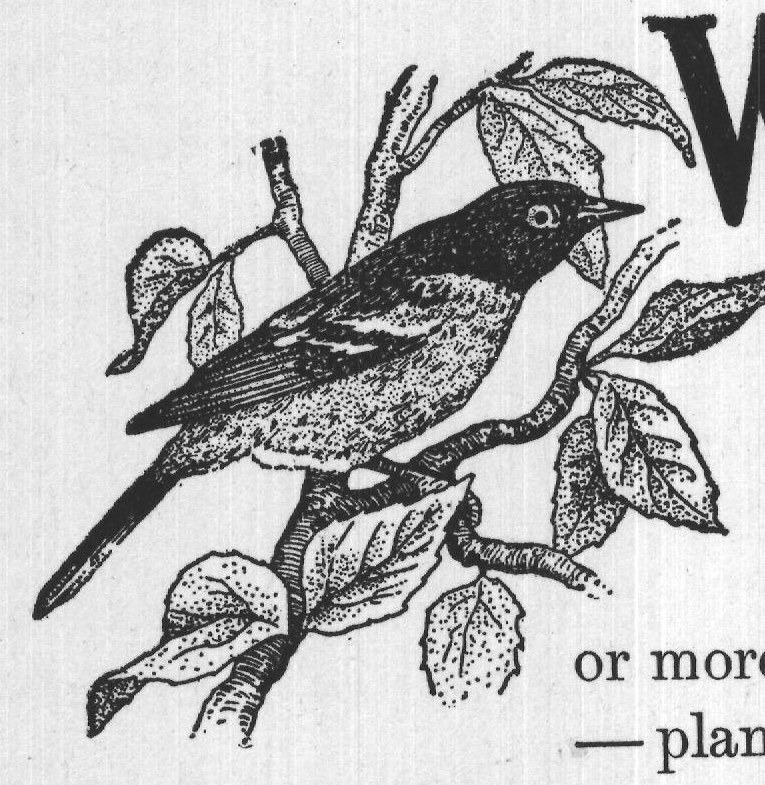
The farmer sows in order that he may reap an increased measure of what he has sown. In doing this he must first turn over the soil. This destroys many existing plants as well as animals that depend upon them for food. The plants thus turned down cannot regain their position and must of necessity die. Not so with many of the animals, however, which soon work their way to the surface. Some of these attack the growing plants which have been made to occupy the place of those destroyed by the plough. Others take wing and seek suitable food in adjoining districts where they add to the numbers already drawing upon the vegetation up to the point of possible continued supply. Here, then, the scales begin to vibrate. In the field the new and tender crop entices the ever-shifting individuals of myriads of forms that have been crowded out elsewhere. The result here too is, or would be, very disastrous were it not for the timely visit of flocks of birds likewise in search of food.
It is during the period of first settlement of a country, when the fields are small, few and widely separated, that injury may and frequently does result from birds. It is then a problem that needs careful consideration, not only for the time being, but also for the future welfare of that country. If animal life is destroyed indiscriminately and without intelligent forethought, calamities unforeseen are sure to follow in the not distant future.
Birds can be useful to man in many ways. They can benefit him by carrying the seeds of various plants from place to place so as to assist him in establishing new groves in which to find shelter from the cold in winter and refuge from the heat of the noonday sun in summer. They plant various shrubs by the wayside that spring up and later are laden with luscious fruit. They also carry the spawn of fishes and small crustaceans among their feathers into new waters, and feed upon the countless seeds of weeds that are scattered broadcast over the face of the earth. Some kinds live almost exclusively upon insects, while others hunt out the small rodents that would, if left to themselves, destroy great quantities of grain and other vegetation. Still other birds benefit mankind by acting as scavengers in the removal of putrid and other offensive matter which would endanger our health. In addition to all these varied direct benefits which are brought about by the presence of birds, man is further indebted to these creatures for the cheer which their gay music, bright plumage and pleasant manners bring to him.
The birds form a carefully organized army of police which is engaged in keeping affairs balanced in nature. But we can go even further summing up the benefits that men may derive from the birds. A great many kinds make excellent food, while others furnish sport and pleasure to a large number of men and boys who seem to require a certain kind of entertainment while accompanied with dog and gun. Dead birds when embalmed as mummies and attached to the head-gear worn by some girls and women are also claimed to cause much happiness.
Birds as Enemies. It would be ridiculous for me to assert here that no injury ever results from the presence of birds on the farm or in the orchard. Quite a number of different species are continually stepping over to the wrong side of the "ledger" as it were, and committing depredations of various kinds which if considered alone would render the perpetrators liable to severe punishment - in some cases even unto death.
Some of the crimes that can be charged to the feathered tribe are cherry and berry-stealing, grape-puncturing, apple-pecking, corn-pulling, grain-eating, the unintentional carrying from place to place of some kinds of scale insects that happen to crawl on their legs and feet, the possible spreading of hog cholera by crows and buzzards, the robbing of the poultry yard, and lastly some birds are accused of making noises that awaken us from our slumbers in the morning.
Some of these crimes are genuine and are to be deplored, while others are more imaginary than real. A few of them could be prevented in part or altogether, while others might be diminished if we were inclined to take the trouble to do it.
After all that can be said pro and con concerning the usefulness of birds in general there remains no doubt, in the minds of thinking people at least, as to the value of these creatures. It is only the vicious, biased, and thoughtless persons who continue ruthlessly to destroy birds indiscriminately without first pausing to consider whether or not it is a proper thing to do, whether it is right or wrong. - Food habits. So varied is this task of evening up in nature that if attended to properly the workers must be numerous in individuals and possess widely different habits. That such is the case can readily be seen by the following brief account of the various groups of our Nebraska birds, along with brief statements of their food habits.
The Grebes and Loons feed chiefly upon snails and other aquatic animals such as are found about their haunts. They also capture many grasshoppers and similar insects that happen in their way. They cannot, therefore, be classed among the especially beneficial birds, neither can they be termed injurious on account of what they eat.
The Gulls, provided as they are with long wings and great powers for flight, are not confined to the seacoast, hence they reach far inland in their migrations, feeding extensively upon insects like locusts, Junebeetles, crickets, etc., large numbers of which they destroy annually. Several kinds of these birds are known to follow the plough and pick up the white grubs and other insects that are turned up and laid bare.
In early days, when grasshoppers did much harm in this state, numerous flocks of these birds were seen to feed upon these insects.
The Cormorants and Pelicans are chiefly destroyers of fishes and frogs, hence can hardly be classed among the most beneficial forms; but whether or not they do any more than to maintain the necessary equilibrium in that particular part of the vast field of nature it is difficult to judge without time for investigation.