Home › Birds' Nests › Birds' Nests: Baltimore
Birds' Nests: Baltimore
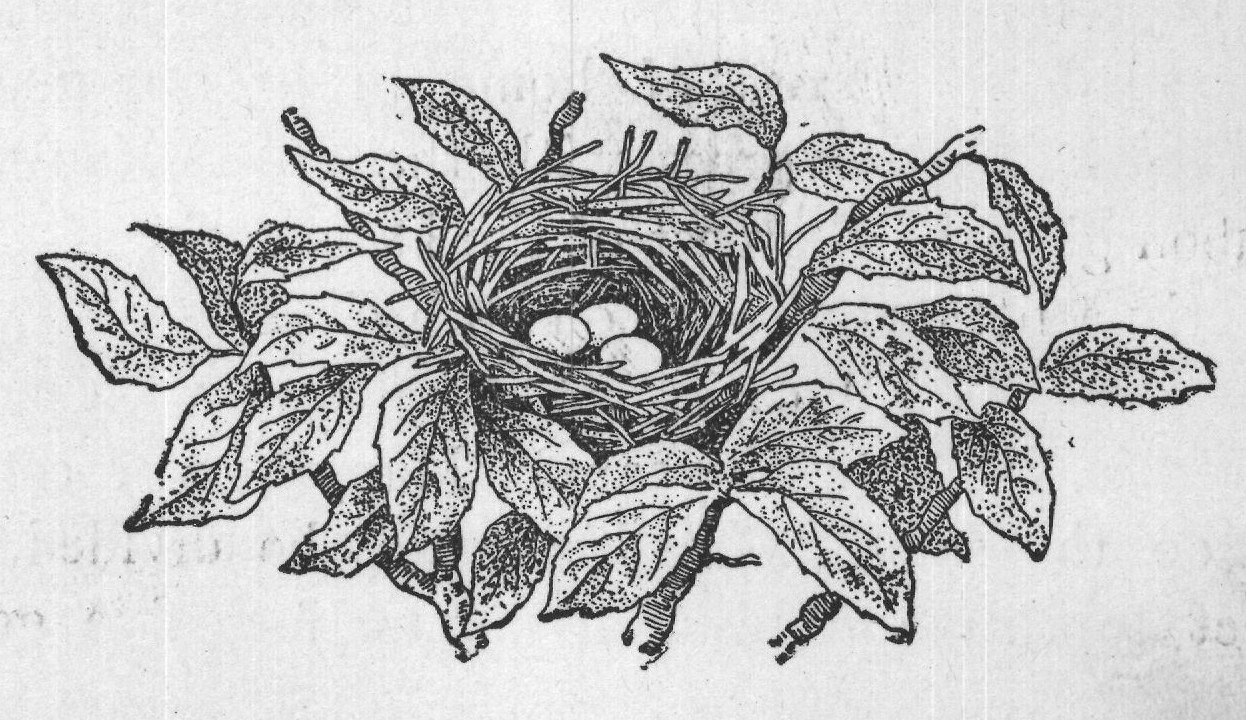
But the nest of nests, the ideal nest, after we have left the deep woods, is unquestionably that of the Baltimore oriole. It is the only perfectly pensile nest we have. The nest of the orchard oriole is indeed mainly so, but this bird generally builds lower and shallower, more after the manner of the vireos.
The Baltimore oriole loves to attach its nest to the swaying branches of the tallest elms, making no at tempt at concealment, but satisfied if the position be high and the branch pendent. This nest would seem to cost more time and skill than any other bird structure. A peculiar flax-like substance seems to be always sought after, and always found. The nest when completed assumes the form of a large, suspended gourd. The walls are thin but firm, and proof against the most driving rain. The mouth is hemmed or overhanded with horse-hair, and the sides are usually sewed through and through with the same.
Not particular as to the matter of secrecy, the bird is not particular as to material, so that it be of the nature of strings or threads. A lady friend once told me that while working by an open window, one of these birds approached during her momentary absence, and, seizing a skein of some kind of thread or yarn, made off with it to its half-finished nest. But the perverse yarn caught fast in the branches, and, in the bird's efforts to extricate it, got hopelessly tangled. She tugged away at it all day, but was finally obliged to content herself with a few detached portions. The fluttering strings were an eye-sore to her ever after, and passing and repassing, she would give them a spiteful jerk, as much as to say, "There is that confounded yarn that gave me so much trouble." From Pennsylvania, Vincent Barnard (to whom I am indebted for other curious facts) sent me this interesting story of an oriole. He says a friend of his, curious in such things, on observing the bird beginning to build, hung out near the prospective nest skeins of many-colored zephyr-yarn, which the eager artist readily appropriated. He managed it so that the bird used nearly equal quantities of various high, bright colors. The nest was made unusually deep and capacious, and it may be questioned if such a thing of beauty was ever before woven by the cunning of a bird.
Birds' Nests Nuttall, by far the most genial of American ornithologists, relates the following: - "A female (oriole), which I observed attentively, carried off to her nest a piece of lamp-wick ten or twelve feet long. This long string and many other shorter ones were left hanging out for about a week before both the ends were wattled into the sides of the nest. Some other little birds making use of similar materials, at times twitched these flowing ends, and generally brought out the busy Baltimore from her occupation in great anger.
She "I may perhaps claim indulgence for adding a little more of the biography of this particular bird, as a representative, also, of the instincts of her race. completed the nest in about a week's time, without any aid from her mate, who, indeed, appeared but seldom in her company, and was now become nearly silent.
For fibrous materials she broke, hackled, and gathered the flax of the asclepias and hibiscus stalks, tearing off long strings and flying with them to the scene of her labors. She appeared very eager and hasty in her pursuits, and collected her materials without fear or restraint, while three men were working in the neigh-. boring walks, and many persons visiting the garden.
Her courage and perseverance were indeed truly admirable. If watched too narrowly, she saluted with her usual scolding, tshrr, tshrr, tshrr, seeing no reason, probably, why she should be interrupted in her indispensable occupation. "Though the males were now comparatively silent on the arrival of their busy mates, I could not help observing this female and a second, continually vocif- P erating apparently in strife. At last she was observed to attack this second female very fiercely, who slyly intruded herself at times into the same tree where she was building. These contests were angry and often repeated. To account for this animosity, I now recollected that two fine males had been killed in our vicinity; and I therefore concluded the intruder to be left without a mate; yet she had gained the affections of the consort of the busy female, and thus the cause of their jealous quarrel became apparent. Having obtained the confidence of her faithless paramour, the second female began preparing to weave a nest in an adjoining elm, by tying together certain pendent twigs as a foundation. The male now associated chiefly with the intruder, whom he even assisted in her labor, yet did not wholly forget his first partner, who called on him one evening in a low, affectionate tone, which was answered in the same strain. While they were thus engaged in friendly whispers, suddenly appeared the rival, and a violent rencontre ensued, so that one of the females appeared to be greatly agitated, and fluttered with spreading wings as if considerably hurt. The male, though prudently neutral in the contest, showed his culpable partiality by flying off with his paramour, and for the rest of the evening left the tree to his pugnacious consort. Cares of another kind, more imperious and tender, at length reconciled, or at least terminated, these disputes with the jealous females; and by the aid of the neighboring bachelors, who are never wanting among these and other birds, peace was at length completely restored, by the restitution of the quiet and happy condition of monogamy."
Birds' Nests Let me not forget to mention the nest under the mountain ledge, the nest of the common pewee, a modest mossy structure, with four pearl-white eggs, looking out upon some wild scene and overhung by beetling crags. After all has been said about the elaborate, high-hung structures, few nests, perhaps, awaken more pleasant emotions in the mind of the beholder than this of the pewee, the gray, silent rocks, with caverns and dens where the fox and the wolf lurk, and just out of their reach, in a little niche, as if it grew there, the mossy tenement!
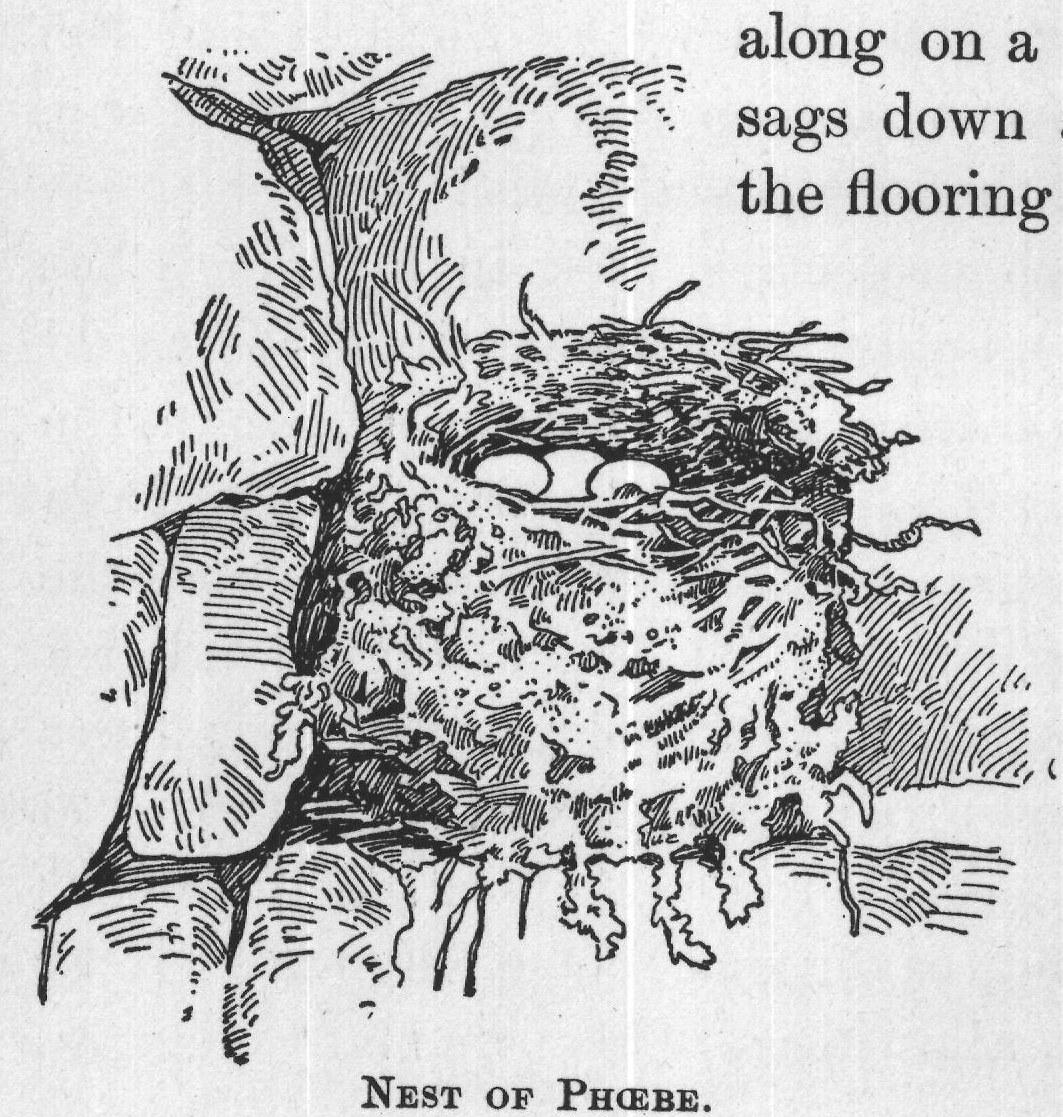
Nearly every high projecting rock in my range has one of these nests. Following a trout stream up a wild mountain gorge, not long since, I counted five in the distance of a mile, all within easy reach, but safe from the minks and the skunks, and well housed from the storms. In my native town I know a pine and oak clad hill, round-topped, with a bold, precipitous front extending half-way around it. Near the top, and along this front or side, there crops out a ledge of rocks unusually high and cavernous. One immense layer projects many feet, allowing a person or many persons, standing upright, to move freely beneath it. There is a delicious spring of water there, and plenty of wild, cool air. The floor is of loose stone, now trod by sheep and foxes, once by the Indian and the wolf. How I have delighted from boyhood to spend a summer-day in this retreat or take refuge there from a sudden shower! Always the freshness and coolness, and always the delicate mossy nest of the phœbe-bird! The bird keeps her place till you are within a few feet of her, when she flits to a near branch, and, with many oscillations (12 I of her tail, observes you anxiously. Since the country has become settled, this pewee has fallen into the strange practice of occasionally placing its nest under a bridge, hay-shed, or other artificial structure, where it is subject to all kinds of interruptions and annoyances. When placed thus, the nest is larger and coarser. know a hayloft beneath which a pair has regularly placed its nest for several successive seasons. Arranged along on a single pole, which sags down a few inches from the flooring it was intended to help support, are three of these structures, marking the number of years the birds have nested there. The NEST OF PHOEBE. ( foundation is of mud with a superstructure of moss, elaborately lined with hair and feathers. Nothing can be more perfect and exquisite than the interior of one of these nests, yet a new one is built every season. Three broods, however, are frequently reared in it.
The pewees, as a class, are the best architects we have. The king-bird builds a nest altogether admirable, using various soft cotton and woollen substances, and sparing neither time nor material to make it substantial and warm. The green-crested pewee builds its Birds' Nests nest in many instances wholly of the blossoms of the white-oak. The wood pewee builds a neat, compact socket-shaped nest of moss and lichens on a horizontal branch. There is never a loose end or shred about it. The sitting bird is largely visible above the rim. She moves her head freely about, and seems entirely at her ease, - a circumstance which I have never observed in any other species. The nest of the great-crested flycatcher is seldom free from snake skins, three or four being sometimes woven into it.
About the thinnest, shallowest nest, for its situation, that can be found is that of the turtle-dove. A few sticks and straws are carelessly thrown together, hardly sufficient to prevent the eggs from falling through or rolling off. The nest of the passenger pigeon is equally hasty and insufficient, and the squabs often fall to the ground and perish. The other extreme among our common birds is furnished by the ferruginous thrush, which collects together a mass of material that would fill a half-bushel measure; or by the fish-hawk, which adds to and repairs its nest year after year, till the whole would make a cart-load.
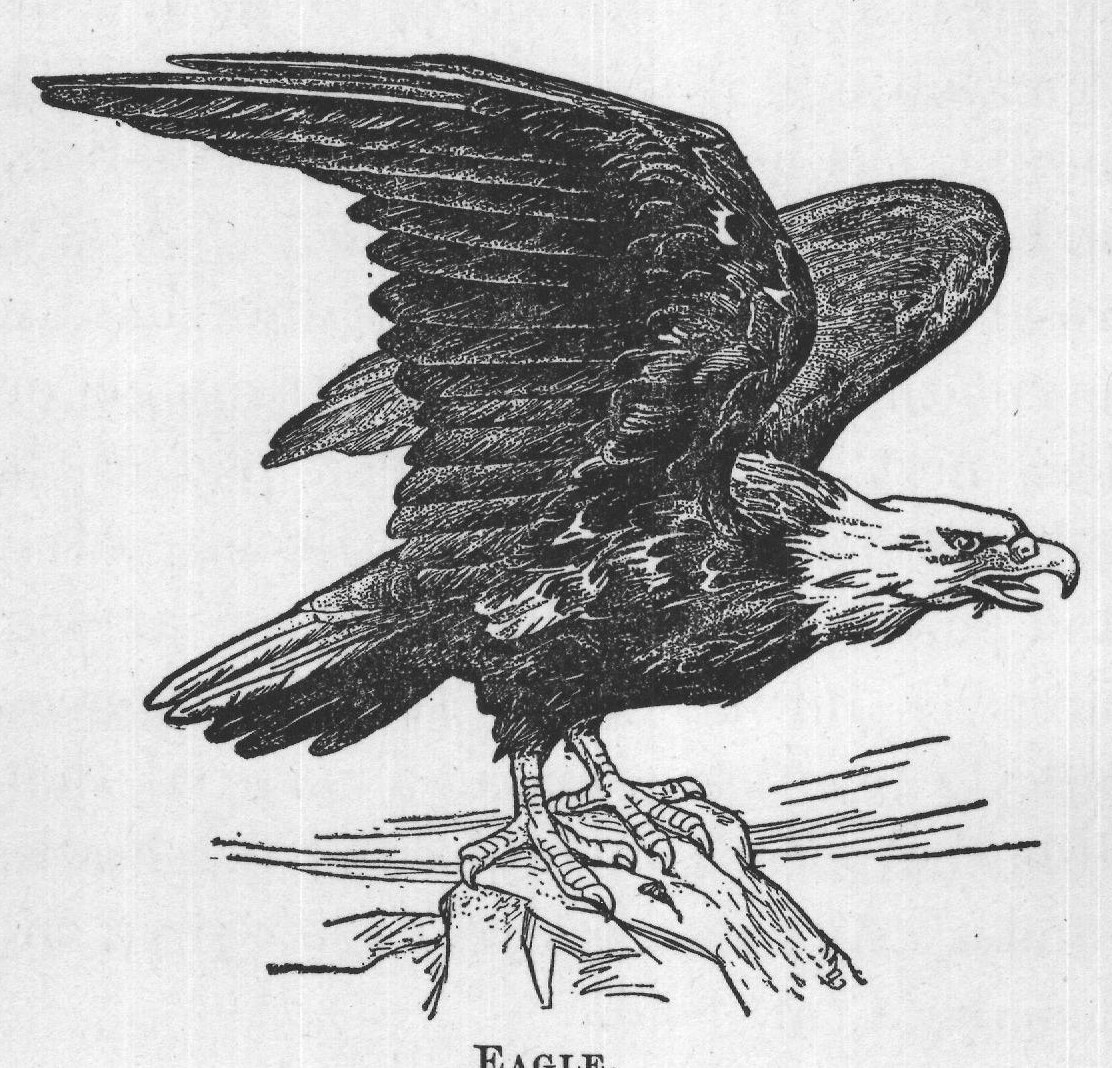
The rarest of all nests is that of the eagle, because the eagle is the rarest of all birds. Indeed, so seldom is the eagle seen, that its presence always seems accidental. It appears as if merely pausing on the way, while bound for some distant unknown region. One September, while a youth, I saw the ring-tailed eagle, an immense, dusky bird, the sight of which filled me with awe. It lingered about the hills for two days.
Some young cattle, a two year-old colt, and half a dozen sheep were at pasture on a high ridge that led up to the mountain, and in plain view of the house. On the second day, this dusky monarch was seen flying about above them. Presently he began to hover over them, after the manner of a hawk watching for mice. He then with extended legs let himself slowly down upon them, actually grappling the backs of the young cattle, and frightening the creatures so that they rushed about the field in great consternation; and finally, as he grew bolder and more frequent in his descents, the whole herd broke over the fence, and came tearing down to the house "like mad." It did not seem to be EAGLE. an assault with intent to kill, but was, perhaps, a stratagem resorted to in order to separate the herd and expose the lambs, which hugged the cattle very closely. When he occasionally alighted upon the oaks that stood near, the branch could be seen to sway and bend beneath him. Finally, as a rifleman started out in pursuit of him, he launched into the air, set his wings, and sailed away southward. A few years afterward, in January, another eagle passed through the same locality, alighting in a field near some dead animal, but tarried briefly.
Birds' Nests So much by way of identification. The bird is common to the northern parts of both hemispheres, and places its eyrie on high, precipitous rocks. A pair built on an inaccessible shelf of rock along the Hudson for eight successive years. A squad of Revolutionary soldiers also found a nest along this river, and had an adventure with the bird that came near costing one of their number his life. His comrades let him down by a rope to secure the eggs or young, when he was attacked by the female eagle with such fury that he was obliged to defend himself with his knife. In doing so, by a mis-stroke, he nearly severed the rope that held him, and was drawn up by a single strand from his perilous position. Audubon, from whom this anecdote is taken, figures and describes this bird as the golden eagle, though I have little doubt that Wilson was right, and that the golden eagle is a distinct species.
The sea-eagle also builds on high rocks, according to Audubon, though Wilson describes the nest of one which he saw near Great Egg Harbor, in the top of a large yellow pine. It was a vast pile of sticks, sods, sedge, grass, reeds, etc., five or six feet high by four broad, and with little or no concavity. It had been used for many years, and he was told that the eagles made it a sort of home or lodging-place in all seasons. This agrees with the description which Audubon gives of the nest of the bald eagle. There is evidently a little confusion on both sides.
The eagle in all cases uses one nest, with more or less repair, for several years. Many of our common birds do the same. The birds may be divided, with respect to this and kindred points, into five general 1 classes. First, those that repair and appropriate the last year's nest, as the wren, swallow, blue-bird, greatcrested flycatcher, owls, eagles, fish-hawk, and a few others. Secondly, those that build anew each season, though frequently rearing more than one brood in the same nest. Of these, the phœbe-bird is a well-known example. Thirdly, those that build a new nest for each brood, which includes by far the greatest number of species. Fourthly, a limited number that make no nest of their own, but appropriate the abandoned nests of other birds. Finally, those who use no nest at all, but deposit their eggs in the sand, which is the case with a large number of aquatic fowls. Thus the common gull breeds in vast numbers on the sand bars or sand islands off the south coast of Long Island. A little dent is made in the sand, the eggs are dropped, and the old birds go their way. In due time the eggs are hatched by the warmth of the sun, and the little creatures shift for themselves. In July countless numbers of them, of different ages and sizes, swarm upon these sandy wastes. As the waves roll out, they rush down the beach, picking up a kind of sea gluten, and then hasten back to avoid the next breaker.