Home › Volumes › Game Birds › Rails, Gallinules, Coots
Sora
Also called: FLORIDA GALLINULE; WATER HEN; REDBILLED MUD HEN; BLUE RAIL
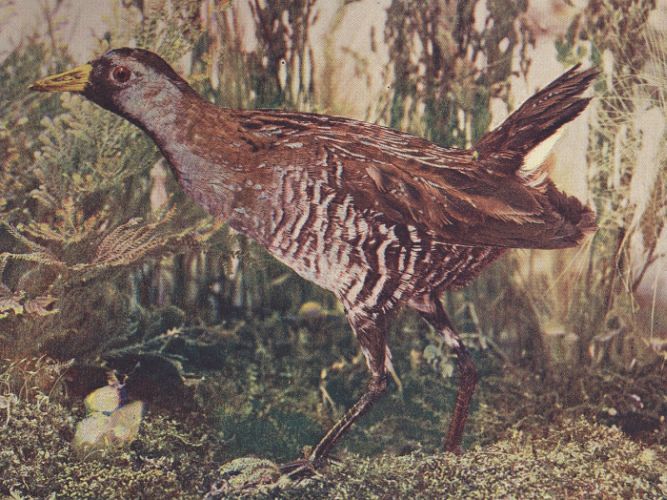
Length.—8 to 9.50 inches.
Male and Female.—"Above, olive brown varied with black and gray; front of head, stripe on crown, and line on throat, black; side of head and breast ashy gray or slate; sides of breast spotted with white; flanks barred slate and white; belly white." (Nuttall.) Bill stout and short (.75 of an inch long). Immature birds have brown breast, no black on head, and a white throat.
Range.—Temperate North America; more abundant on the Atlantic than the Pacific slope. Nests from Kansas, Illinois, and New York northward to Hudson Bay; winters from our southern states to West Indies and northern South America.
Season.—Common summer resident at the north; winter resident south of North Carolina; sometimes in sheltered marshes farther north.
Length.—12 to 14 inches.
Male and Female.—A bare, bright red shield on forehead, same color as bill; plumage uniform dark bluish or grayish black, darkest on head and neck; washed with olive brown on back and shoulders, and fading to whitish underneath; flanks conspicuously streaked with white; space under tail white; legs greenish yellow, reddish at joint.
Range.—Temperate and tropical America, nesting from Ontario and New England to Brazil and Chili, and wintering from our southern states southward.
Season.—Summer resident or transient summer visitor, from May to October, north of the southern states.
Called also.—WHITE-BILLED COOT; CINEROUS COOT; MUDHEN; CROW DUCK; BLUE PETER; MOOR HEN; MEADOW HEN
Length.—14 to 16 inches.
Male and Female.—General color slate; very dark on head and neck, lighter on under parts; edge of wing, tips of secondaries, and space below tail, white. Bill ivory white; two brownish spots near tip, the same shade as the horny plate on front of head, which is a characteristic mark of both gallinules and coots. Legs and feet pale green, the latter with scalloped lobes.
Range.—North America at large, from Greenland and Alaska to the West Indies and Central America; nesting throughout range, but more rarely on Atlantic coast.
Season.—Resident in the south; chiefly a spring and autumn migrant at the north, April, May; September to November.
Where flocks of bobolinks (transformed by a heavy moult into the streaked brown reed birds of the south) congregate to feed upon the wild rice or oats in early autumn, sportsmen bag the soras also by tens of thousands annually, both of these misnamed "ortolans" coming into market in September and October, by which time the sora's pitifully small, thin body has acquired the only fat it ever boasts. "As thin as a rail" at every other season, however, is a most significant expression, yet many people think it is a fence rail that the adage refers to.
The strongly compressed heads and bodies of all the rail tribe, enabling these birds to thread the maze of aisles among the sedges without causing a blade to quiver and tell the tale of their where-abouts, is almost ludicrous when exposed to view--a rare sight. After one has punted a skiff over the partly submerged grass of their retreats and has waited silent and motionless for endless moments, a dingy little brown, black, and gray bird may walk gingerly out of the reeds, placing one long foot timidly before the other, curling the toes of each foot as it is raised, while with head thrust forward and downward, and with the elevation of the rear end of the body emphasized by the pointed tail that jerks nervously at every step taken, an incarnation of fear moves before you. One old shooter declares he has seen rails swoon and go into fits from fright.
Food gathered from the surface of the ground is picked off with sharp pecks, but all the rails run up the rushes also, clinging with the help of their hind toes to the swaying stem within reach of the grain hanging in tassels at the top. The long front toes, flattened but scarcely lobed, enable them to swim across a ditch or inlet, and all the rails are good divers. Rather than expose themselves as a target for the gunner, they will cling to submerged stalks, with their bills only above water, and allow a skiff to pass over them, without stirring. When thoroughly frightened by the dogs' constant flushing, and the shooting of their masters in the marsh, or, more particularly, when wounded, many never rise again.
It is always the sportsman's hope to flush the rails, whose strong legs and skulking habits sufficiently protect them in the sedges, but whose slow, short flight keeps them within range of the veriest tyro. The 'prentice hand is tried on rails. Trailing their legs after them, and feebly fluttering their wings as they rise just above the tops of the rushes, they soon drop down into them again as if exhausted; yet these are the very birds that migrate from the West Indies to Hudson Bay. Their flight is by no means so feeble as it appears. Darky "pushers" enfold the goings and comings, the nesting and incubation of the rails, with all manner of absurd superstitions.