Home › Volumes › Game Birds › Herons and Bitterns
Great Blue Heron
Also called: BLUE CRANE; (erroneously) SANDHILL CRANE
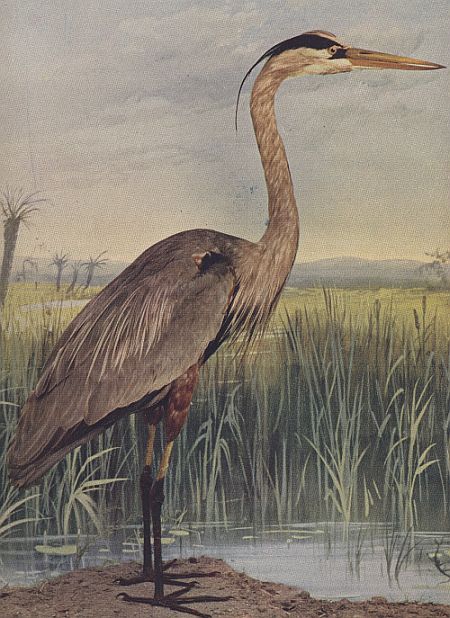
Length.—42 to 50 inches. Stands about 4 feet high.
Male and Female.—Crown and throat white, with a long black crest beginning at base of bill, running through eye, and hanging over the neck, the two longest feathers of which are lacking in autumn. Very long neck, light brownish gray, the whitish feathers on lower neck much lengthened and hanging over the dusky and chestnut breast. Upper parts ashy blue; darker on wings, which are ornamented with long plumes, similar to those on breast, in nesting plumage only. Bend of wing and thighs rusty red. Under parts dusky, tipped with white and rufous. Long legs and feet, black. Bill, longer than head, stout, sharp, and yellow.
Range.—North America at large, from Labrador, Hudson Bay, and Alaska; nesting locally through range, and wintering in our southern states, the West Indies, and Central and South America.
Season.—Summer resident at the north, April to October, often to December; elsewhere resident all the year.
The Japanese artists, "on many a screen and jar, on many a plaque and fan, " have taught some of us the aesthetic value of the heron and its allies--birds whose outstretched necks, long, dangling legs, slender bodies, and broad expanse of wing give a picturesque animation to our own marshes. But American artists seek them out more rarely than shooters, and a useless mass of flesh and feathers lies decomposing in many a morass where the law does not penetrate and the rifle ball does. Longfellow, in "The Herons of Elmwood," paints a word picture of this stately bird, full of appreciation of its beauty and the mystery of the marsh. Surely no one enjoyed
"The cry of the herons winging their way
O'er the poet's house in the elmwood thickets"
more than Lowell himself.
"Sing him the song of the green morass,
And the tides that water the reeds and rushes;
Sing of the air and the wild delight
Of wings that uplift and winds that uphold you,
The joy of freedom, the rapture of flight
Through the drift of the floating mists that infold you."
Hern, an obsolete form of heron, was perhaps last used by Tennyson when he wrote of "The Brook" that comes "from the haunts of coot and hern." The old adage, "not to know a hawk from a handsaw," lacks its meaning if we do not recall how heronsewe, a heron (not heronshaw, as is often written), was corrupted in England long ago, when hawking was a favorite sport there, into hernser, in turn corrupted into handsaw. Tradition says that the soul of Herodias became incarnate in the heron, the favorite bird of Herod, but in that case the common heron of Europe (Ardea cinerea of Linnaeus) should bear her hated name, and not this distinctly American species.
Patience, an easy virtue of the tropics, from whence the great blue heron comes, characterizes its habits when we observe them at the north. Standing motionless in shallow water, the Sphinx-like bird waits silently, solemnly, hour after hour, for fish, frogs, small reptiles, and large insects to come within range; then, striking suddenly with its strong, sharp bill, it snaps up its victim or impales it, gives it a knock or two to kill it if the thrust has not been sufficient, tosses it in the air if the prey is a fish, and, in order to avoid the scratching fins, swallows it head downward. Hunters pretend to excuse their wanton slaughter by saying herons eat too many fish; but possibly these were created as much for the herons' good as our own, and no thanks are offered for the reptiles and mice they destroy.
Wild, shy, solitary, and suspicious birds, it is next to impossible to approach them, even after one has penetrated to the forbidding retreats where they hide. Near sunset is the hour they prefer to feed. In Florida one meets herons constantly, fishing boldly on the beach, wading in the lagoons, perching on stumps, and walking with stately tread and slow through the sedges by the river side, their long necks towering above the tallest grasses. The cypress swamps all through the south contain herons of every kind; but at the north the sight of this lone fisherman is rare enough to be memorable. Nine times out of ten he will be standing with his head drawn in to rest between his shoulders, and motionless as a statue. As he generally chooses to fish under the shadow of a tree by the water, or among the rushes that grow out into the sluggish stream, his quiet plumage and stillness protect him from all but the sharpest eyes. Disturb him, and with a harsh rasping squawk he spreads his long wings, flaps them softly and solemnly, and slowly flies deeper into the marsh. At close range he looks a comical mass of angles; but as he soars away and circles majestically above, his great shadow moving over the marsh like a cloud, no bird but the eagle is so impressively grand, and even it is not so picturesque.