Home › Volumes › Game Birds › Snipe, Sandpipers, Etc.
Bartramian Sandpiper
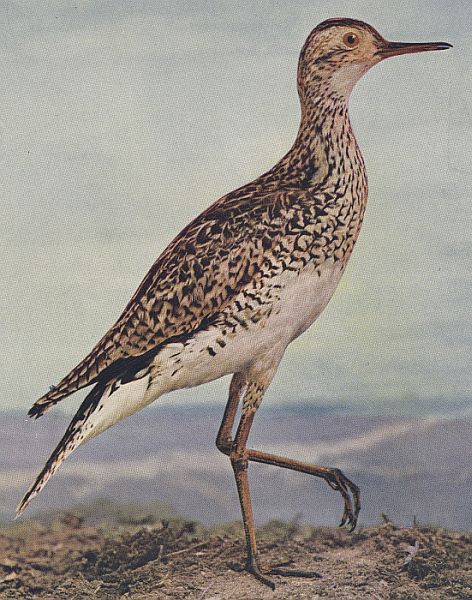
Called also.—UPLAND, or FIELD, or GRASS, or HIGHLAND PLOVER; BARTRAM'S TATTLER; PRAIRIE PIGEON; PRAIRIE SNIPE; QUAILY
Length.—11.50 to 12.75 inches; usually just a foot long.
Male and Female.—Upper parts blackish varied with buff, brown, and gray; the head and neck black streaked with buff, and a buff stripe through the eye; the back and the wing coverts dusky barred with buff, the lighter color prevailing on the nape and wings; outer primary olive brown barred with white, the others barred with black; lower back, rump, and central tail coverts brownish black; tail feathers brownish gray, the outer ones varying from orange brown to buff or white, all more or less barred with black, with a broad black band across the end, and white tips of increasing breadth. Under parts white, washed with buff on breast and sides, which are streaked or barred with black. Bill comparatively short, yellow, with black ridge and tip; feet dull yellow.
Range.—North America, chiefly east of Rocky mountains and north to Nova Scotia and Alaska; nesting nearly throughout its North American range; wintering southward so far as Brazil and Peru.
Season.—Summer resident or migrant; April, July, August, September.
It is in high, dry, grassy meadows, among the stubble in old pastures, in rustling corn fields and on the open plains, and not always near salt water, that the sportsman looks for this so called wader, more precious in his sight than any other small game bird except possibly the woodcock, Bob White, and Jack snipe. Few birds have been more tirelessly sought after; few that were ever abundant in New England and other eastern states have been so nearly exterminated there by unchecked, unintelligent, wanton shooting. It is to Kansas, Texas, and the great plains watered by the Missouri that one must now go to find flocks numbering even fifty birds, whereas our grandfathers once saw them in flocks of thousands on the Atlantic slope. Like the geese, ducks, and certain other birds that are exceedingly afraid of men and impossible to stalk afoot, this wary "plover" pays no attention whatever to horses and cattle; hence shooting from a wagon is the common method of hunting it in some parts of the west to-day; and an unsuspicious flock, suddenly startled to wing only when the wheels rumble beside it, soon fairly rains plover. Shot easily penetrates the delicate tender flesh unprotected by a dense armor of feathers such as generally saves a goose under similar circumstances.
Delicious as a broiled plover is, there is no true sportsman who will hesitate to admit that the graceful, slender, beautifully marked, sweet voiced bird is vastly more enjoyable in life. A loud, clear, mellow, rippling whistle that softly penetrates to surprising distances, like the human voice in a whispering gallery, has an almost ventriloqual quality, and one never knows whether to look toward the clouds or among the stubble at one's feet for the musician. For liquid purity of tone can another bird note match this triplet? At the nesting season, especially, a long, loud, weird cry, like the whistling of the wind, chr-r-r-r-r-e-e-e-e-e-oo-oo-oo-oo, as Mr. Langille writes it, may be heard even at night; the mournful sound is usually uttered just after the bird has alighted on the ground, fence, or tree, and at the moment when its wings are lifted, till they meet above its back. Everyone who has ever heard this cry counts it among the most remarkable sounds in all nature. The spirited alarm call, quip-ip-ip, quip, ip, ip, rapidly uttered when the bird is flushed in its feeding grounds, and still another sound, a discordant scream quickly repeated, that comes chiefly from disturbed nesting birds, complete the list of this tattler's varied vocal accomplishments.
If this upland plover realized how perfectly the plumage on its back imitates the dried grass, it might safely remain motionless and trust to the faultless mimicry of nature to conceal it. As you look down from your saddle into a dry field, the sharpest eye, often fails to see these birds squatting there until something (but not the horse) frightens them and a good sized flock surprises you when it takes wing. Three or four sharply whistled notes ring in your very ears as the plovers mount. The swift flight is well sustained. Mere specks seem to float across the heavens, and were it not for the soft, clear rippling whistle that descends from the clouds, who would imagine that these birds so commonly seen on the ground would penetrate to such a height above it? In the migrations along the coast and inland, serried ranks, flying high, cover immense distances daily. The pampas of the Argentine Republic hold flocks that have gathered on our own great plains, who shall say how soon after the journey was begun?