Home › Volumes › Fishes › The Perches
Wall-eyed Pike; Pike-perch
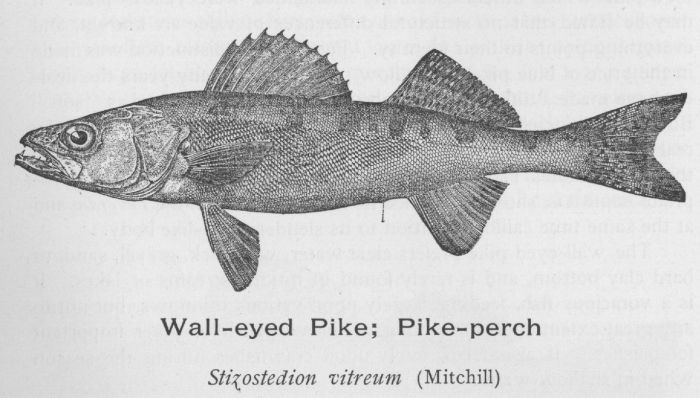
This important fish is a species of wide distribution. It is found from Lake Champlain westward throughout the Great Lakes region and to Assiniboia. It is native also to the small lakes of New York and the Susquehanna and Juniata rivers, east of the Alleghenies. In the Mississippi Valley it occurs in many of the larger streams and small lakes as far south as Georgia and Alabama. Though found in many streams, it is preferably a fish of the lakes, and it reaches its greatest abundance in the Great Lakes, particularly in Lake Erie. In different parts of its range it is known by different names. Among the Great Lakes it is called the wall-eyed pike, yellow pike, dore or dory by the French-Canadians, and pickerel in places where the true pike (Esox lucius) is found.
In the Susquehanna and Juniata rivers, and in the small lakes of northern Indiana, it is known as salmon or jack salmon, names absurd and wholly without excuse. Southward in the Mississippi Valley it is the jack. Elsewhere it is called okow, blowfish, or green pike. In the Great Lakes, particularly in Lakes Erie and Ontario, the young of a certain colour are known as blue pike, which commercial fishermen believe to be a wholly distinct species from the yellow pike. So firmly fixed is this belief that they have little patience with the naturalist who tells them otherwise. They all admit, however, that they have never found any blue pike with roe, and are unable to point out any differences except that of colour. And not all of them agree regarding that character. We have been shown fish which some fishermen said were blue pike which others as stoutly maintained were yellow pike. It may be stated that no structural differences of value are known, and everything points to their identity. Formerly no distinction was made in the price of blue pike and yellow pike, but for many years the dealers have made a difference, and now the blue pike is classed as "soft." But this is principally on account of their abundance rather than to any real inferiority of flavour or keeping qualities. A book-name used by the United States Fish Commission is pike-perch, and a very appropriate name it is, showing at once its relationship with the Percidae and at the same time calling attention to its slender, pike-like body.
The wall-eyed pike prefers clear water, with rock, gravel, sand, or hard clay bottom, and is rarely found in muddy streams or lakes. It is a voracious fish, feeding largely upon various minnows, but not to any great extent upon the young of the whitefish or other important food-fishes. It also feeds freely upon crawfishes during the season when in shallow water.
This fish ordinarily inhabits water of moderate depth, deeper than that frequented by the black bass, but more shallow than that sought by the whitefish and cisco. It varies greatly in size, the maximum length being about 3 feet and the maximum weight about 25 pounds. But examples of this size are very rare. Specimens weighing even 15 pounds are not common. It is doubtful if those taken in the Great Lakes average heavier than 10 pounds. Those taken in Lake Maxinkuckee run from 3 to 7 pounds. The so-called blue pike average less than 2 pounds.
The spawning-time of the wall-eyed pike is in the early spring, and begins even before the ice goes off. The spawning-place is in shoal water, usually on the edges of the bars, on hard or gravel bottom. The eggs are very small, only about 1/12 inch in diameter, and average about 150,000 to the quart. The spawning fish at Put-in Bay average about 2 pounds in weight, and produce about 90,000 eggs each. Larger fish produce proportionally a greater number; and a 20-pound fish would yield about 900,000 eggs.
This is one of the most important fishes propagated by the United States Fish Commission. The principal propagating-station is at Put-in Bay, and the output in 1900 was 89,700,000 eggs, fry, and finger lings.
Those who are acquainted with the wall-eyed pike as food-fish hold it in very high esteem. The flesh is firm, flaky, and white, and of delicious flavor.
Colour, dark olive, finely mottled with brassy, the latter colour forming indistinct oblique bars; sides of head more or less vermiculated; lower jaw flesh-coloured; belly and lower fins pinkish; spinous dorsal with a large jet-black blotch on membrane of the last 2 or 3 spines, otherwise nearly plain; second dorsal and caudal mottled--olive and yellowish; base of pectoral dusky, without distinct black blotch.
The colour of this fish is very variable, as is indicated by some of its vernacular names, as yellow pike, gray pike, and blue pike. It can always be told from the sauger by its fewer subequal pyloric coeca.