Home › Volumes › Fishes › The Perches
Sauger; Sand-pike
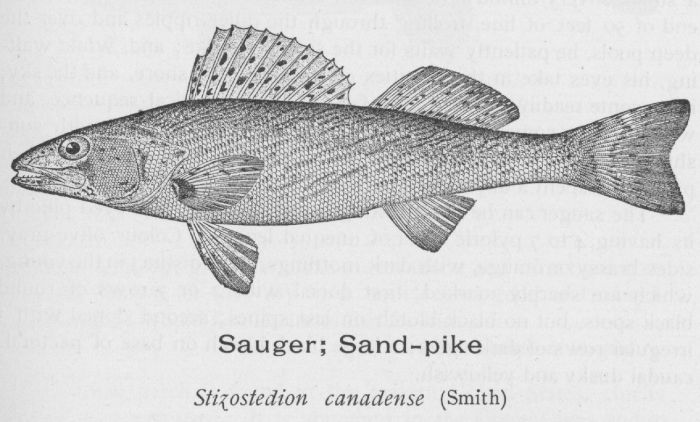
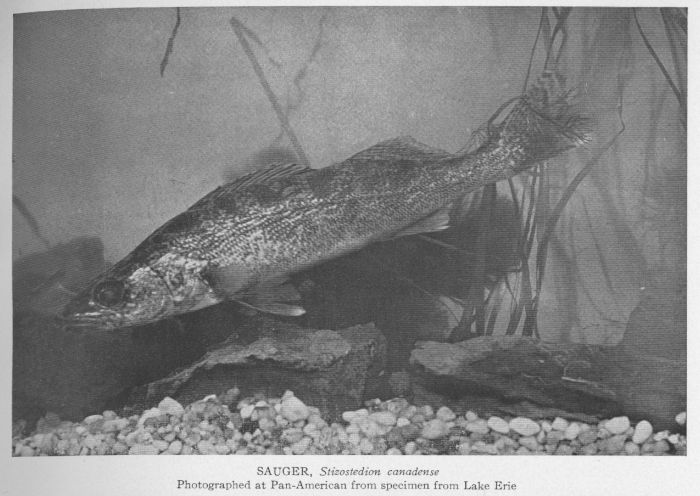
The sauger is found from the St. Lawrence westward through the Great Lakes, and in the Mississippi Valley west to Montana and south to Tennessee and Arkansas. It is especially abundant northward, in the St. Lawrence and the lower Great Lakes, where the typical form is found. In the upper Great Lakes and southwestward is found the subspecies griseum, which differs chiefly in the smoother opercles, fewer opercular spines, and the less complete squamation of the head. In the upper Missouri basin is found the subspecies boreum, differing only in the more slender head.
The sauger is a much smaller fish than the wall-eyed pike, its length seldom exceeding a foot or 18 inches and its weight a pound or two. It is on this account much less important as a food-fish than the wall-eye. Nor is it much valued as a game-fish, except, perhaps, in the Mississippi Valley, where it is frequently taken by casting and sometimes by trolling.
A few years ago the sauger was, to the few elect who knew where to find it, the choicest game-fish of the lower Wabash River; and we knew a minister who always went "saugering" when he failed in other ways to get the proper inspiration for his next Sunday's sermon. Starting in at the Vandalia bridge, he would direct his oars man to get out into the current, then row slowly up stream, even to old Fort Harrison and beyond, perhaps to Durkee's Ferry; then, turning, slowly drift with the current home again. Meanwhile, with a small, silvery minnow (a satin-fin, creek chub, or river chub) at the end of 50 feet of line, trolling through the quiet ripples and over the deep pools, he patiently waits for the sauger's strike; and, while waiting, his eyes take in the beauties of the river, the shore, and the sky; ideas come readily, his thoughts fall together in logical sequence, and when Sunday comes, the sermon that he preaches is filled with sunshine, and love, and faith in humanity; and his flock know that their pastor has spent a day upon the river.
The sauger can be easily distinguished from the wall-eyed pike by its having 4 to 7 pyloric coeca of unequal length. Colour, olive-gray, sides brassy or orange, with dark mottlings, most distinct in the young, which are sharply marked; first dorsal with 2 or 3 rows of round black spots, but no black blotch on last spines; second dorsal with 3 irregular rows of dark spots; a large black blotch on base of pectoral; caudal dusky and yellowish.
GENUS PERCA LINNAEUS
The River Perch
Body oblong, somewhat compressed, the back elevated; cheeks scaly, opercles mostly naked, the opercle armed with a single spine; preopercle and shoulder-girdle serrated, the former with retrorse, hooked serrations below; premaxillaries protractile; teeth in villiform bands on jaws, vomer, and palatines; no canine teeth; branchiostegals 7; gill-membranes separate; scales small, ctenoid; lateral line complete; dorsal fins entirely separate; caudal emarginate; air-bladder present; pyloric coeca 3.
Three species known, all freshwater fishes of northern regions, only one of them in America.