Home › Volumes › Fishes › The Basses, Crappies and Sunfishes.
Large-mouthed Black Bass; Straw Bass
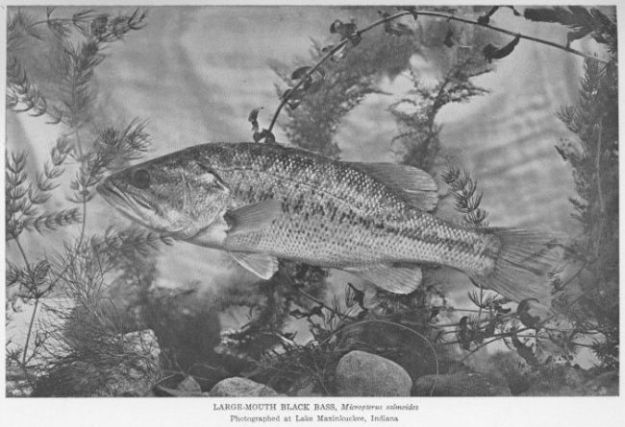
Among the Centrarchidae, the large-mouthed black bass is second only to its cogener, the small-mouthed species, as a game-fish. It is equally well known to anglers, and its range is even greater. From Canada and the Red River of the North it extends southward to Florida, Texas, and even into Mexico. In all suitable waters it is everywhere abundant, but prefers lakes, bayous and other sluggish waters. In the small lakes of the Upper Mississippi Valley it is most abundant in those of moderate or shallow depths. Some small lakes that are rather shallow, whose bottoms are chiefly mud, and whose water is warm, are found to be well suited to the straw bass, and to be entirely without the small-mouthed black bass. But small lakes of considerable depth, cool water and with bottom partly of mud and partly of sand and gravel, such as Lake Maxinkuckee, seem equally well adapted to both species. In the ponds, bayous, lagoons and sluggish streams of the South the straw bass is very abundant. It frequently enters brackish water along the coast, where it seems to be permanently resident.
In the North the maximum weight of the straw bass is about 8 pounds. Examples of that size are rarely seen, however. The average size does not exceed 3 or 4 pounds, though examples weighing 5 or 6 pounds are not at all rare. In the warm waters of the South, particularly in Florida, where the temperatare is equable and food abundant, this fish attains a much greater size. Dr. Henshall gives the maximum weight at 12 to 14 pounds, he himself having seen examples of those weights.
The straw bass, under favourable surroundings, grows very rapidly. The conditions favourable for rapid and large growth are abundant food and waters of warm or moderate temperature and wide extent. The species is very productive. In May, 1892, the Fish Commission placed in one of the rearing ponds at Washington 15 adult large-mouth black bass, 7 or 8 of which were females. These fish spawned in June and at Thanksgiving time, when the young were removed from the pond, there were taken out, by actual count, over 37,000 young, each 3 to 4 inches long and 500 each weighing about one-half pound. These fish had received abundant food, but the 500 larger ones had doubt-less eaten many smaller ones of their own kind.
This fish has received many vernacular names, among which may be mentioned large-mouthed black bass, straw bass, green bass, bayou bass, slough bass, lake bass, moss bass, grass bass, marsh bass, Oswego bass, trout, green trout, welchman, chub, and many others more or less absurd. The most distinctive and expressive name is doubtless "large-mouthed black bass," the only objection to which is its length. For many reasons "straw bass" for this species and "black bass" for the small-mouthed species are excellent names.
The relative merits of the 2 species as game-fishes have been much discussed. This depends upon many factors, as the character of the water with regard to extent, depth, temperature and presence of vegetation, character of bottom, food, season, time of day, personality of the particular fish, and many others. Dr. Henshall regards them as of equal gameness. Our own