Home › Volumes › Fishes › The Basses, Crappies and Sunfishes.
Small-mouthed Black Bass; Black Bass
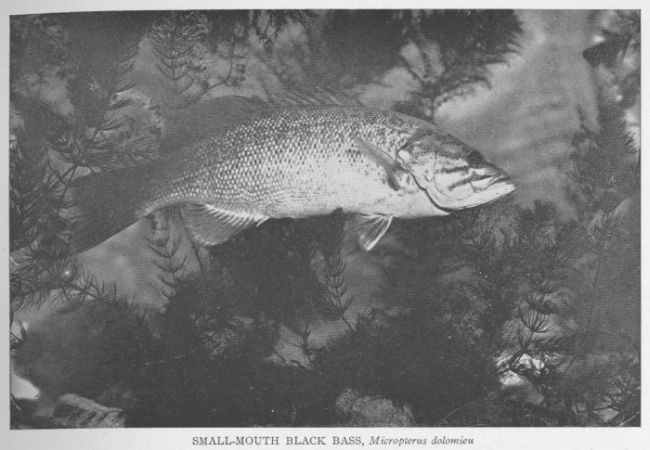
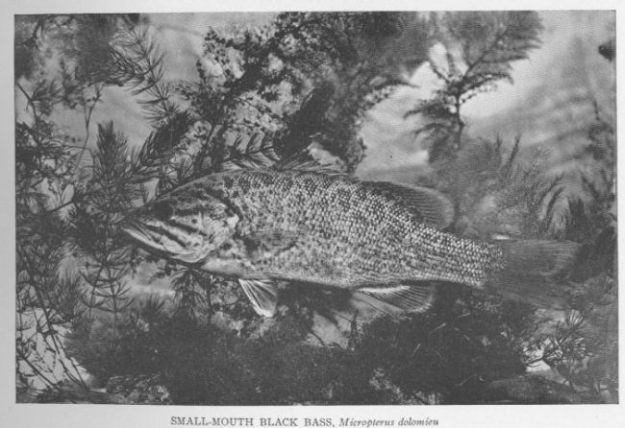
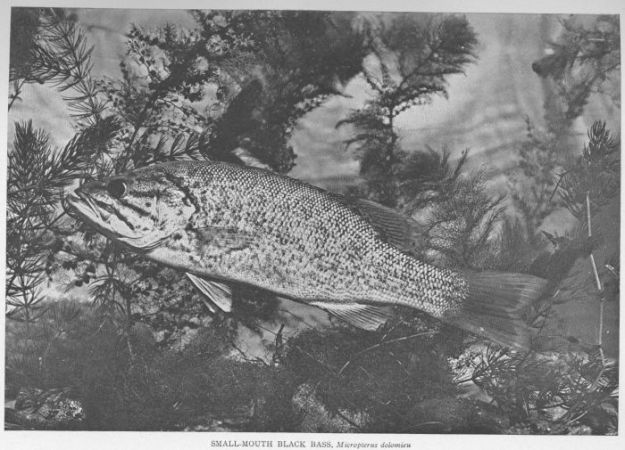
In the felicitous words of Dr. James A. Henshall, the author of the "Book of the Black Bass,"
"The black bass is eminently an American fish; he has the faculty of asserting himself and making himself completely at home wherever placed. He is plucky, game, brave and unyielding to the last when hooked. He has the arrowy rush of the trout, the untiring strength and bold leap of the salmon, while he has a system of fighting tactics peculiarly his own. He will rise to the artificial fly as readily as the salmon or the brook trout, under the same conditions; and will take the live minnow, or other live bait, under any and all circumstances favourable to the taking of any other fish. I consider him, inch for inch and pound for pound, the gamest fish that swims." And there are few, if any, who will be disposed to take issue in this matter with so experienced and expert an angler as Dr. Henshall.
The black bass is found in most suitable waters from Lake Champlain westward to Manitoba and southward on both sides of the mountains from James River, Virginia, to South Carolina and the Great Lakes to northern Mississippi and Arkansas. Through the operations of the Federal and various State Fish Commissions it has been introduced into many waters to which it was not native. It was planted in the headwaters of the Potomac as early as 1853, and since then it has been successfully introduced into many waters in New England and other states east of the Alleghanies, into many of the Western States, and in England, France, Germany, and other foreign countries.
In nearly all the localities where the black bass has been planted it has done well, and it is now an abundant species not only throughout its natural habitat but in many other places. It is by preference a fish of the clear running streams, and clearer, colder lakes. In the North it is equally abundant in lakes and streams, while in the southern part of its range it will be found only in the cooler streams which possess a good current.
The habits, game qualities and food value of the black bass are so well known, and so much has been written about this splendid fish, that a lengthy presentation of the subject is not given here.
This fish varies greatly in size in different waters. The maximum weight seems to be about 5 pounds. An example caught in Lake Maxinkuckee, 18 3/4 inches long, and 12 inches in circumference, weighed 4 pounds. The largest ever taken in that lake weighed about 5 pounds.
Like all fishes of wide distribution, the black bass presents great variations in colour; but whatever the colour the adult can always be readily distinguished from the large-mouthed black bass by the presence of about 17 rows of scales on the cheek instead of 10 or 11 in the latter species.
Head 2 1/2 to 3 1/2; depth 2 3/4 to 3 1/2; eye 5 to 6 1/2; D. X, 13 to 15; A. III, 10 to 12; scales 11-72 to 85-25, 67 to 78 pores, about 17 rows on cheek. Body ovate-fusiform, becoming deeper with age; mouth large, but smaller than in the large-mouthed black bass; maxillary ending considerably in front of posterior border of orbit, except in very old examples; scales on cheek minute; those on body small; dorsal fin deeply notched, but less so than in the other species, the ninth spine being about half as long as the fifth, and not much shorter than the tenth; soft dorsal and anal each scaly at the base. General colouration, dull golden green, with bronze lustre, often blotched with darker, especially on head; young with darker spots along the sides, which tend to form short vertical bars, but never a dark lateral band; 3 bronze bands radiating from eye across cheek and opercles; a dusky spot on point of opercle; belly white; caudal fin yellowish at base, then black, with white tips; dorsal with bronze spots, its edge dusky. In some waters the fin-markings are obsolete, but they are usually conspicuous in the young. Southern examples usually have the scales on lower part of sides with faint dark streaks. Adults have all these markings more or less obliterated, the colour ultimately becoming a uniform dead green, without silvery lustre.