Home › Volumes › Fishes › The Basses, Crappies and Sunfishes.
Red-eared Sunfish
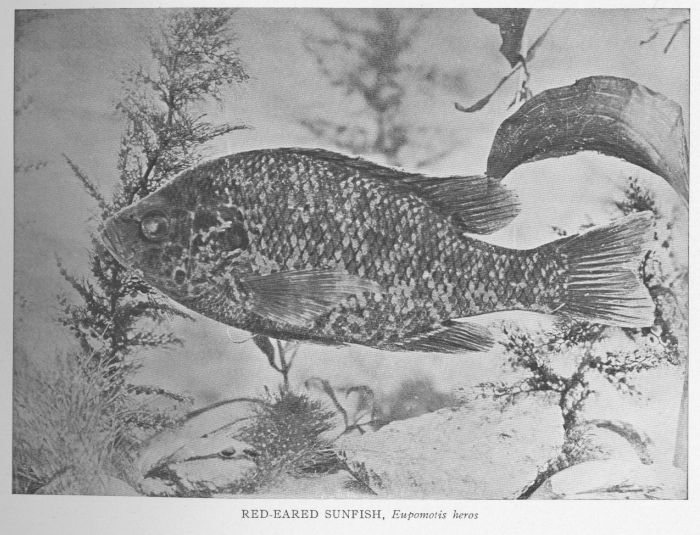
This sunfish is found from northern Indiana to Florida and the Rio Grande. It is an inhabitant of lowland streams and ponds, but does not appear to be common anywhere. It reaches a length of 6 or 7 inches. Nothing is definitely known as to its food and game qualities.
Body robust, moderately elongate, dorsal and ventral outlines equally curved; head rather large, the projecting snout forming a considerable angle above the eyes; mouth rather wide, oblique, maxillary reaching slightly part front of eye; pectoral fin reaching beyond middle of pupil; opercular flap smaller than eye, much as in E. gibbosus; gillrakers short and not very stiff; pharyngeal teeth paved, less blunt than in E. gibbosus. Colour, dark, greenish above, gradually becoming brassy toward belly which is light brassy; opercular spot greenish black; the flap with a broad, blood-red border in the male, plain in the female; no dark spot on dorsal or anal.
GENUS MICROPTERUS LACEPEDE
The Black Basses
Body oblong, compressed, the back not much elevated; head oblong, conic; mouth very large, oblique, the broad maxillary reaching nearly to or even beyond the eye; supplemental bone well developed; lower jaw prominent; teeth on jaws, vomer and palatines in broad villiform bands, the inner depressible; usually no teeth on tongue; preopercle entire, the opercle ending in 2 flat points without cartilaginous flap; branchiostegals normally 6; gillrakers long and slender; scales rather small, weakly ctenoid; lateral line complete; dorsal fin divided by a deep notch, the spines low and not especially strong; anal fin much smaller than the dorsal; pectoral obtusely pointed, the upper rays longest; ventrals below the pectorals and close together; caudal fin emarginate. Size large.
Two species, among the most important of American gamefishes, now largely introduced into European waters.
a. Mouth moderate, the maxillary in adult not extending beyond eye; scales small, about 17 rows on cheek; young more or less barred or spotted; never with a black lateral band; dolomieu
aa. Mouth very large, the maxillary in adult extending beyond eye; scales rather large, about 10 rows on cheek; young with a blackish lateral band; .....................salmoides