Home › Volumes › Fishes › The Sea-bass
Nassau Grouper; Hamlet; Cherna Criolla
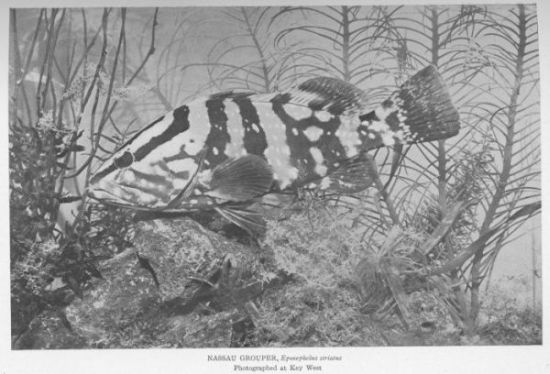
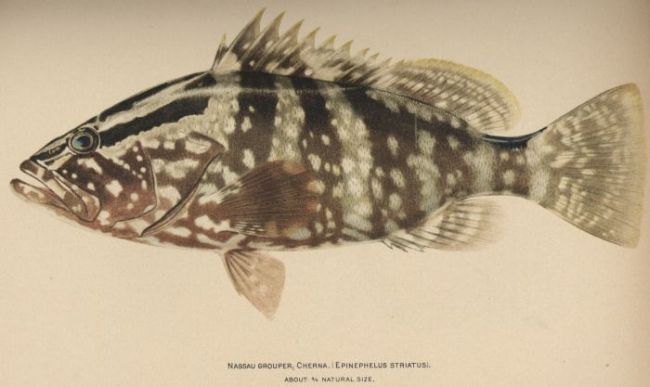
This large species is common from Key West to Brazil. It is common about Key West and many large examples are taken. It attains a length of 3 feet and a weight of 50 pounds, though those seen in the Key West market usually do not exceed 10 pounds. It is a good food-fish and is found all the year round about Key West.
Colour in life, rather pale olivaceous gray, paler below, sides with obscure whitish cloudings; side with about 4 irregular broad vertical bars dark brown in colour, each enclosing small whitish spots, these bars darkest on back and extending on dorsal fin; a square jet-black blotch on upper edge of caudal peduncle; a dark band from snout through eye to side below origin of dorsal; another on median line of snout, forking opposite front of eye, the 2 bands extending backward and ceasing on occiput without reaching the other band; cheek light brown with whitish blotches; fins colour of body but lighter; dorsal and caudal with narrow pale yellow border.
The red hind or cabrilla (E. guttatus) is found from the Carolinas through the West Indies to Brazil. It is rare on our coast, but is common at Havana.
From related species it may be distinguished by its colour, which in life is light yellowish olive above, whitish below; 3 broad, oblique, obscure olive bands running upward and backward on side; spots on body vivid scarlet, those above darker, edges of scales brown; inside of mouth mostly pale, partly scarlet; belly spotted; dorsal olive-yellow, somewhat clouded, a few red spots on spinous dorsal; soft dorsal broadly edged with black; caudal yellowish, the posterior half black, its edge white; anal like soft dorsal; pectoral light yellow, with rows of small scarlet spots; ventrals red, blackish at tips.
The speckled hind or john-paw (E. drummond-bayi) is most abundant on the Snapper Banks in the Gulf of Mexico, but it has been recorded from the Bermudas and Charleston. It attains a weight of 30 pounds, and is an important food-fish in the Pensacola market. It is perhaps the most beautiful in colour of all the groupers.
Colour, dark umber-brown, densely covered with small pearly-white spots, those below smaller and nearly round, all in irregular series; fins not dark-edged, all covered with similar spots, those of the paired fins chiefly on the inner surface; lower side of head flushed with red and unspotted; caudal fin more densely spotted than the body, the terminal spots lavender; pectoral with a subterminal orange band.