Home › Volumes › Fishes › The Sea-bass
Red Grouper; Cherna Americana
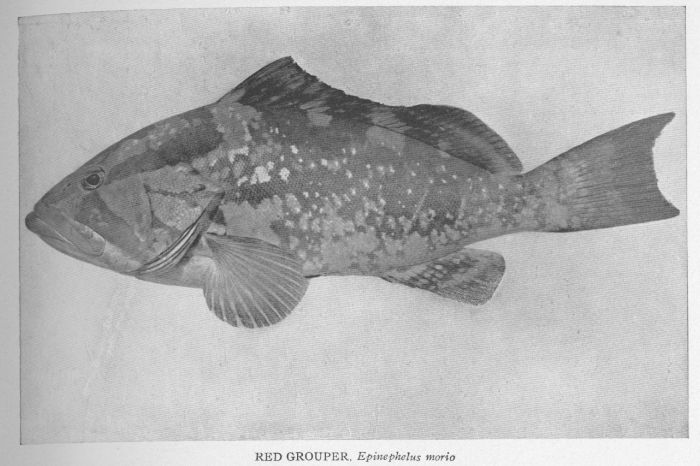
The red grouper is the most abundant and best-known species of the genus. It is found on our South Atlantic and Gulf coasts from Virginia to Texas and southward to Brazil. It is an easily recognizable species, separated from all others by the elevation of the second dorsal spine. Besides the vernacular names given above, it is known also as cherna, mero, cherna de vivera, negre, and jaboncillo.
The red grouper is a very handsome fish, bearing some resemblance to the Nassau grouper, but the warm browns on the side of the body and head are richer, while the general appearance is somewhat coarser. It is one of the largest and most important food-fishes of our tropical waters, reaching a length of 2 or 3 feet and a weight of 20 to 40 pounds. It is most abundant on the west coast of Florida, in company with the red snapper. It is also abundant on the south coast of Florida, where it is found throughout the year. The red grouper is more of a bottom fish than the red snapper, and swims more slowly, seldom rising to the surface. It is very voracious, consuming large quantities of crustaceans and small fish. Large crabs and small fishes in perfect condition have been found in their stomachs, and several new species have been obtained in this way. On the Snapper Banks on the west coast of Florida it is caught by the red-snapper fishermen in the same manner in which the red snapper is taken, which is with hook and line, a piece of bone-fish or other fish being used as bait. As a game-fish it does not rank high, its movements being slow, and when hooked it usually has to be hauled in as a dead weight. It will take any kind of bait. When red snappers were more abundant the red grouper did not find a ready sale in Northern markets, though it has always been in good demand at Havana and Key West. The maximum weight of those taken about Key West is about 25 pounds and the average only 8 to 15 pounds.
The red grouper is very tenacious of life, and will live several hours after being taken out of the water, even though exposed to considerable heat. This is one reason why Key West fishermen have preferred red groupers for transportation to Cuba, since they must go a long way to market through warm water, and the groupers bear the crowding and chafing in the live-wells of the smacks better than other species.
GENUS GARRUPA JORDAN
This genus is closely allied to Epinephelus, but has the skull very broad and flat; the interorbital little concave, and the median ridge scarcely evident.
The only known species is Garrupa nigrita, known as the black jewfish, black grouper, or mero de lo alto, which occurs from Charleston and Pensacola south to Brazil and strays to Sicily.
It is an immense fish, one of the largest known, reaching a weight of about 500 pounds, and rivaling in size the largest known examples of the spotted jewfish and the California jewfish. No small examples have ever been seen, only one weighing less than 100 pounds having been recorded.
Colour, plain chocolate-brown, varying to blackish gray, without markings, or with faint blotches, the lower parts scarcely paler, the distal parts of the vertical fins darker; a dark streak along the edge of the maxillary.
GENUS PROMICROPS GILL
In this genus the cranium is extremely broad and depressed between the eyes, the anterior profile of the head being more or less concave.
Only one species certainly known, the spotted jewfish, Promicrops itaiara, a tropical fish of very large size, rivaling the black grouper and the California jewfish in weight. It reaches 2 to 6 feet in length and occurs on both coasts of tropical America north of Florida and the Gulf of California. It is not uncommon in the West Indies, especially about rocks. Colour of adult, nearly uniform dull olive-brown, the spots or bands faint or obsolete.
GENUS ALPHESTES BLOCH & SCHNEIDER
This genus differs from Epinephelus chiefly in the presence of a strong antrorse spine on the lower limb of the preopercle. There are but 2 known species, only one of which (Alphestes afer) is of much importance. This species, known as the cherna or guaseta, is found from Cuba to Brazil, and has been recorded also from Africa and the Falkland Islands. It is common about Porto Rico, where it reaches a foot or more in length and is regarded as a good food-fish.
Colour in life, yellowish brown, paler below; upper part of side with about 7 longitudinal stripes of dark brown from head to tail, these becoming rows of round orange spots below; 6 dark inconspicuous vertical bars on body; head with many smaller orange-brown spots; lower part of head and breast with pale bluish spots; fins brownish; ventrals olive edged with darker; other fins obscurely barred; inside of mouth pale.