Home › Volumes › Fishes › The Sea-bass
Rock-hind; Cabra Mora
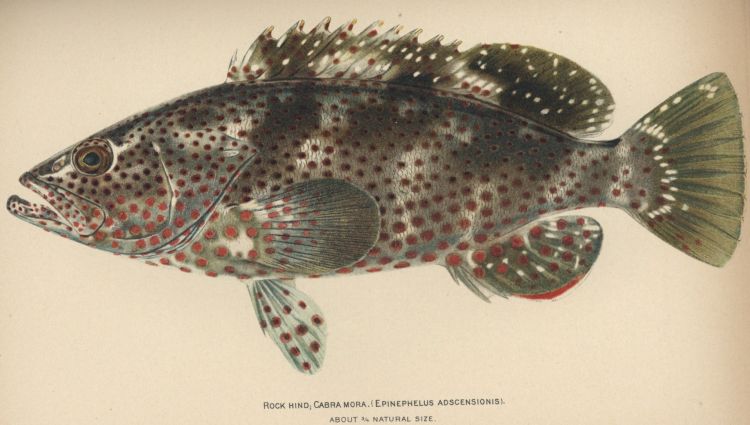
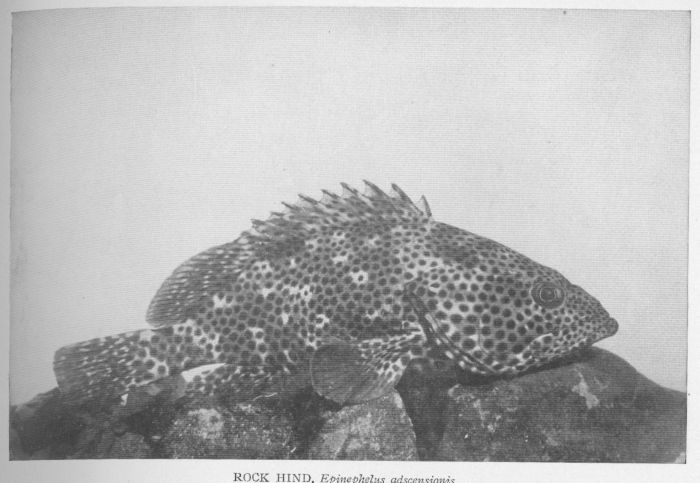
This beautiful and important species is known from southern Florida, Ascension and St. Helena islands, the West Indies, and to Brazil. It has also been recorded from the Cape of Good Hope. It reaches a length of 18 inches, is common in rocky places, and is considered the finest food-fish of the group.
Head 2 2/5; depth 3; eye 6; D. XI, 17; A. III, 7 or 8; scales 12-90 to 110-40, 55 to 60 pores. Body rather robust, little compressed, the greatest thickness 2 in depth; head subconic, acute; mouth rather large, maxillary reaching beyond eye, 2 1/3 in head; lower jaw rather strongly projecting, more prominent than in any other species.
Colour in life, olivaceous gray, with darker clouds; a number of irregular whitish blotches scattered over body; 5 ill-defined, roundish, blackish blotches along side of back, the 4 under dorsal fin extending on fin; head and body everywhere covered with round orange-brown spots of varying size, the centres more orange, the borders brownish, these largest on breast, smallest on lips and under parts, equally distinct everywhere; mouth pale within, the roof with red spots; dorsal light olive, with sparse spots like those on body but smaller; no dark edge to dorsal and anal; numerous white spots on dorsal, most numerous on soft part; caudal pale olive with some paler spots; anal reddish, marked like the dorsal, its spots larger; basal half of pectoral like dorsal, the distal half plain olive; ventrals pale with orange spots.
E. guaza, the merou or mero, is found on the eastern Atlantic from England to the Cape of Good Hope, but has been recorded from our waters only from the coast of Brazil. It is a large fish, reaching a length of 3 feet and a weight of 25 pounds or more.
E. labriformis is a Pacific coast species, known from Cape San Lucas south to the Galapagos Islands. It reaches 2 feet in length and is rather common about rocky places.
The yellow-finned grouper (E. flavolimbatus) is known from Cuba and the Snapper Banks off the west coast of Florida. It may be the adult of E. niveatus, from which it seems to differ only in colour. In life brownish flesh-colour, unspotted; a clear blue streak from angle of eye to preopercle; no spots or blotches anywhere, and no black on caudal peduncle; whole dorsal with a narrow edge of bright yellow.
The snowy grouper (E. niveatus) is known from the West Indies south to Brazil and occasionally north in the Gulf Stream to Woods Hole. Colour, brown with round whitish spots on body, smaller than pupil, regularly arranged in vertical and horizontal series, 4 in former and 5 in latter, these rows sometimes irregular; no distinct spots on breast; a very large black blotch on upper part of caudal peduncle, this sometimes absent.