Home › Volumes › Fishes › The Basses, Crappies and Sunfishes.
Crappie
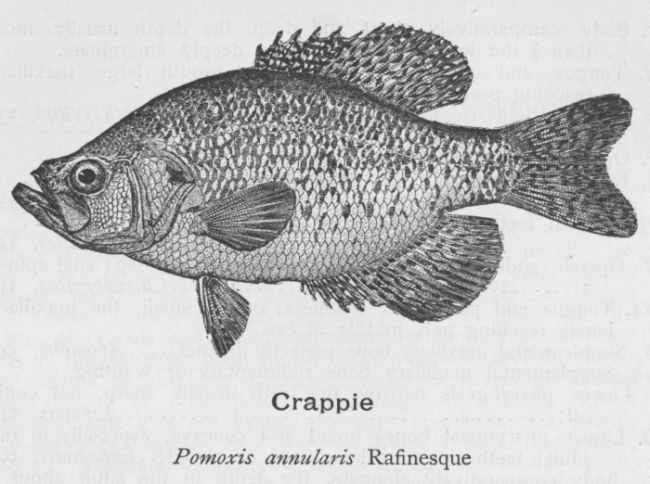
The crappie is found from Vermont and New York westward through the Great Lakes region and Mississippi Valley to the Dakotas and south to Texas. It is therefore a fish of wide distribution and has, in consequence, received many vernacular names. It is called bachelor in the Ohio Valley, campbellite, croppie, and new-light in Illinois, Indiana, and Kentucky; tin-mouth or paper-mouth in northern Indiana and Illinois, and sac-a-lait, and chinquapin perch in the lower Mississippi and Texas. In other places it is known as bridge perch, goggle-eye, speckled perch, shad, and John Demon, the last name being heard in northeastern Indiana. The crappie and the calico bass are confounded by most anglers and fishermen, and many of the vernacular names are, in consequence, interchangeable. Where only one species is found it is quite apt to be known as the crappie. The crappie is found from the St. Lawrence and the Great Lakes south to Texas and west to the Dakotas and Kansas. It is generally abundant in ponds, lagoons, bayous and all sluggish waters, but is much more common in the southern portions of its range. In the lower Mississippi Valley the young of this species literally swarm in the overflow ponds and bayous and vast numbers perish every year when these waters dry up, as many of them do.
The crappie reaches a length of about a foot and, when found in water that is not too warm or too muddy, is regarded as an excellent pan-fish. As it is usually found, however, in muddy water, its flavour is not devoid of the taste of its environment and the species is by many not regarded with very high favour as a food-fish.
As a game-fish it is held in high esteem in the South and at least as far north as Washington. Among Louisiana anglers this fish is said to be a great favourite. It will take a minnow bait as promptly as will a black bass, but is not very pugnacious, and will not make much of a fight; besides, the mouth is very tender and the hook is quite apt to tear out unless the fish is handled with considerable skill. This fact, in the opinion of the expert angler, more highly commends the crappie as it requires greater skill in handling the tackle.
The range of the crappie has been considerably extended through the operations of the United States Fish Commission. Large numbers are reclaimed every year from the overflow ponds along the Mississippi and transplanted into various waters.
Colour, silvery-olive, mottled with dark green, the dark markings chiefly on the upper part of the body and having a tendency to form narrow vertical bars; dorsal and caudal fins marked with green; anal fin pale, nearly plain; fins very high, but lower than in the calico bass.