Home › Volumes › Fishes › The Basses, Crappies and Sunfishes.
Calico Bass
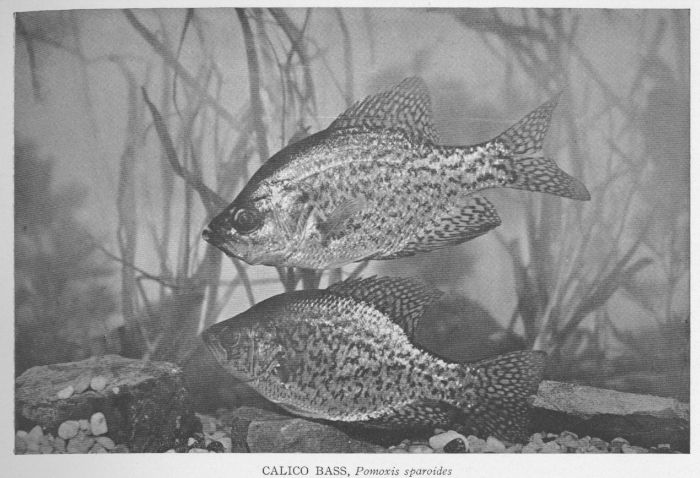
The calico bass is found throughout the Great Lakes region and south to New Jersey and Texas. Among the Great Lakes and throughout the upper Mississippi Valley it is an abundant and well-known species. Like its congener, the crappie, it prefers the lakes, ponds, bayous and sluggish lowland streams. The 2 species have essentially the same geographic range, the calico bass, however, being the more common species northward while the crappie is the more abundant in the south.
In the lagoons about Buffalo, N. Y., as well as in the small lakes of Michigan and northern Indiana it is abundant. It is also very abundant in the ponds and bayous in Illinois and large numbers are every year transplanted from the ponds about Meredosia by the United States Fish Commission.
Grass bass, barfish, strawberry bass, bitterhead, banklick bass, and lamplighter are names which have been applied to this fish; in fact, all the names of the crappie have been applied to this species, but the names in most general use are calico bass and strawberry bass.
It reaches a length of a foot or more. In Lake Maxinkuckee we have seen specimens 14 inches long and weighing a pound. The usual size, however, does not exceed 10 or 12 inches and a weight of half a pound. As a food and game-fish the calico bass does not differ appreciably from the crappie. Their habits are essentially the same, both preferring the quiet waters of bayous, ponds and lakes, though this species is more often seen in clearer, colder waters.
At Cedar and Maxinkuckee lakes, in northern Indiana, the calico bass affords much sport to the angler. They bite best in the early spring, in June, and again late in the fall. They may be taken still-fishing with grasshoppers, worms or live minnows, or by trolling with live minnow or spoon. They will at times rise to the artificial fly and we have seen some fine catches made in that way. Trolling is a favourite mode of fishing for this species and the crappie at Lake Maxinkuckee. They take the lure with a rush and vim which promises a more exciting fight than really develops, for they soon give up completely and are lifted into the boat without a struggle. At Cedar Lake they are fished for from flat-bottomed skiffs and from sail-boats, with bait of minnows, worms or pieces of fish. When fishing from a sail-boat the angler uses two lines with spoon-baits or "whirl," by means of which large catches are made.
Colour, silvery-olive, mottled with clear olive-green the dark mottlings gathered in small irregular bunches and covering the whole body; vertical fins with dark olive reticulations surrounding pale spots; anal marked like the dorsal; a dusky opercular spot. The calico bass and the crappie resemble each other closely, but are perfectly distinct and well-marked species. The easiest way to distinguish them is by means of the dorsal spines, the crappie having only 5 or 6,while the calico bass always has 7 or 8. The different colouration, particularly of the anal fin, and the difference in the anterior profile are also constant and important differential characters.
GENUS CENTRARCHUS CUVIER & VALENCIENNES
This genus contains but one species, C. macropterus, the flier or round sun-fish.
This interesting little sunfish reaches a length of 5 or 6 inches. It inhabits lowland streams, ponds and bayous from Virginia southward near the coast to Florida and Louisiana, and northward sparingly in the Mississippi Valley to Southern Illinois. In the Dismal Swamp region and elsewhere in clear water it is abundant. It is a handsome little fish, and in some places affords considerable sport to local fishermen. It posses considerable gameness and takes the hook baited with angleworm or small cockroach with an avidity which doubtless gave rise to the name "Flier," by which it is most generally known.
Colour, green or greenish, with series of dark brown spots on side below lateral line, forming interrupted, longitudinal lines; a dark spot below eye; soft dorsal and anal reticulated; young with a black ocellus at base of soft dorsal.
GENUS ACANTHARCHUS GILL
This is another genus containing but a single species, the mud sunfish, A. pomolis.
This is another of the small sunfishes found in the lowland streams and sluggish waters of the Middle Atlantic Coast. It occurs from southern New York near the coast to South Carolina; it is locally common, especially in the lower Delaware. It attains a length of about 6 inches and is used to some extent as a panfish. It is inferior in every way to the flier.
Colour, very dark greenish; body usually with 5 rather indistinct blackish longitudinal bands along side; cheek with dark bands which run nearly parallel, the lowest passing across the maxillary around the front part of the lower jaw; a black opercular spot; fins plain dusky.
GENUS AMBLOPLITES RAFINESQUE
The Rock Basses
This genus is characterized by having the body oblong, moderately compressed; mouth large, maxillary broad, the supplemental bone well developed; lower jaw projecting; teeth on vomer, palatines, and tongue; those on tongue in a single patch; pharyngeal teeth sharp; branchiostegals 6; opercle ending in 2 flat points; preopercle serrate at its angle; gillrakers rather long and strong, dentate, fewer than 10 in number, developed only on the lower portion of the arch; scales large, somewhat ctenoid; lateral line complete; dorsal fin much larger than the anal, spines rather low; caudal emarginate.