Home › Volumes › Fishes › The Fiatolas
Harvest-fish
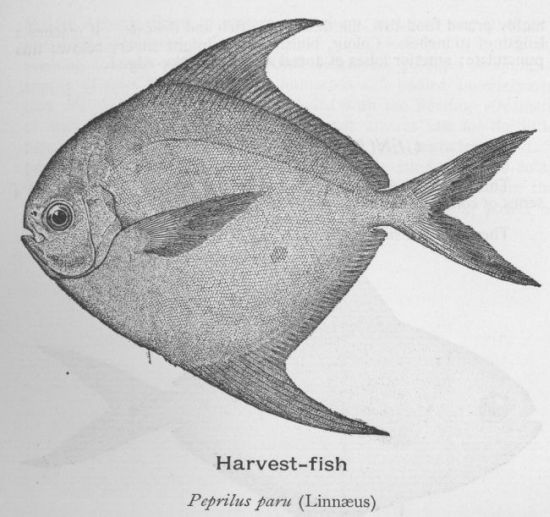
This delicious little fish has been found from Cape Cod to Brazil, but it is not abundant anywhere except about the mouth of Chesapeake Bay. At Norfolk, where it is called whiting, it is a fish of considerable commercial importance, and it is one of the most common pan-fishes one sees hawked about the streets of Baltimore, Washington and other middle Atlantic cities. It reaches a length of 6 inches. One interesting fact in the life history of the fish is its habit of swimming beneath the Portuguese man-of-war.
The genus Palometa is distinguished from Peprilus only by the lower fins. The 3 known species are each of rare occurrence. The first, P. palometa, reaches a length of 3 inches and occurs in the Pacific off Columbia. Another species, P. media, is known only from Mazatlan. The third species, P. simillima, the "California Pompano," occurs on our Pacific Coast from Puget Sound to San Diego. During summer it is abundant, especially about Santa Cruz, and is a highly prized food-fish, the flesh being rich and delicate. It reaches a length of 10 inches. Colour, bluish above, bright silvery below; fins punctulate; anterior lobes of dorsal and anal dusky-edged.
GENUS PORONOTUS GILL
This genus differs from Palometa only in the presence of a series of conspicuous, wide-set pores above the lateral line.
There is but a single species in our waters.
Butterfish; Dollarfish
Poronotus triacanthus (Peck)
This is the butterfish of the coast of Massachusetts and New York, the harvestfish of New Jersey, the dollarfish of Maine, the sheepshead of Cape Cod, the pumpkinseed of Connecticut, and the starfish of Norfork. It occurs from Maine to South Carolina, and is generally common between Cape Cod and Cape Henry. It is a summer visitor, appearing and disappearing with the mackerel. It breeds in early summer and the young are abundant in July, August, and September, swimming about, like the harvestfish, with various jelly-fishes. During the summer certain species of large jelly-fishes, called sun-squalls, are found abundantly on our Middle Atlantic Coast in waters near shore, and each one is almost invariably accompanied by 10 or 12 or even more young butterfish, seeming to seek shelter under their disks, and perhaps obtaining a supply of food from among the numerous soft bodied invertebrates that are constantly becoming entangled with the floating streamers of their protectors. This position is not always safe for the little fish, as they are sometimes destroyed by the tentacles of their protector which are provided with powerful sting or lasso-cells. Though the fish are, by this commensal arrangement, safe from the attacks of larger fish, they often fall victims to the stinging power of the jelly-fish and are devoured.