Home › Volumes › Fishes › The Basses, Crappies and Sunfishes.
Rock Bass; Redeye; Goggle-eye
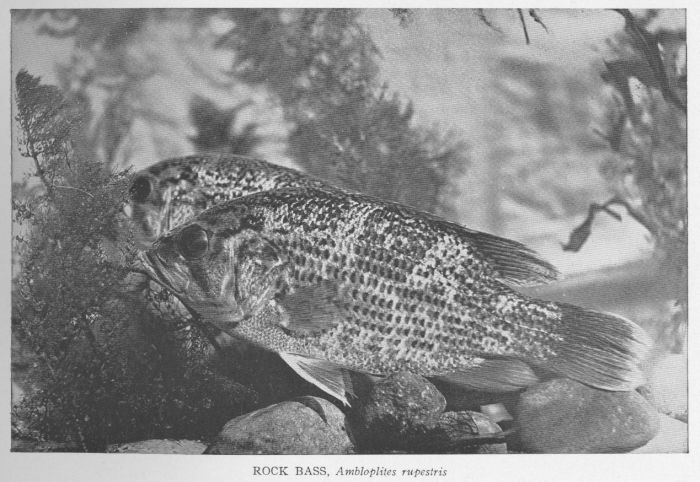
The common rock bass is one of our most familiar panfishes. It is found from Vermont and New York westward to Manitoba and south to Louisiana and Texas. In the upper Mississippi Valley and in the Great Lakes it is very abundant, and is found in practically every lake, pond and stream. It is found not only in the rivers, but also in the creeks and smaller streams. It prefers clear, cool water, and is therefore least abundant in bayous and shallow, muddy lakes. In the lakes it will be found about patches of potamogeton or other aquatic vegetation. In the streams it most delights to dwell in the quiet water of deep holes where there are large boulders among which some water plants are growing, or about old stumps or logs where the water is 3 to 6 or 8 feet deep.
The rock bass reaches the length of 12 inches and a weight of 1 to 1 1/2 pounds, though it does not usually attain this size. The average weight probably does not exceed 1/2 pound. It spawns in the spring, when it constructs a nest on a gravel bed where the water is moderately swift, or on a bar, if in a lake. The parent fish defend the nest with much vigour. This species is pre-eminently a boy's fish, though it is by no means despised by anglers of maturer years, and in the Great Lakes region and upper Mississippi Valley it is one of the better fishes often seen on the small boy's string.
As a game-fish it is rather disappointing. It takes the hook with vim and energy and begins a most vigorous fight which, however, it usually fails to keep up. It can usually be caught at any season and at any time of day; good fishing may be had even at night. Any kind of bait may be used, but small minnows, white grubs, and angleworms are best. It will take the trolling spoon quite readily and the spinner and the bucktail also are successful lures. Minnows may be used either in still-fishing or in trolling. During the summer grasshoppers are a good bait, and pieces of freshwater mussel or yellow perch are excellent. In the fall still-fishing with small minnows usually meets with success. Casting with the artificial fly is not a common method for catching the rock bass, yet we have had many good rises and have taken some fine examples in that way; we have also taken it on the artificial frog. Small crawfish also are a tempting bait.
As already stated, they are pretty gamy when first hooked, and make quite a fight at times, especially at first, and again when brought alongside the boat.
As a pan-fish the rock bass is not equal to the bluegill. Its flesh is softer and less flaky, and is apt to have a muddy taste unless the fish comes from rather cool, clear water. We are inclined to think that those from streams are of better flavour than the ones taken from lakes.
The rock bass has been handled to some extent by the United States Fish Commission, through whose operations it has been introduced into waters which it did not previously inhabit.
Head 2 3/4; depth 2 to 2 1/2; eye 3 1/2 to 4 1/2; snout 4; maxillary 2 1/3; D. XI, 10; A. VI, 10; scales about 6-39-12, 6 to 8 rows on cheek; coeca 7; vertebrae 14+18; gillrakers 7 to 10. Body oblong, moderately compressed, head large; profile in adult somewhat depressed above the eyes; mouth large, the maxillary reaching middle of pupil; gillrakers developed only on lower part of arch; preopercle serrate near its angle. Colour, olive green, conspicuously tinged with brassy, and with much dark mottling; the young irregularly barred and blotched with black, and with very little brassy; the adult with a dark spot on each scale, these forming interrupted black stripe; a black opercular spot; dark mottlings on the soft dorsal, caudal and anal; eye more or less red.
In the Roanoke River of Virginia is found a rock bass closely resembling the common rock bass. It seems to differ only in having the scales on the cheek minute and imbedded and wholly invisible over most of the cheek, and in having the profile over the eyes more concave. No other differences have been noted, and the species are probably not distinct.
The habits of the Roanoke rock bass do not differ from those of the common species.
GENUS ARCHOPLITES GILL
This genus contains a single species, the Sacramento perch, A. interruptus, the only species of the family found on our Pacific of Coast.