Home › Volumes › Butterflies › Nymphs
Variegated Fritillary
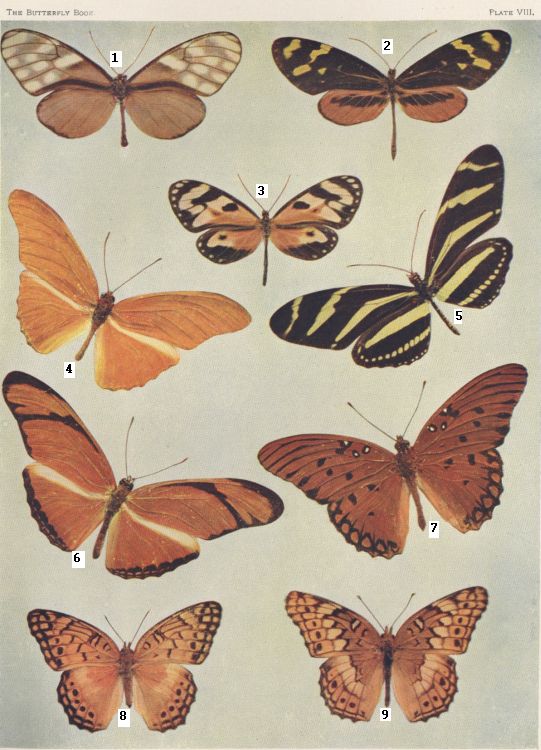
Butterfly.--The upper side of both wings is dull ferruginous, darker toward the base, crossed by an irregular black median line, which is darker, broader, and more zigzag on the fore wing than on the hind wing. This line is followed outwardly on both wings by a pair of more or less wavy limbal lines, inclosing between them a series of round blackish spots. The outer margin is black, with the fringes pale fulvous, checkered with black at the end of each nervule. At the end of the cell in the fore wing there are two black lines inclosing paler fulvous spots, and both wings near the base have some curved black lines. On the under side the fore wings are marked somewhat as on the upper side, but paler in color, with a large apical patch of brownish-gray broken by a transverse band of darker brown. The hind wings are dark brown, with the markings of the upper side obscurely repeated; they are mottled with gray and crossed by a broad central band of pale buff.
The species varies very much, according to locality, both in size and in the depth of the markings. Expanse, 1.75-2.75 inches.
Egg.--The egg is conoidal, relatively taller than the eggs of the genus Argynnis, which closely resemble it. There is a depression at the apex, surrounded by a serrated rim, formed by the ends of the vertical ribs, of which there are about twenty, some longer and some shorter, about half of them reaching from the apex to the base. Between these vertical ribs there are a multitude of smaller cross-ridges.
Caterpillar.--The caterpillar is cylindrical, reddish-yellow in color, marked with two brown lateral bands and a series of white spots upon the back. There are six rows of short branching spines upon the body, which are black in color; the two uppermost of these spines on the first segment are much elongated and are directed forward. The head is smaller than the body in the mature caterpillar, and is black. On the under side the caterpillar is pale or whitish; the legs are blackish-brown. It feeds upon the passion-flower.
Chrysalis.--The chrysalis is pearly-white, marked with black spots and longitudinal streaks.
This species has been taken as far north as Long Island and Connecticut, though it is a very rare visitant in New England; it is quite common in Virginia and thence southward, and occurs not infrequently in southern Illinois and Indiana, ranging westward and southward over the entire continent to the Isthmus of Panama, and thence extending over the South American continent, wherever favorable conditions occur.