Home › Volumes › Butterflies › Nymphs
Gulf Fritillary
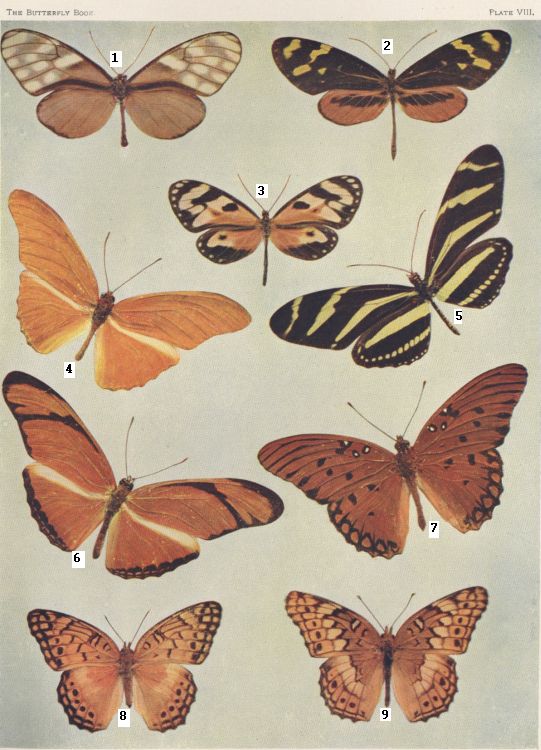
Butterfly.--The upper side is bright fulvous; the veins on the fore wings are black, very heavy near the tip; there are four black spots on the outer border, and three discal spots of the same color; there are three irregular black spots toward the end of the cell, pupiled with white; the hind wings have a black border inclosing rounded spots of the ground-color; between the base and the outer margin there are three or four black spots; the under side of the fore wings is light orange, the markings of the upper side showing through upon the under side; the apex of the front wing is brown, inclosing light silvery spots; the secondaries are brown, with numerous elongated bright silver spots and patches. The female does not differ from the male, except that she is darker and the markings are heavier. Expanse, 2.50-3.25 inches.
Caterpillar.--The caterpillar is cylindrical, with the head somewhat smaller than the body, pale yellowish-brown in color, marked with longitudinal dark-brown bands, of which the two upon the side are deeper in color than the one upon the back, which latter is sometimes almost entirely effaced; the base is slaty-black. There are orange spots about the spiracles. There are six rows of black branching spines upon the body, and two similar spines upon the head, these latter somewhat recurved. The feet and legs are black. The caterpillar feeds upon the various species of passion-flower which are found in the Southern States.
Chrysalis.--The chrysalis is dark brown, marked with a few small pale spots.
This species ranges from the latitude of southern Virginia southward to Arizona and California. It is abundant also in the Antilles and Mexico.