Home › Volumes › Butterflies › Nymphs
Regal Fritillary
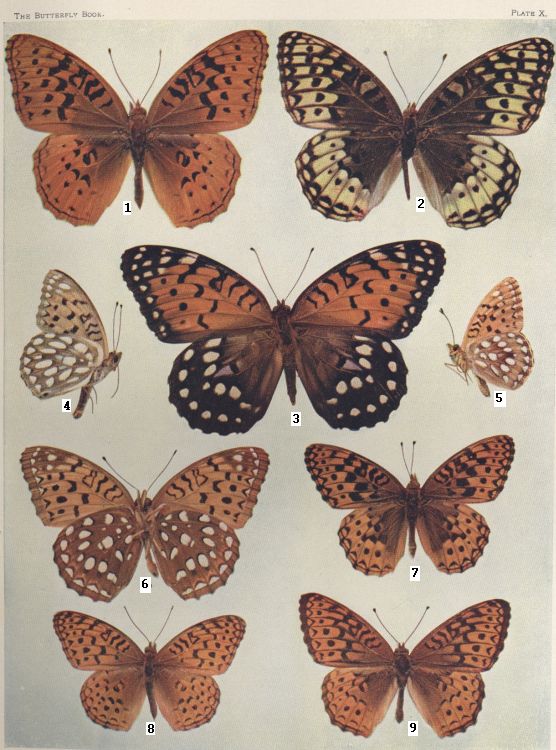
Butterfly.--The upper side of the fore wings of the male is bright fulvous, marked very much as in other species of the genus. The upper side of the hind wings is black, glossed with blue, having a marginal row of fulvous and a submarginal row of cream-colored spots. On the under side the fore wings are fulvous, with a marginal row of silver crescents, and some silvery spots on and near the costa. The hind wings are dark olive-brown, marked with three rows of large irregular spots of a dull greenish-silvery color. The female is at once distinguished from the male by having the marginal row of spots on the hind wings cream-colored, like the submarginal row, and by the presence of a similar row of light spots on the fore wings. Expanse, 2.75-4.00 inches.
Egg.--The egg in form is like those of other species of Argynnis.
Caterpillar.--The caterpillar moults five times before attaining to maturity. When fully developed it is 1.75 inches long, black, banded and striped with ochreous and orange-red, and adorned with six rows of fleshy spines surmounted by several black bristles. The spines composing the two dorsal rows are white, tipped with black; those on the sides black, tinted with orange at the point where they join the body. The caterpillar feeds on violets, and is nocturnal in its habits.
Chrysalis.--The chrysalis is brown, mottled with yellow and tinted on the wing-cases with pinkish. It is about an inch long, and in outline does not depart from the other species of the genus.
This exceedingly beautiful insect ranges from Maine to Nebraska. It is found in northern New Jersey, the mountainous parts of New York and northern Pennsylvania, and is reported from Arkansas and Nebraska. It is rather local, and frequents open spots on the borders of woodlands. At times it is apparently common, and then for a succession of seasons is scarce. It flies from the end of June to the beginning of September.