Home › Volumes › Butterflies › Nymphs
Diana
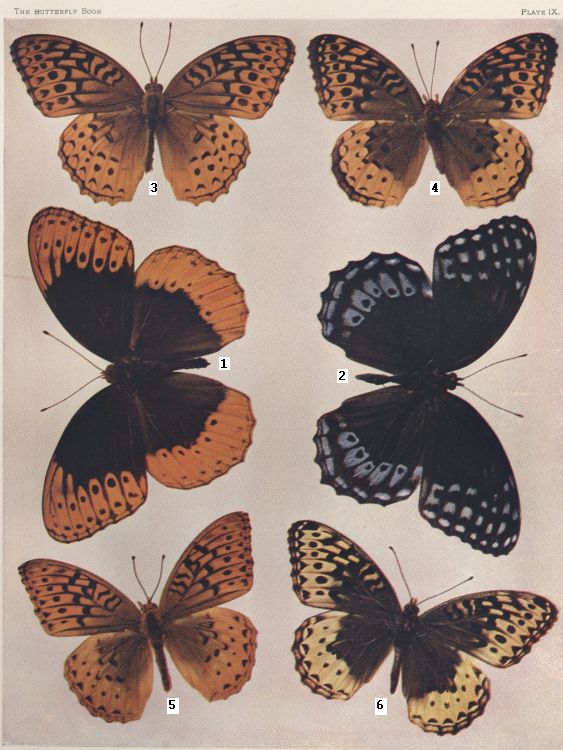
Butterfly.--The male on the upper side has both wings deep rich brown, bordered with fulvous, this border being more or less interrupted by rays of brown along the nervules and two rows of circular brown spots, larger on the fore wings than on the hind wings. The wings on the under side are pale buff, deeply marked with black on the base and middle of the fore wings, and clouded with grayish-fulvous on the inner two thirds of the hind wings. A blue spot is located near the end of the cell in the fore wings, and the hind wings are adorned by a marginal and submarginal row of narrow silvery crescents and a few silvery spots toward the base. The female on the upper side is a rich bluish-black, with the outer border of the fore wings marked by three rows of bluish-white quadrate spots, the outer row being the palest, and often quite white. The hind wings are adorned by three more or less complete rows of bright-blue spots, the inner row composed of large subquadrate spots, each having a circular spot of black at its inner extremity. On the under side the female has the ground-color slaty-brown, paler on the hind wings than on the fore wings, which latter are richly marked with blue and black spots. The silvery crescents found on the under side of the hind wings of the male reappear on the under side of the female, and are most conspicuous on the outer margins. Expanse, 3.25-4.00 inches.
Egg.--The egg is pale greenish-white, and conformed in outline to type.
Caterpillar.--The larva is velvety-black, adorned with six rows of fleshy spines armed with bristles. The spines are orange-red at the base. The head is dull brown.
Chrysalis.--The chrysalis is dusky-brown, with lighter-colored short projections on the dorsal side.
This splendid butterfly, which is the most magnificent species of the genus, is confined to the southern portion of the Appalachian region, occurring in the two Virginias and Carolinas, northern Georgia, Tennessee, and Kentucky, and being occasionally found in the southern portion of Ohio and Indiana, and in Missouri and Arkansas.