Home › Volumes › Butterflies › Sulphurs and Whites
Mustard White
Butterfly.--This is a Protean species, of which there exist many forms, the result of climatic and local influences. Even the larva and chrysalis show in different regions slight microscopic differences, for the influences which affect the imago are operative also in the early stages of development. The typical form which is found in Europe is rarely found in North America, though I have specimens from the northern parts of the Pacific coast region which are absolutely indistinguishable from European specimens in color and markings. I give a few of the well-marked forms or varieties found in North America to which names have been given.
(a) Winter form oleracea-hiemalis, Harris, Plate XXXIV, Fig. 16, male. The wings are white above in both sexes. Below the fore wings are tipped with pale yellow, and the entire hind wing is yellow. The veins at the apex of the fore wings and on the hind wings are margined with dusky.
(b) Aberrant form virginiensis, Edwards, Plate XXXIV, Fig. 14, male. The wings are white above, slightly tipped at the apex of the fore wings with blackish. Below the wings are white, faintly, but broadly, margined with pale dusky.
(c) Form pallida, Scudder, Plate XXXIV, Fig. 15, female. In this form the wings are white above and below, with a small black spot on the fore wing of the female above, and hardly any trace of dark shading along the veins on the under side.
(d) Alpine or arctic for bryoniae, Ochsenheimer, Plate XXXIV, Fig. 17, female. In this form, which is found in Alaska, Siberia, and the Alps of Europe, the veins above and below are strongly bordered with blackish, and the ground-color of the hind wings and the apex of the fore wings on the under side are distinctly bright yellow.
(e) Newfoundland variety acadica, Edwards, Plate XXXIV, Fig. 19, female. This form is larger than the others, and in markings intermediate between pallida and bryoniae. The under side in both sexes and the upper side in the female are distinctly yellowish.
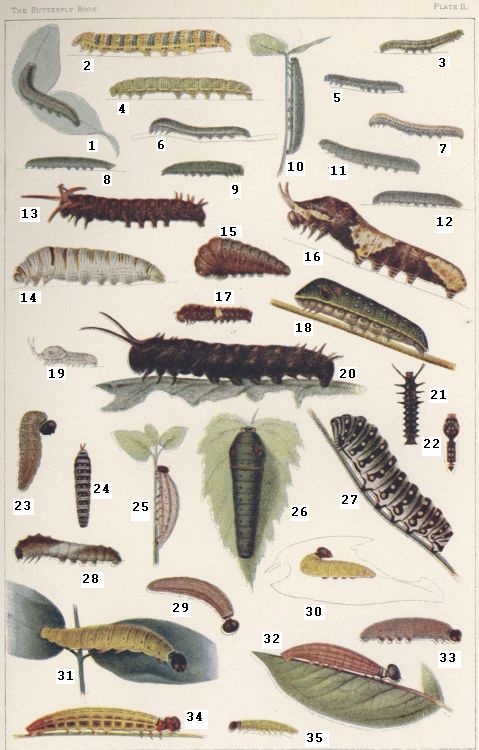
Early Stages.--These are well known and have often been described, but some of the varietal forms need further study.
The species ranges from the Atlantic to the Pacific, and from Alaska to the northern limits of the Gulf States.