Home › Volumes › American Animals › Bears
Polar Bear
- Length
- 7 feet.
- Description
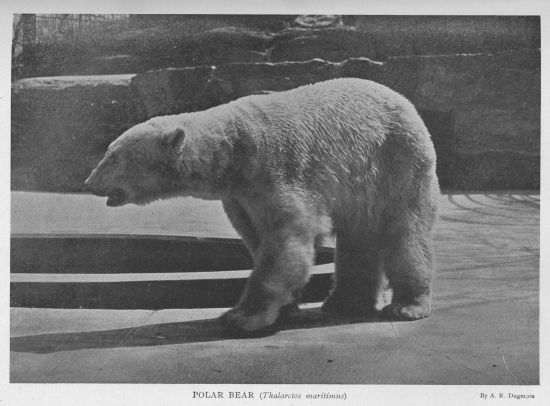
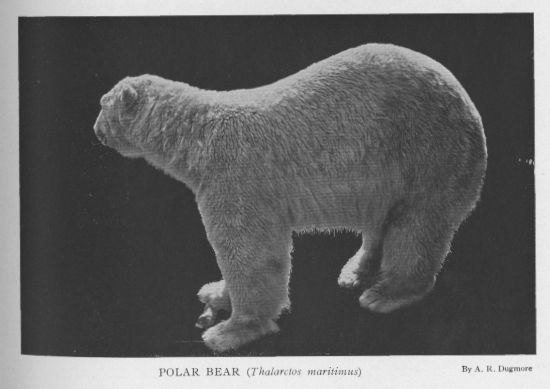
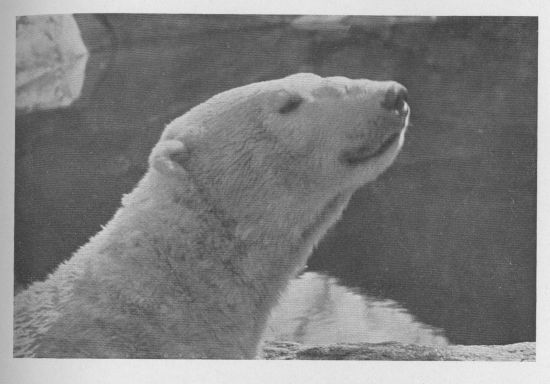
- Entirely white at all seasons, or slightly tinged with yellowish; fleshy parts of nose and lips black.
- Range
- Circumpolar regions South to Northern Labrador.
The Polar Bear is the beach ranger of the northern seas. Other bears the world over keep to the shady thickets and forest tangles, where, when the hunting is poor, they can gather wild berries and nuts, and grub roots out of the black earth. But the polar bear rarely tastes vegetable food except in the few short weeks of an Arctic summer. In the desolate, treeless north, he shuffles along over ice-crusted ridges, powdered with snow. His favourite hunting grounds are along the margin of the ice-fields, where the drifting floes grind against the fixed ice of the shore line, and rend and split with the heaving of the ocean. Here he watches for seals at their breathing holes, as patiently as a cat watches for mice, or stalks them under cover of the ice cakes at the edge of the breakers.
If he sees one resting on the ice where there is small chance of creeping on it undetected, he plunges into the sea and swims far out among the whitecaps to the leaward and makes his approach under water. He is a powerful swimmer even in a heavy sea, and catches salmon swimming like an otter.
Anything eatable that floats or is cast ashore is his food, a dead whale or a herring being alike acceptable. With comparatively few exceptions, it is only the old males of the species that face the dull length of an Arctic winter out-of-doors. In the autumn, when the snowstorms become heavy and frequent, and the driving scud from the sea shuts out the low sun, most of the she bears look round for some protected hollow in which to pass the winter.
Under the projecting shelf of a ledge and between neighbouring rocks are favourite winter dens of theirs. Sometimes one will dig a cave for herself in the snowdrift, or, curling up in the bed of a rock, she lets the snow bury her as it will, the one object in any case being to have plenty of snow piled above her for protection against the coming winter. In those northern latitudes the summers are far too short for a young bear born in the spring to gain sufficient strength for withstanding the hardships of the rough winter that closes in so rapidly.
The young polar bears are born soon after the old one has buried herself for the winter, and for months she hibernates there under the snow with only a slender breathing shaft kept open by the warmth that rises from her fat body.
For the entire winter the cubs draw all their nourishment from her and grow strong and lusty, while she, being without food of any sort, becomes lean and gaunt during her long rest before the late spring releases them from their prison.
In the latter part of the winter the cave is gradually enlarged by their breathing and the warmth of their bodies, which melts away the snow around them, until finally they succeed in breaking away a passage and come out into the flat rays of the sun. There are now great companies of wild fowl and sea-birds gathering to nest among the cliffs, and seals with their young on the ice; so the old bear has a good chance to recuperate her strength and teach her cubs to hunt and fish for themselves.
When more nourishing food is hard to get, she crops the salt grass back of the beaches, and later gathers berries and roots from the bogs thawed for a little while at the surface by the long hours of sunlight. The polar bear's courage in defense of her young is well known. Almost every Arctic explorer has brought back vigorous accounts of her valour and self-sacrifice. If only the humans could have shown up half as well as the bears in these encounters, they would make much more cheerful reading.