Home › Volumes › American Animals › Bears
Black Bear
Also called: Cinnamon Bear
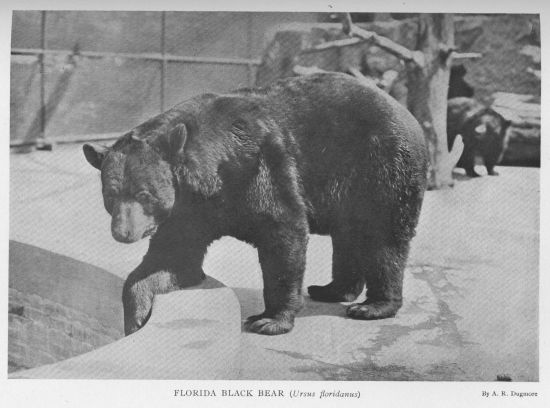
Length.—5 feet.
Description.—Colour entirely black, with a brownish tinge on the face. Some individuals are uniform dark chestnut or cinnamon, with purplish reflections in certain lights, and are called “Cinnamon Bears.” For many years this colour phase was thought to represent a distinct species.
Range.—Forest regions of North America, except the Gulf States, and Labrador, where allied varieties occur.
The black bear originally inhabited nearly all the woods of North America. It is still fairly common in lonely regions where there is much thick timber and rough land.
The black bear differs from the typical bear of folk-lore and story-books, that roars and attacks people on sight, is the brown bear of Europe, a rough, shaggy beast, clumsy and awkward, like our grizzly bear. The black bear is a smooth-coated, well-shaped fellow, savage enough when attacked and compelled to fight for its life, or to protect its cubs, but at other times timid and inoffensive. When you walk through the woods the shy rabbit allows you to approach to within a few steps before it takes fright and goes bounding away, but the black bear is much more easily frightened. Long before you have got within sight of him he is running for his life with almost the speed of a fox, yet in his encounters with dogs he has proved himself a dangerous antagonist, plucky and ready to fight. The fact is, his terror of man is the only thing that could possibly save him. If he had assumed the same attitude toward man in this country that the brown bear has in Europe, the last of his race would have been shot in the days of our grandfathers.
Except in early spring, black bears live principally upon vegetable food; blueberries are their favourite diet, though fruit of any kind seems to suit them well enough.
They also dig for roots and bugs, and catch grasshoppers and crickets in the grass.
When there is plenty of such food to be had, they will, it is said, pass the newly killed carcass of a deer or a sheep without noticing it.
This, however, probably depends a good deal on the individual, some of them being always fond of meat. Like all bears, they are passionately fond of honey and very clever at finding bee-trees. When a bear has discovered a bee-tree he courageously attacks it with teeth and claws, endeavouring to enlarge the opening sufficiently to enable him to reach the honey. But the stings of the enraged insects about his nose and mouth cause him to stop frequently. If the bear is at work at the foot of the tree, he can roll on the ground in order to get rid of his tormentors when the pain becomes too severe, but if he is high up on the trunk he can only rub them off against the bark and hold his ground, knowing it will not be long after the honeycomb is broken into before the bees will leave him in peace, each hastening to fill its honey-bags before it is too late. Black bears hibernate throughout the winter, stowing themselves away in hollow trees and caves among the rocks. In the extreme north of this range they follow the example of the polar bear, curling up in a cave or hollow where the drifting snow will bury them and keep them warm until spring. When they come out at the end of the winter the skin on the feet cracks and peels off, leaving them soft and tender.
They now have rather a hard time of it for a few weeks; for food is scarce and difficult to get even for an animal in the best condition; and to be handicapped with sore feet and weakened by a four-months’ fast at the same time is hard luck.
They now roam the woods in the hope of finding some animal or bird uncovered by the melting of the snow, and sniff for newly awakened snakes and bugs around mossy old stumps and decaying timber. Later, when the ice has melted, they can get succulent plants along the margin of lakes and ponds, and catch suckers and other fish that run up the “rattling shallows.” Then they go looking for checkerberries on sunny banks in the woods, or, if the opportunity offers, kill cows and sheep that have been turned out to pasture. In summer they keep to gloomy swamps and mountain-sides, where they feed on roots, nettles, etc., to a certain extent. In hot weather they get lots of fun wallowing in the mud like so many pigs.
In August and later they visit the farmers’ corn-fields and munch the juicy ears and stalks; pork is a favourite meat of theirs, and they often show an astonishing degree of boldness, for an animal usually so shy, in breaking into pig-pens in the night. As autumn advances they gather nuts, acorns, wild grapes, berries and mushrooms. It is at this season that they get the most honey, and also dig up the nests of savage yellow-jackets, in spite of all the stinging that inevitably follows.